Table of Contents
Project Overview: New Orleans Residential Sound Testing
- Project: Field Sound Transmission Leak Check & Flanking Inspection
- Location: New Orleans, LA (private residence — address withheld)
- Facility Type: Shotgun-Style Duplex, Wood-Frame Multifamily
- Client: Duplex Owner, Tenant Noise Complaint
- Measured ASTC: 35.6 (well below building code minimum)
- Scope: White-Noise STC Leak Check, dBA Flanking Sweep, Retrofit Specification
The Test Brief: Shotgun Duplex Demising Wall
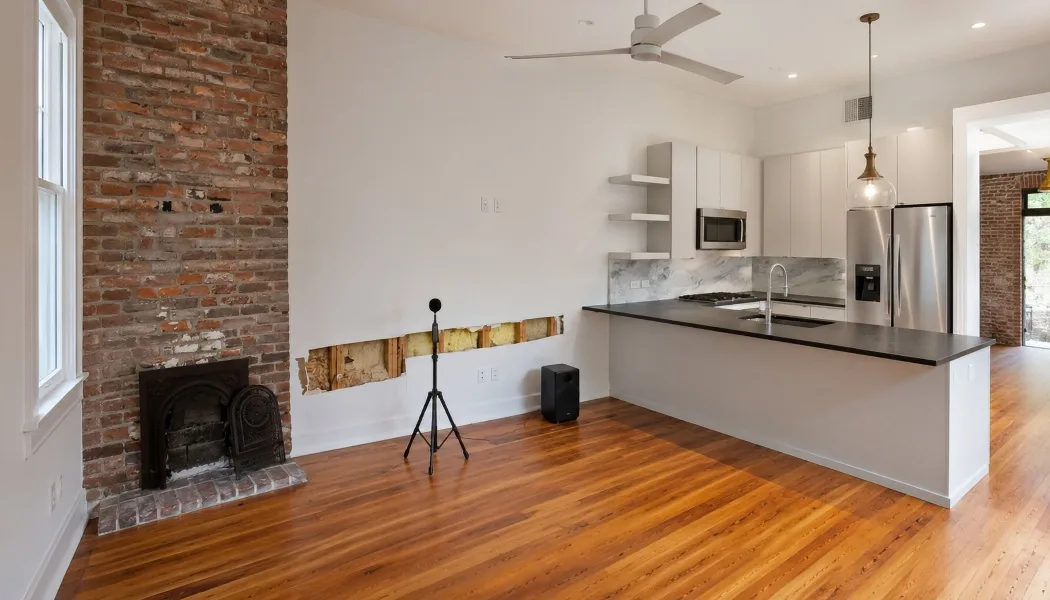
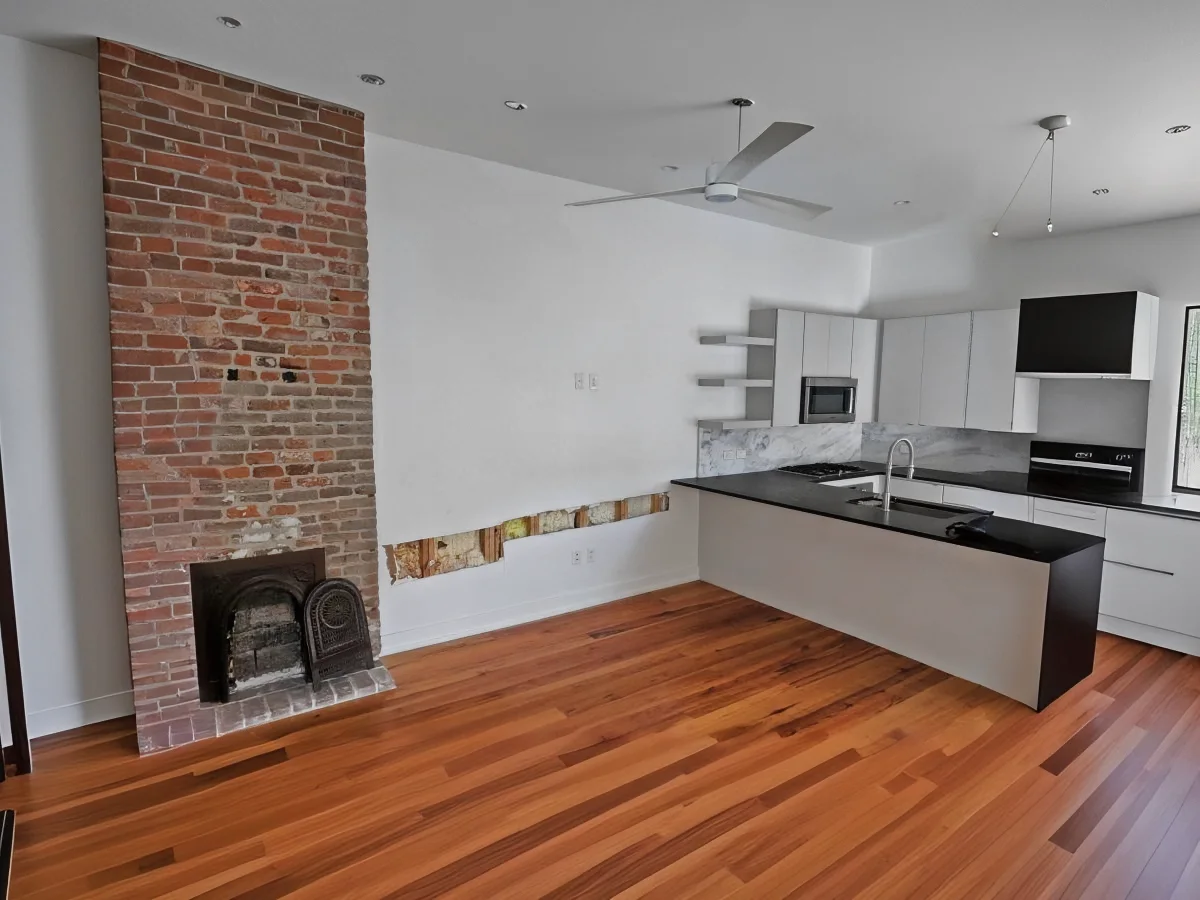
The duplex owner had a long-running tenant noise complaint between adjacent units of a New Orleans shotgun-style home. Conversations and TV from one side were carrying clearly into the other, and standard troubleshooting (caulking outlets, sealing baseboards) had not moved the needle. With one of the tenants moving out, the wall was finally cut open, and Commercial Acoustics was called in to measure how the demising wall was actually performing.
The wall in question separated the two front rooms facing the street. Construction was a 2×6 wood stud assembly with spray-foam insulation in the cavity, two layers of drywall on one side, and a single layer of drywall on the other. That kind of asymmetric build sits in the STC 35 to 37 range per standard lab testing — code minimum for multifamily demising walls is STC 50, and the field equivalent is normally 5 to 10 points lower than the lab number.
Field Test Method and Equipment
- Source: White-noise generator, calibrated send-side level
- Receive Meter: Type 1 SPL meter, instantaneous and 10-second readings
- Method: Sound Transmission Leak Check (faster than full ASTM E336)
- Sweep Points: Baseboards, perimeter, outlets, every wall penetration
A Sound Transmission Leak Check is the right tool when the question is “is this wall close to spec or way off.” It uses the same source-and-receive logic as a full certified ASTC test but skips the calibrated reverberation adjustments and longer averages. The measurement takes a few minutes per position and is more than accurate enough to flag a wall that is failing.
When a certified field STC number is needed for code compliance, a developer dispute, or a buyer’s inspection, the test moves to the full ASTM E336 field STC standard — calibrated meter, full octave-band sweep, reverberation correction, longer averages. For a quick “is the wall broken” answer, the leak check is what runs.

Sound Test Findings: ASTC 35.6
- Source dBA: 101.3 dBA at the send side
- Receive dBA: 67.0 dBA at the receive side
- Calculated ASTC: 35.6 (well below the STC 50 code minimum)
- Flanking Result: No prevalent leaks at outlets, baseboards, or penetrations
An ASTC of 35.6 places the wall well under multifamily code and matches the asymmetric 2×6 lab assumption almost exactly. That kind of clean lab-to-field match means the wall is not leaking around the edges or through penetrations — it is the wall itself that is the limiting factor. For a refresher on what the STC numbers actually mean in lived experience, the STC rating chart walks through speech-and-music intelligibility at every common rating.
The flanking sweep ran along the baseboards, the wall perimeter at floor and ceiling, every outlet box, and any other wall penetration. None showed a meaningful dBA drop relative to the wall field, which confirmed the leak path was not the issue. The construction itself was the bottleneck.

Wall Construction and Why It Underperformed
- Framing: 2×6 wood stud, single row (no resilient channel)
- Cavity: Spray-foam insulation, full fill
- Drywall: 2 layers one side, 1 layer the other (asymmetric)
- Lab STC for This Build: 35 to 37 (matches the 35.6 measured)
This is a common shotgun-house demising wall build and a common shotgun-house performance failure. Spray foam in the cavity is rigid and couples both sides of the wall together at the studs; resilient channel or a staggered-stud assembly would decouple them and lift the STC by 8 to 12 points on its own. The asymmetric drywall layers help slightly versus a single-layer-each build but not enough to clear code.
The honest conversation with the owner started here: the wall as built will never hit STC 50 without invasive work. The drywall was already removed on one side as part of the tenant turnover, which is the cheapest possible moment to retrofit a demising wall.

Recommended Retrofit to STC 45+
- Add Layer: One ply of mass-loaded vinyl soundproofing membrane
- Reinstall: Drywall over the membrane on the opened side
- Expected Lift: ASTC 45+ (from 35.6 baseline, ~10 dB improvement)
- Why It Works: Mass + decoupling beats cavity insulation for STC
The retrofit recommendation was a single ply of Wall Blokker mass-loaded vinyl membrane behind the existing drywall on the open side. Mass-loaded vinyl adds dense surface mass without adding wall thickness, which is the right move when one side of the wall is already open and the framing cannot be touched.
STC 45 in the field is not code-compliant for a new build, but it is a meaningful improvement on a 35.6 baseline and gets the duplex into the range where standard speech and TV stop transmitting clearly between units. Hitting STC 50+ field would require pulling drywall on both sides, adding a second stud row or resilient channel, and rebuilding the assembly — an option, but not what the owner had budget for.
Multifamily Sound Testing in New Orleans
- Common Settings: Duplex, condo, apartment, shotgun-style multifamily
- Trigger Events: Tenant complaint, unit turnover, sale or lease dispute
- Test Type: Leak check (fast) or full ASTM E336 ASTC (certified)
- Coverage: New Orleans, the Gulf Coast, and projects across the U.S.
Sound testing on residential multifamily in New Orleans almost always starts the same way: a tenant complains, a unit turns over, and the owner has a narrow window to figure out whether the wall is broken or whether the expectations were just unrealistic. A leak check answers that question in a single site visit. If the number is below code and the assembly turns out to be the limiting factor (as it was here), the next step is a retrofit spec scaled to budget.
For a sister sound-testing case study in a different sector, see the Ochsner sound testing project covering hospital patient rooms. For a comparable New Orleans residential retrofit that went the full retrofit route, see the 731 St Charles condo soundproofing case study.
Conclusion: New Orleans Residential Sound Testing
A 2×6 wood-stud demising wall with asymmetric drywall and a spray-foam cavity measured at ASTC 35.6 in the field — well below code, exactly where the lab math said it would land, and almost certainly the wall the original duplex owners had been hearing through for years. A single ply of mass-loaded vinyl behind the open side of the wall lifts that number into the STC 45+ range and ends the conversation for most everyday speech and TV transmission. Sound testing across New Orleans and the Gulf Coast is one of the fastest ways to find out which conversation a noise complaint is actually about.
FAQs: New Orleans Residential Sound Testing
What is a sound transmission leak check?
A sound transmission leak check is a quick field test that measures how much sound passes through a wall using a white-noise source on one side and a Type 1 SPL meter on the other. It skips the calibrated reverberation adjustments of a full ASTM E336 ASTC test, which makes it fast and cheap, but accurate enough to flag whether a wall is failing or close to spec.
What does ASTC mean and how is it different from STC?
ASTC stands for Apparent Sound Transmission Class — the field equivalent of the lab STC rating. STC numbers are measured in a controlled lab. ASTC is the same logic measured in a real building, where flanking paths, construction tolerances, and finishes pull the number down. Field ASTC is typically 5 to 10 points lower than the lab STC for the same wall assembly.
What STC should a duplex demising wall hit?
Multifamily demising walls in most U.S. building codes target STC 50 lab and STC 45 field. The New Orleans duplex tested here came in at ASTC 35.6, well below either threshold. A retrofit with mass-loaded vinyl membrane can lift a wall like that into the ASTC 45 range without rebuilding the framing.
How much does sound testing cost in New Orleans?
A single-wall leak check in New Orleans typically runs in the low four figures depending on access, prep, and how many positions need to be measured. A full ASTM E336 certified ASTC test costs more because of the meter calibration and longer averaging requirements. Pricing scopes from a quick walkthrough call.

Walker Peek|Founder & CEO, Commercial Acoustics
Walker founded Commercial Acoustics in 2013 to bring aerospace-grade engineering discipline to soundproofing, and runs the firm as CEO from its 12,000 sq ft Tampa production facility. The company designs custom acoustic panels, sound membranes, and masking systems for multi-family, hospitality, healthcare, and commercial projects across the US — built around Walker’s invention, Wall Blokker, an EVA-based sound barrier that hits STC 50-plus at roughly $1 per square foot installed.
A Jacksonville native, Walker spent five years at Kennedy Space Center with Craig Technologies before founding Commercial Acoustics — certifying aerospace manufacturing to the AS9100 standard and leading Six Sigma Black Belt process-improvement teams on NASA programs. He is a certified Industrial Noise Control Engineer and the author of Architectural Acoustics: A Practical Handbook.
