Table of Contents
Project Overview: Church Acoustic Panel Installation
- Project: Sanctuary Acoustic Panel Installation, 50 Wall-Mounted Panels
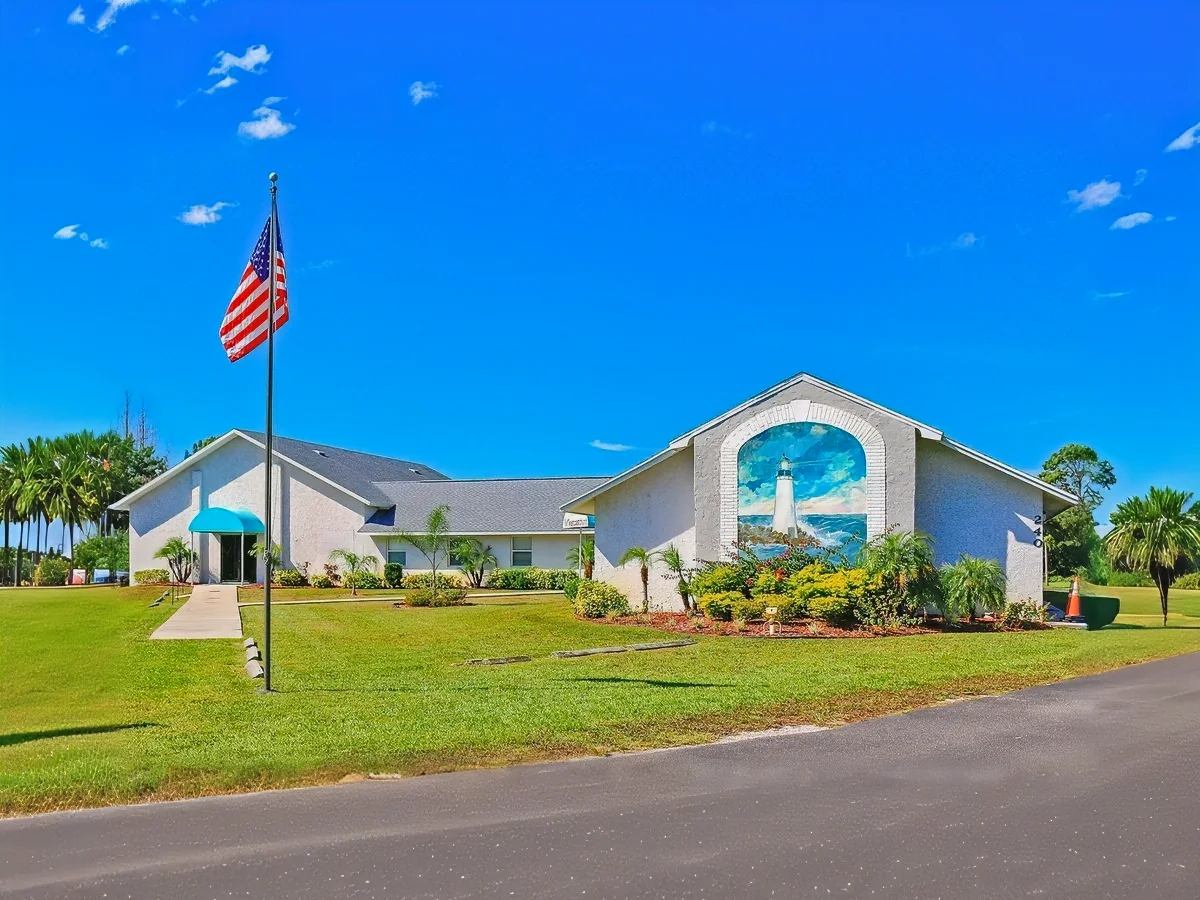
- Location: 240 Pine St, Englewood, FL 34223
- Facility Type: Worship Center Sanctuary with Live Band and Amplified Speakers
- Client: Westcoast Church
- Objective: Reduce RT60 from 1.6 Seconds to the Worship Range of 1.1 to 1.3
- Scope: 3-Position Reverberation Test, Sabin Calculation, Panel Layout, Install
Sanctuary Reverberation Challenges at Westcoast Church
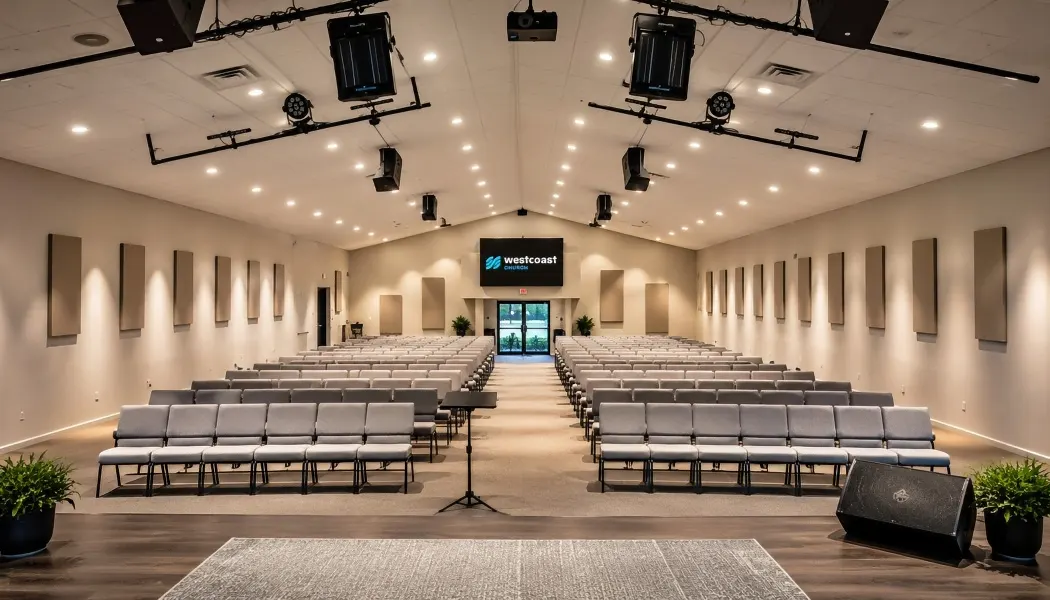
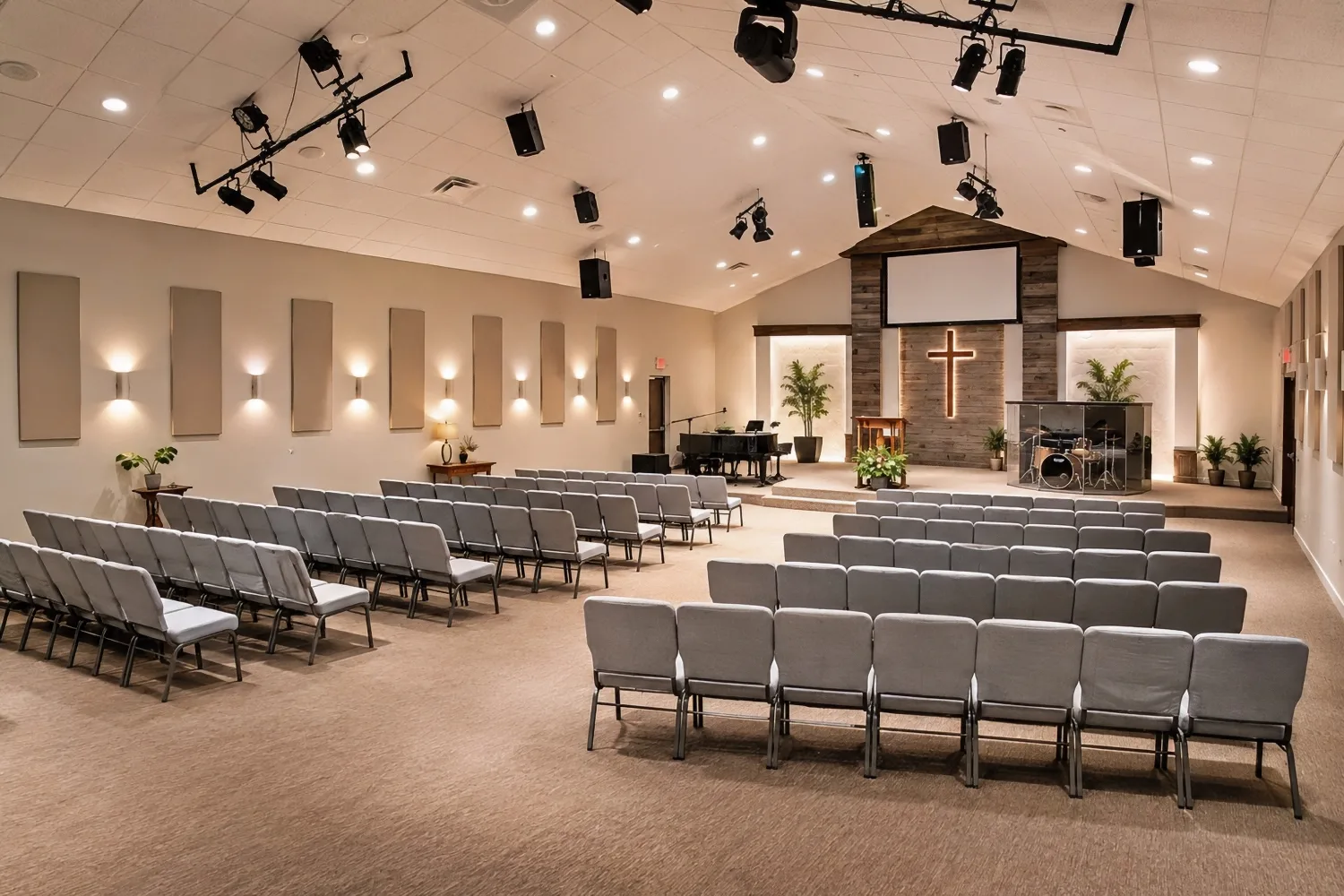
Westcoast Church in Englewood, Florida pulled the previous wall panels out of its primary sanctuary, and noise complaints followed almost immediately. The room had gone live: gabled acoustic ceiling tile overhead, painted drywall on three sides, drywall and glass on the east wall, and only a low-profile carpet on the floor. Once the absorption was gone, music ran long and speech intelligibility collapsed.
The room also has a working live band setup: amplified speakers on the ceiling grid and a partially-shielded drum kit at the front. None of that is forgiving in a 1.6-second room. Worship-space targets sit in the 1.1 to 1.3 second band, where the music can ring out without smearing the lyrics. Commercial Acoustics was brought in to quantify the gap and lay out the fix.
Reverberation Testing in the Sanctuary
- Front (Stage): 1.6 seconds RT60
- Center of Sanctuary: 1.5 seconds RT60
- Back of Sanctuary: 1.6 seconds RT60
- Equipment: Nor131 Type 1 SPL meter, Nor1251 calibrator, hand-held
The center reading came in slightly tighter than the front and back, which is consistent with how a gabled-ceiling sanctuary behaves: the apex traps energy at the ends. A single broadband number is fine for sizing absorption, but worship spaces still need to be checked across the speech band (500 Hz to 2 kHz) because that is where intelligibility lives. To plan a similar space yourself, the room acoustics calculator walks the Sabin math start to finish.
Sabin Calculation and Panel Specification
- Target RT60: 1.2 seconds, mid-worship range
- Minimum Absorption: 250 SF, NRC 1.00 (base layer)
- Recommended Absorption: 535 SF for full margin
- Panel Spec: 2 ft by 4 ft, NRC 1.00, acoustically-transparent fabric
Working from the measured RT60 and the room volume, the Sabin model called for a 250 square foot minimum to land near the 1.3-second top of the worship band, and 535 square feet to hit the 1.2-second target with margin. The recommendation came in two tiers so the church could install the base layer first, listen to the room, then add panels only if needed.
Panel selection was constrained: any product had to publish a full NRC 1.00 across the speech band, accept impaling-clip wall mount, and use an acoustically-transparent fabric face so the absorber actually performs. The acoustic absorption panel line in 2’x4′ format meets all three.
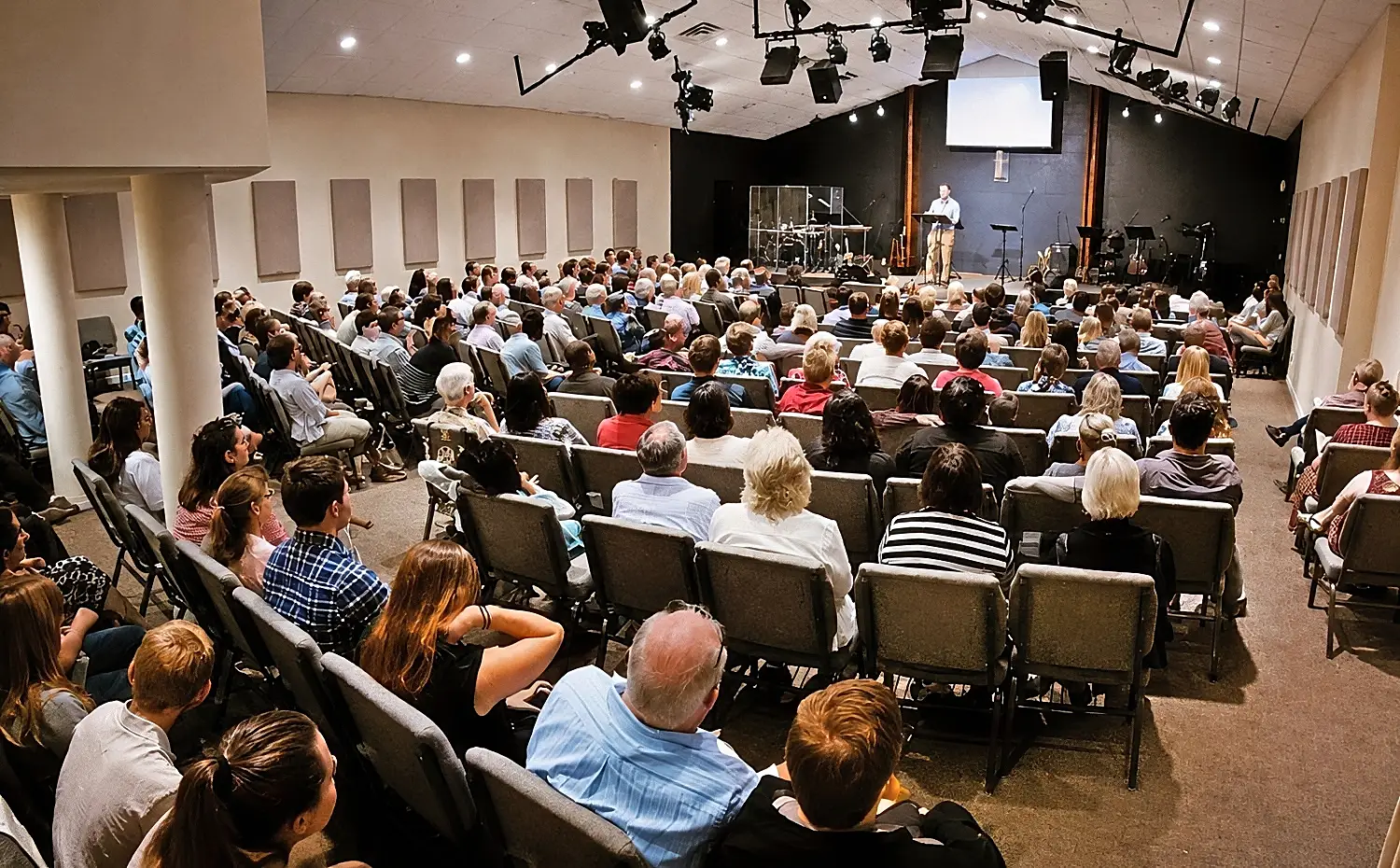
Installation: 50 Panels, One Day
- Quantity: 50 acoustic absorption panels, 2 ft by 4 ft each
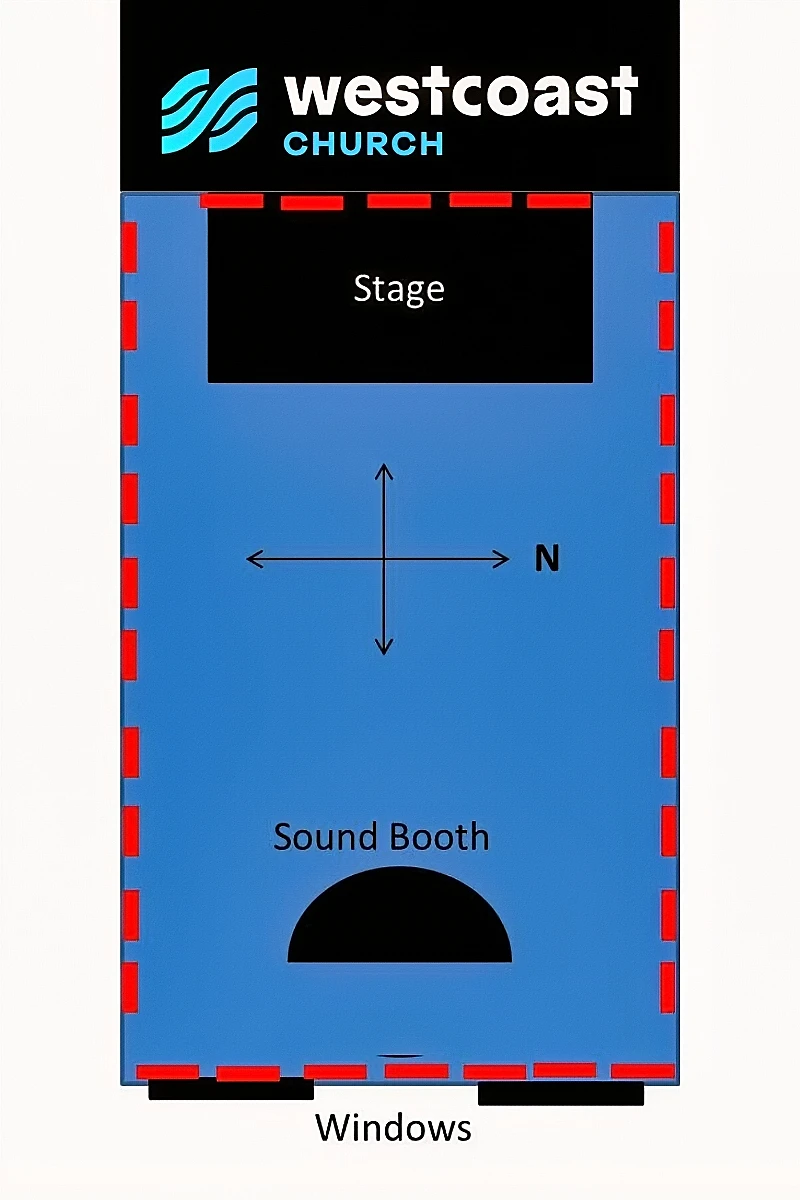
- Mount: Impaling clips, perimeter walls, even spacing at seated head height
- Install Time: Under one full crew day
- Fabric Face: Acoustically-transparent, color-matched to the sanctuary palette
Impaling-clip mount is the right call here because it lets the church pull and re-position panels later without patching drywall, which matters in a room that gets reconfigured for events. Crew time on site came in under a single working day.
The acoustically-transparent fabric face is the part that quietly determines whether a panel actually delivers its rated NRC. A vinyl-coated decorative fabric in front of an absorber kills the high-frequency performance and turns an NRC 1.00 product into something closer to NRC 0.6. We matched the church’s interior palette without crossing that line. For a deeper read on absorption strategy in worship spaces, see church acoustical design.
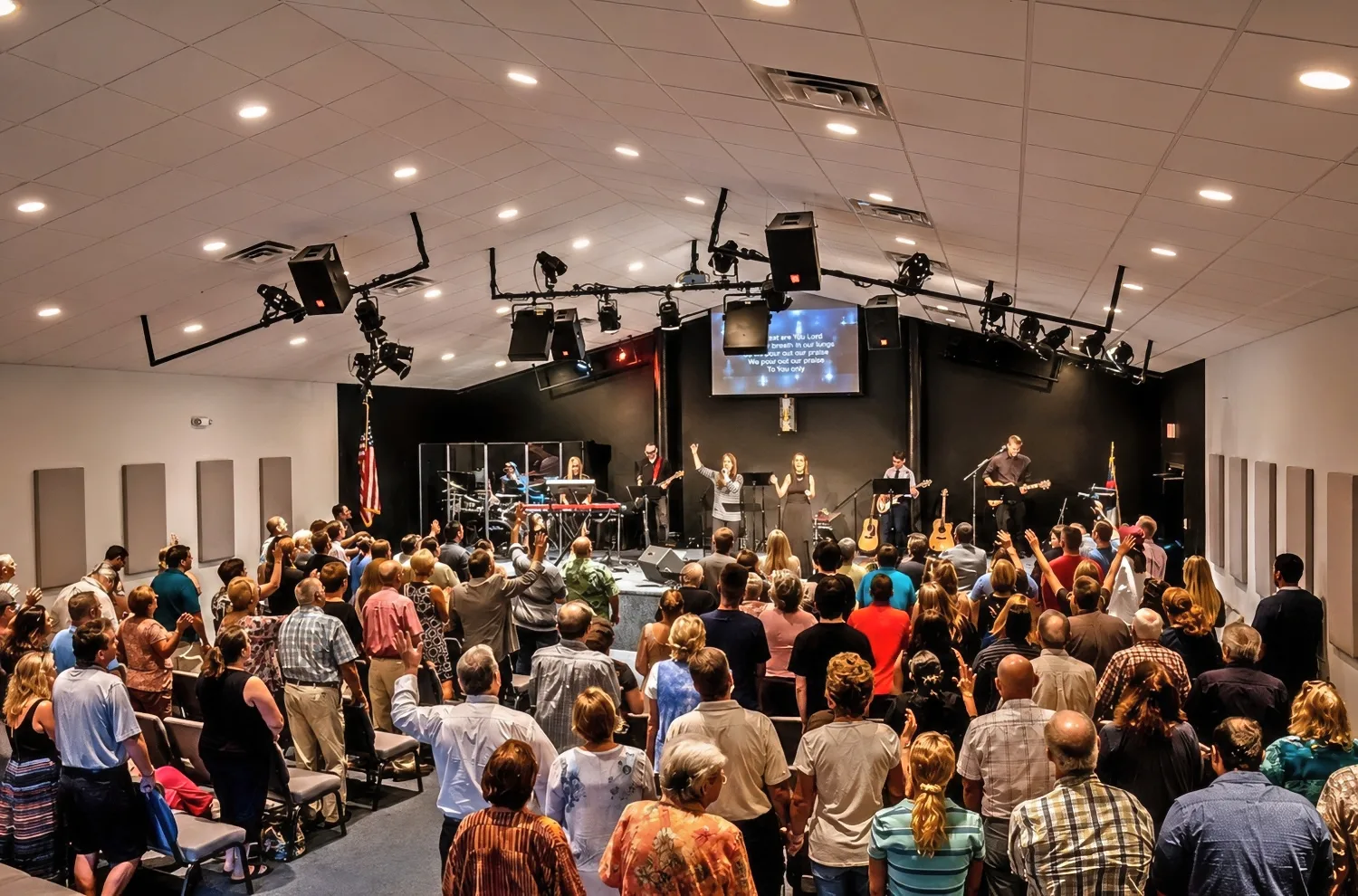
Results: 1.05-Second RT60
- Pre-Install RT60: 1.5 to 1.6 seconds across three sanctuary positions
- Post-Install RT60: 1.05 seconds, beating the 1.2-second model
- Absorption Added: 400 SF (50 panels at 8 SF each), NRC 1.00
- Outcome: Clear improvement in speech intelligibility during music and services
Coming in 0.15 seconds tight of the 1.2-second target is the kind of overshoot you can live with in a worship space; it leaves headroom for soft furnishings and full attendance, both of which add a little more absorption naturally. Client feedback was direct: “This company is a dream to work with. Great communication skills and customer service was second to none. Thank you Commercial Acoustics for an excellent job.” — Mark Morris, Westcoast Church.
For a sibling project that took the reverberation problem further with a stretched-fabric wall system, see Lakes Church reverberation control.

Conclusion: Church Acoustic Panel Installation
A 1.6-second sanctuary became a 1.05-second sanctuary in a single install day, on a budget that bought 50 panels and the testing to size them correctly. If your worship space sounds long, washed out, or louder than it should be, the path forward is the same one Westcoast Church took: measure first, model the absorption, then install.
FAQs: Church Acoustic Panel Installation
What RT60 should a church sanctuary target?
For most worship spaces, 1.1 to 1.3 seconds is the working window. That gives music enough decay to feel alive without smearing speech intelligibility. Larger sanctuaries with traditional choir or organ programs can run a touch longer; rooms built around amplified contemporary worship with live drums should aim for the lower end of that range.
How many acoustic panels does a sanctuary need?
It depends on room volume, current RT60, and panel NRC. A Sabin calculation is the right way to size it. As a rough anchor: Westcoast Church added 50 panels (about 400 square feet of NRC 1.00 absorption) and dropped a 1.6-second sanctuary to 1.05 seconds. Smaller rooms can land closer to the target with 25 to 35 panels.
Where should acoustic panels be mounted in a sanctuary?
Even distribution around the wall perimeter at seated head height is the default, since that intercepts the first reflections that hurt speech clarity most. Avoid clustering panels in one zone; the room will sound dead in that corner and live everywhere else. Vertical or horizontal orientation is an aesthetic choice with no acoustic difference.
Can I leave the original ceiling tile and only treat the walls?
Yes, when the ceiling already carries usable absorption. Westcoast Church kept its gabled acoustic-tile ceiling and treated only the perimeter walls, and the math worked. If your ceiling is exposed structure or hard-finished, you will likely need ceiling clouds or baffles in addition to wall panels to hit a worship-range RT60.

Walker Peek|Founder & CEO, Commercial Acoustics
Walker founded Commercial Acoustics in 2013 to bring aerospace-grade engineering discipline to soundproofing, and runs the firm as CEO from its 12,000 sq ft Tampa production facility. The company designs custom acoustic panels, sound membranes, and masking systems for multi-family, hospitality, healthcare, and commercial projects across the US — built around Walker’s invention, Wall Blokker, an EVA-based sound barrier that hits STC 50-plus at roughly $1 per square foot installed.
A Jacksonville native, Walker spent five years at Kennedy Space Center with Craig Technologies before founding Commercial Acoustics — certifying aerospace manufacturing to the AS9100 standard and leading Six Sigma Black Belt process-improvement teams on NASA programs. He is a certified Industrial Noise Control Engineer and the author of Architectural Acoustics: A Practical Handbook.
