Table of Contents
Project Overview: Clubhouse Echo Acoustic Treatment
- Project: 24 Large-Format Fabric-Wrapped Acoustic Panels for Clubhouse Echo
- Location: Southwest Florida
- Facility Type: Community Clubhouse with High Tapered Ceilings and Hard Finishes
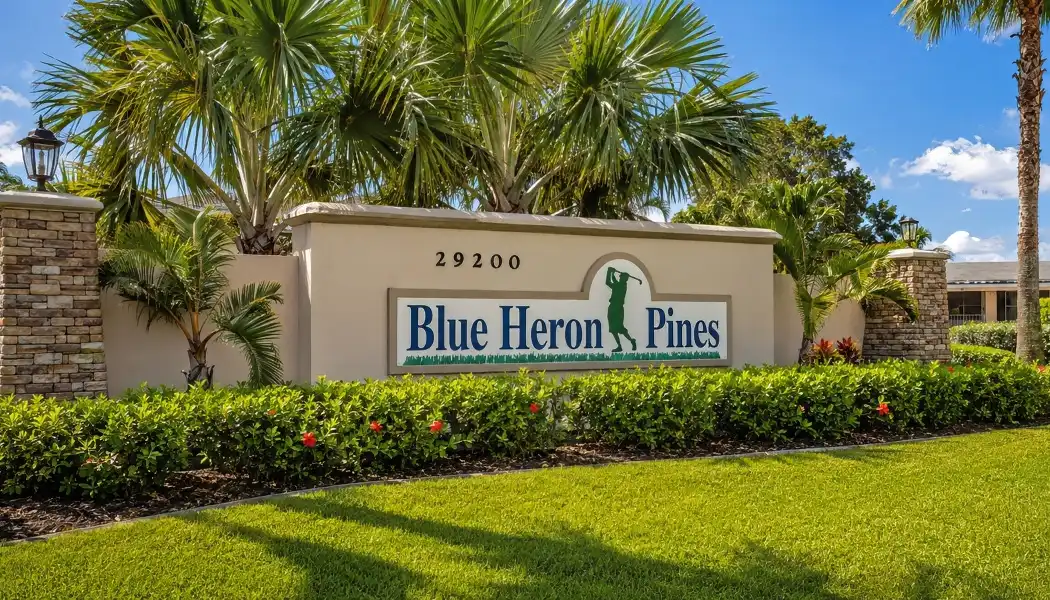
- Client: Blue Heron Pines Clubhouse
- Address: 29201 Jones Loop Road Punta Gorda, FL 33950
- Pre-Treatment RT60: 1.5 seconds (above the speech-intelligibility threshold)
- Scope: Reverb Test, 24× 3’×6′ Custom Panels, Symmetric Wall Layout
Why Clubhouses Have Persistent Echo Problems
Clubhouses are one of the most common acoustic clients we work with, and the reason is structural. The standard clubhouse footprint pairs high tapered ceilings (great for visual openness) with reflective walls and hard floors (great for cleaning and durability). Together those choices guarantee an echo problem.
Sound transmission to adjacent space is rarely the issue — most clubhouses sit in stand-alone buildings or share walls with retail and dining where higher background levels are expected. The persistent issue is reverberation inside the main hall. With LVT or tile underfoot, drywall walls without acoustic treatment, and ceiling volume above the seating, the room rings every time someone speaks.

Reverberation Test: 1.5 Seconds Pre-Treatment
- Pre-Treatment RT60: 1.5 seconds, broadband
- Speech-Failure Threshold: 1.5 seconds in any program type
- Target Range: 0.9 to 1.1 seconds for community-clubhouse use
- Hard Surfaces: Drywall, glass, LVT/tile floor, exposed structure overhead
1.5 seconds RT60 is exactly the point where speech intelligibility falls apart in any program type. The Blue Heron Pines clubhouse measured at that line — usable for music and informal hangout, unusable for speeches or community announcements. The target window for clubhouse multi-program use sits at 0.9 to 1.1 seconds, where the room reads as lively but conversations remain clear.
Why Speech Intelligibility Matters in Community Clubhouses
Community clubhouses serve an audience where age-related hearing loss is common. Even mild presbycusis — the gradual high-frequency hearing decline that affects most people over 60 — interacts badly with reverberant rooms. Reflections smear consonants, and consonants carry the meaning in spoken English.
A 1.5-second clubhouse with a 60-person audience that includes hearing-loss attendees is functionally unusable for the most important programs the clubhouse hosts: announcements, speeches, presentations, and any community discussion that depends on someone being able to follow what was said. That accessibility gap is what the Blue Heron Pines management called us in to fix.
The acoustic intervention here is also an accessibility intervention. For deeper context on hearing-loss accessibility considerations, see the Hearing Loss Association of America.

24 Large-Format 3’×6′ Fabric-Wrapped Panels
- Quantity: 24 custom-fabricated panels
- Size: 3 ft × 6 ft each — large-format for fewer visible panel breaks
- Construction: Fabric-wrapped over high-NRC fiberglass core
- Fabric Selection: Swatches mailed to designer and manager for approval
The 3’×6′ panel size is the differentiator on this project. Standard pre-fabricated panels at 2’×2′ would have meant 50 to 60 individual units across the same total square footage, with all the visible edges and panel-grid quality that comes with smaller pieces. Large-format fabric-wrapped acoustic panels at 18 square feet apiece read as designed wall elements, not retrofit gear.
Fabric selection ran through the clubhouse manager and designer with hard-copy swatches mailed for review. The fabric face matched the existing wall palette so the panels integrated visually rather than introducing a contrasting acoustic-gear color. That detail mattered for an active community space where members see the room every day.

Symmetric Layout: Why Distribution Beats Clumping
- Pattern: Symmetric distribution along all four walls
- Why: Distributed absorption reads better acoustically than clumped panels
- Aesthetic: Symmetry reads as architectural intent
- Install Time: Two-week fabrication, single-day install
The 24 panels distributed across all four walls deliver more effective absorption than the same panel count clumped on a single wall. Sound waves originating from any speaker position have multiple reflection paths to find absorption — the more evenly the panels are distributed around the room, the more chances each reflection has to be absorbed before reaching a listener.
Symmetry matters visually too. A clubhouse member who walks the room every week notices an off-balance panel layout immediately, even if they cannot articulate why. Symmetric distribution reads as architectural design intent rather than acoustic gear bolted onto whatever wall had open space.

Results: RT60 from 1.5 to 1.05 Seconds (40%+ Reduction)
- Pre-Install RT60: 1.5 seconds
- Post-Install RT60: ~1.05 seconds
- Reduction: Over 40 percent drop, inside the community-clubhouse working window
- Outcome: Speeches usable, atmosphere preserved, hearing-loss attendees included
Post-install measurement returned ~1.05 seconds RT60 — a 40 percent drop from baseline that landed the room squarely in the 0.9 to 1.1 second working window for community clubhouse use. Speeches and announcements became intelligible across the entire hall. Music and dance programs kept their lively atmosphere. The acoustic compromise that suits multi-program clubhouse use was achieved cleanly.
Most importantly, attendees with age-related hearing loss reported that they could follow community announcements again. That accessibility outcome is the one that justified the project from the management side, even though it never appears in the standard pre/post RT60 comparison.
Clubhouse Acoustic Targets by Program
Different clubhouse programs call for different RT60 targets. Quiet programs like cards and bingo want tighter rooms. Lively dances and music programs want more reverberation. Community gatherings with speeches want the middle. The table below maps the working windows across the four most common clubhouse use cases.
| Clubhouse Use | Target RT60 | Why It Matters | Treatment Approach |
|---|---|---|---|
| Community Gatherings & Speeches | 1.0 – 1.2 sec | Speech intelligibility for aging attendees with hearing loss | Large-format fabric-wrapped wall panels, symmetric layout |
| Bingo / Cards / Quiet Programs | 0.8 – 1.0 sec | Conversation across multiple tables | Distributed standard wall panels |
| Dances & Music Programs | 1.2 – 1.5 sec | Lively atmosphere preserved | Selective panel coverage only |
| Multi-Purpose Hall (Mixed Programs) | 1.0 – 1.3 sec | Compromise across all use cases | Wall panels + ceiling fabric clouds |
The Blue Heron Pines install landed at 1.05 seconds — the upper edge of the community-gathering window, where multi-program clubhouses should sit.
For a sister project that took the same approach at a different clubhouse, see the Country Club of Ocala clubhouse acoustic case study.
For a multipurpose-room sister with similar reverberation goals, see the multipurpose room acoustic treatment case study.
To run the panel-quantity math on your own clubhouse, the how many acoustic panels do I need walkthrough covers the Sabin formula in plain English.
Conclusion: Clubhouse Echo Acoustic Treatment
Twenty-four large-format 3’×6′ fabric-wrapped panels symmetrically distributed across the Blue Heron Pines clubhouse walls dropped RT60 from 1.5 to 1.05 seconds — a 40 percent reduction that restored speech intelligibility for community gatherings, kept the room lively for music programs, and made announcements accessible to attendees with age-related hearing loss. Talk to us about your clubhouse echo if you’re scoping similar work.
FAQs: Clubhouse Echo Acoustic Treatment
Why do clubhouses have such bad echo?
High tapered ceilings, hard tile or LVT floors, and reflective drywall walls together guarantee long reverberation. Most untreated clubhouses measure between 1.4 and 2.0 seconds RT60 — well above usable for speeches.
What RT60 should a community clubhouse target?
Community gatherings with speeches target 1.0 to 1.2 seconds. Quiet card and bingo programs run 0.8 to 1.0 seconds. Dances and music programs can run 1.2 to 1.5 seconds. Multi-program halls settle at 1.0 to 1.3 seconds.
Why use large-format 3 by 6 panels instead of standard sizes?
Twenty-four 3’×6′ panels deliver the same absorption as 50 to 60 standard 2’×2′ panels, with fewer visible panel breaks. They read as designed wall elements rather than a panel grid, which matters in spaces members see every day.
Does clubhouse acoustic treatment help attendees with hearing loss?
Yes. Reverberant rooms smear consonants, which carry speech meaning. Reducing RT60 from 1.5 to 1.05 seconds restores intelligibility for attendees with mild to moderate presbycusis — most clubhouse audiences over 60.

Walker Peek|Founder & CEO, Commercial Acoustics
Walker founded Commercial Acoustics in 2013 to bring aerospace-grade engineering discipline to soundproofing, and runs the firm as CEO from its 12,000 sq ft Tampa production facility. The company designs custom acoustic panels, sound membranes, and masking systems for multi-family, hospitality, healthcare, and commercial projects across the US — built around Walker’s invention, Wall Blokker, an EVA-based sound barrier that hits STC 50-plus at roughly $1 per square foot installed.
A Jacksonville native, Walker spent five years at Kennedy Space Center with Craig Technologies before founding Commercial Acoustics — certifying aerospace manufacturing to the AS9100 standard and leading Six Sigma Black Belt process-improvement teams on NASA programs. He is a certified Industrial Noise Control Engineer and the author of Architectural Acoustics: A Practical Handbook.
