
Table of Contents
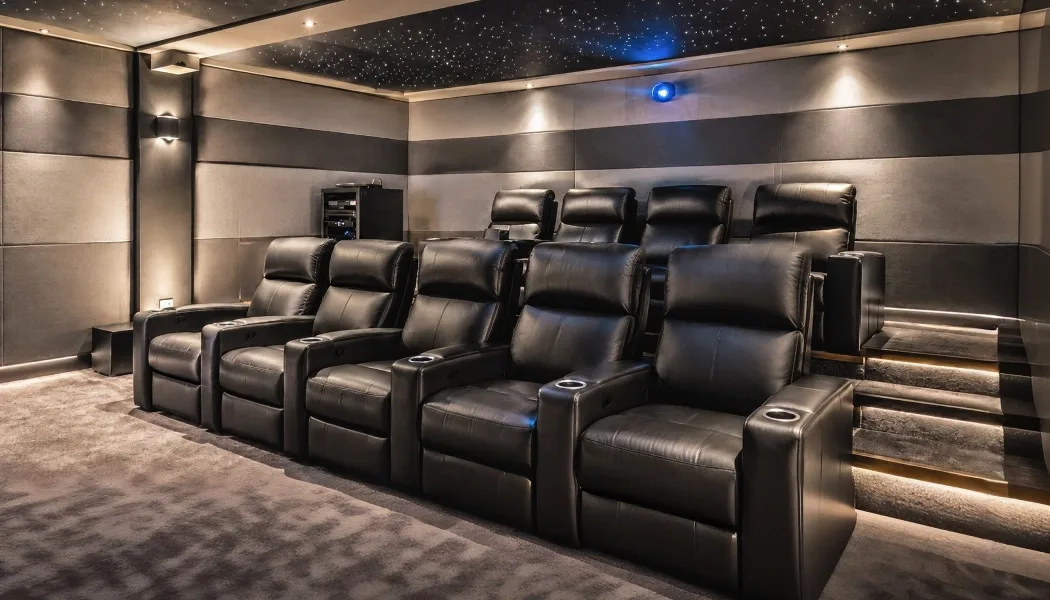
Project Overview: Custom Home Theater Acoustic Fabric Wall
- Project: Floor-to-Ceiling Stretched Fabric Wall in a Custom-Built Home Theater
- Location: Clearwater, FL (private residence)
- Facility Type: High-End Custom Home Theater Inside a Luxury Residence
- Client: Homeowner via General Contractor (project anonymized)
- Treatment: Floor-to-Ceiling Stretched Fabric, Custom Tracks, 1″ Fiberglass Core
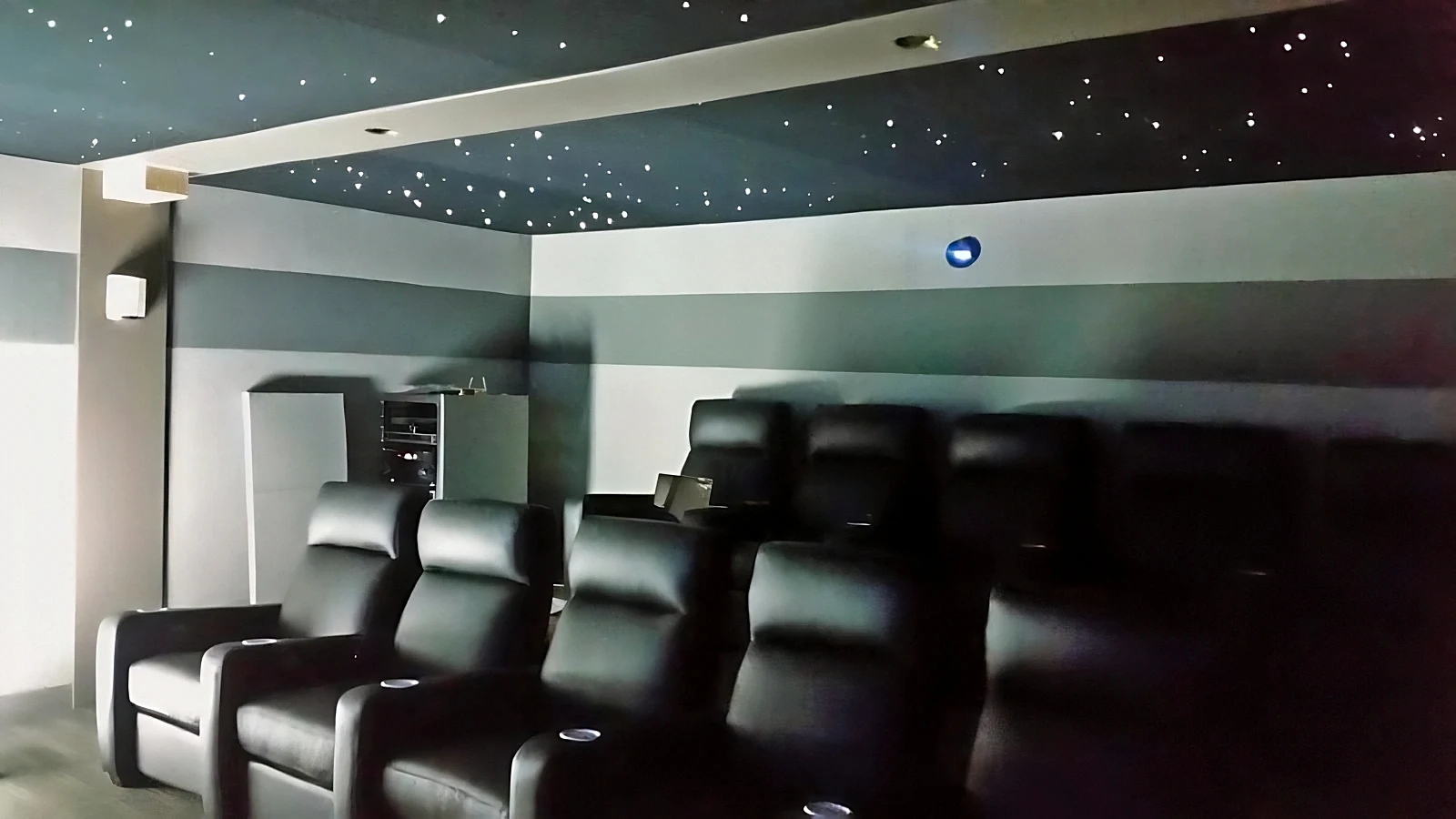
- Detail: Custom Acoustical Ceiling Fabric with Fiber-Optic Starlight Display
Why Custom Home Theaters Need Different Acoustic Treatment
Residential home theaters carry a different acoustic brief than commercial movie theaters. The room has to deliver audiophile-grade absorption — film soundtracks ride on tight reverberation control — while reading as a continuation of the home’s interior design language, not a black-box performance space.
Commercial cinemas can use industrial-looking acoustic panels and visible treatment because the space is purely functional. Custom home theaters cannot. The treatment has to look like architecture, blend with the surrounding home aesthetic, and deliver flat broadband absorption for amplified audio across a 5.1 or 7.1 surround setup.
Stretched fabric wall systems became the right tool here because they solve both problems in one move: continuous wall coverage means no panel grid breaking the visual plane, and the underlying high-NRC fiberglass delivers the absorption math the room needs.
Stretched Fabric Wall System Specification
- Core: 1″ dense fiberglass board insulation
- Track: Custom-cut track frames mounted floor-to-ceiling
- Face: Acoustically-transparent fabric matched to home decor
- Fabric Source: Guilford of Maine or equivalent for acoustic transparency
The 1″ fiberglass core does the acoustic work. Dense fiberglass at this depth absorbs across the speech and lower-music bands cleanly without needing the thicker cores recording studios use for sub-100-Hz control. Home theater playback runs amplified, so the room’s job is to control mid- and high-frequency reflections, not absorb everything down to the LFE.
The fabric face was matched to the home theater seats and surrounding interior design palette. Guilford of Maine acoustic fabric is the standard pick because it passes airflow at the speech and music frequencies of interest, which is what makes the underlying fiberglass functional. A vinyl-coated decorative fabric in front of an absorber kills the high-frequency performance and turns NRC 1.0 into something closer to NRC 0.6.
Floor-to-Ceiling Coverage Beats Panel Layouts in Home Theaters
The decision between continuous fabric wall and individual acoustic panels is bigger than the acoustic difference suggests. From a pure absorption standpoint, a panel grid covering the same square footage as a fabric wall delivers similar RT60 reduction. The difference shows up in the room’s read.
Panel grids interrupt the wall plane. Each panel has visible edges, gaps between units, and a stamped-on quality that reads as acoustic gear bolted to drywall. In a luxury residence where every other surface is finished to design-magazine standards, that visual discontinuity stands out hard.
Stretched fabric wall reads as a continuous designer wall plane. Same room, same absorption, completely different perceived quality. For a sister project that took the same approach in a commercial setting, see the smart home theater fabric wall case study at Intelligent Design’s showroom.
The Starlight Fiber-Optic Ceiling
- Ceiling Fabric: Custom acoustical fabric from Guilford of Maine
- Lighting Layer: Fiber-optic starlight display integrated behind the fabric
- Acoustic Function: Continuous absorption surface across the ceiling plane
- Visual Function: Ambient star-field background for film viewing
The starlight ceiling is the detail that turns a high-end home theater build into a luxury one. Fiber-optic strands run behind the acoustic fabric, with each fiber terminating as a pinpoint of light visible through the fabric weave. The effect is a slow, dimmable star field above the seating — perfect ambient for a theater experience.
Acoustically, the ceiling fabric does the same work as the wall fabric: continuous high-NRC absorption across the ceiling plane, which is the largest single reflective surface in any home theater. Treating it removes the dominant first-reflection path before it reaches the listening position.
Cost: Why Stretched Fabric Often Beats Panels Per Square Foot
The counterintuitive part of this project: stretched fabric wall came in cheaper per square foot than an equivalent panel grid would have. That’s the opposite of what most operators expect, since custom-fabricated systems usually carry a premium. The math flips at scale.
Pre-fabricated panels are sized in a factory and priced per unit, with each unit carrying its own framing, fabric wrap, and installation hardware. Across 20 panels, that per-unit overhead compounds. Stretched fabric wall builds the framing once (the track) and runs continuous fabric over it — no per-unit framing repeats. Material savings on framing and shipping outweigh the custom-install cost.
The break-even point is around 80 to 100 square feet of treatment. Below that, panels are usually cheaper. Above it — which describes most full-room home theaters and large conference rooms — fabric wall wins on cost while delivering better aesthetic continuity. The same dynamic shows up in our commercial work: see the stretched fabric acoustic wall system product page for the deeper spec breakdown.
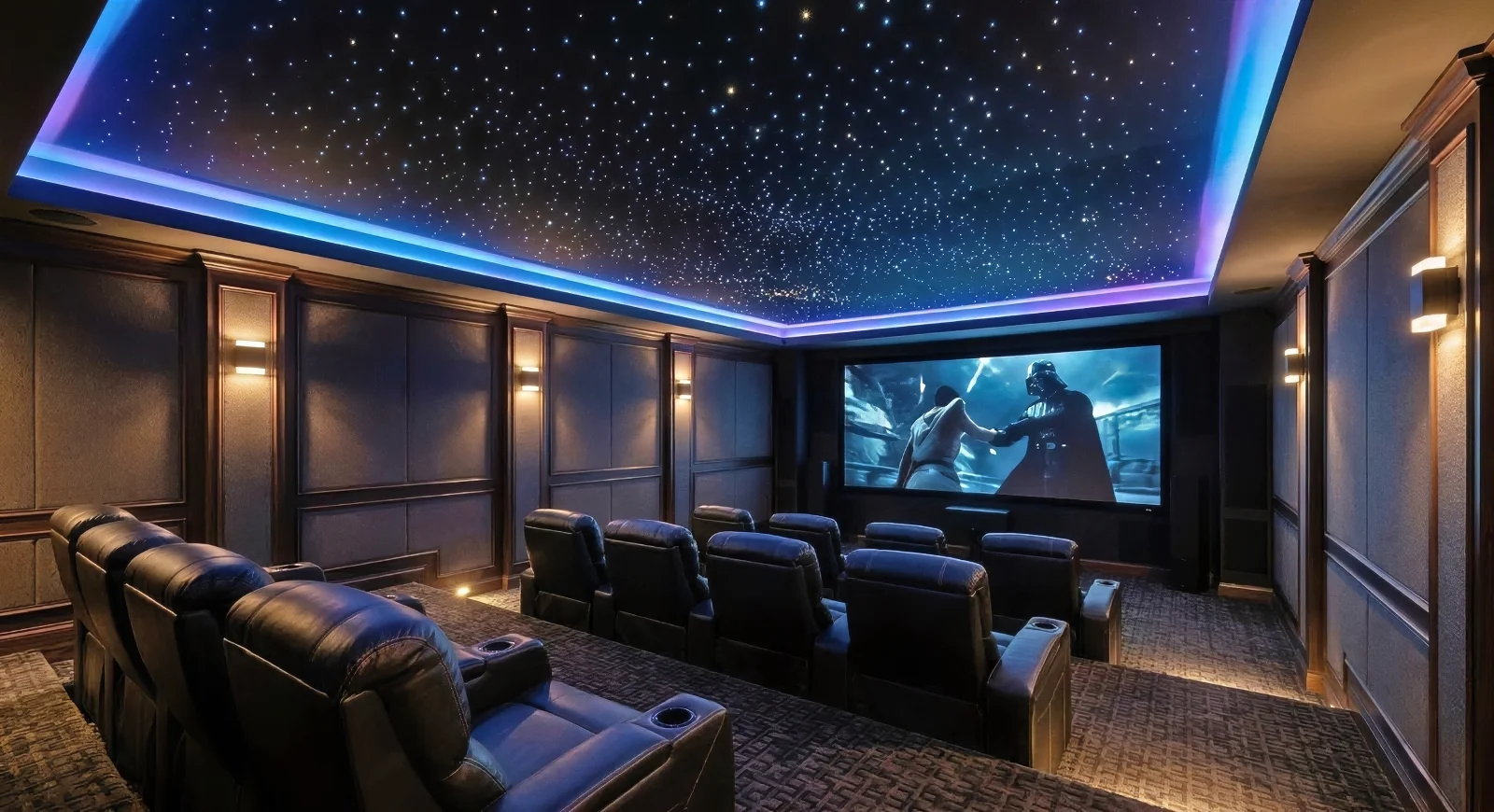
Home Theater Acoustic Targets and Treatment Types
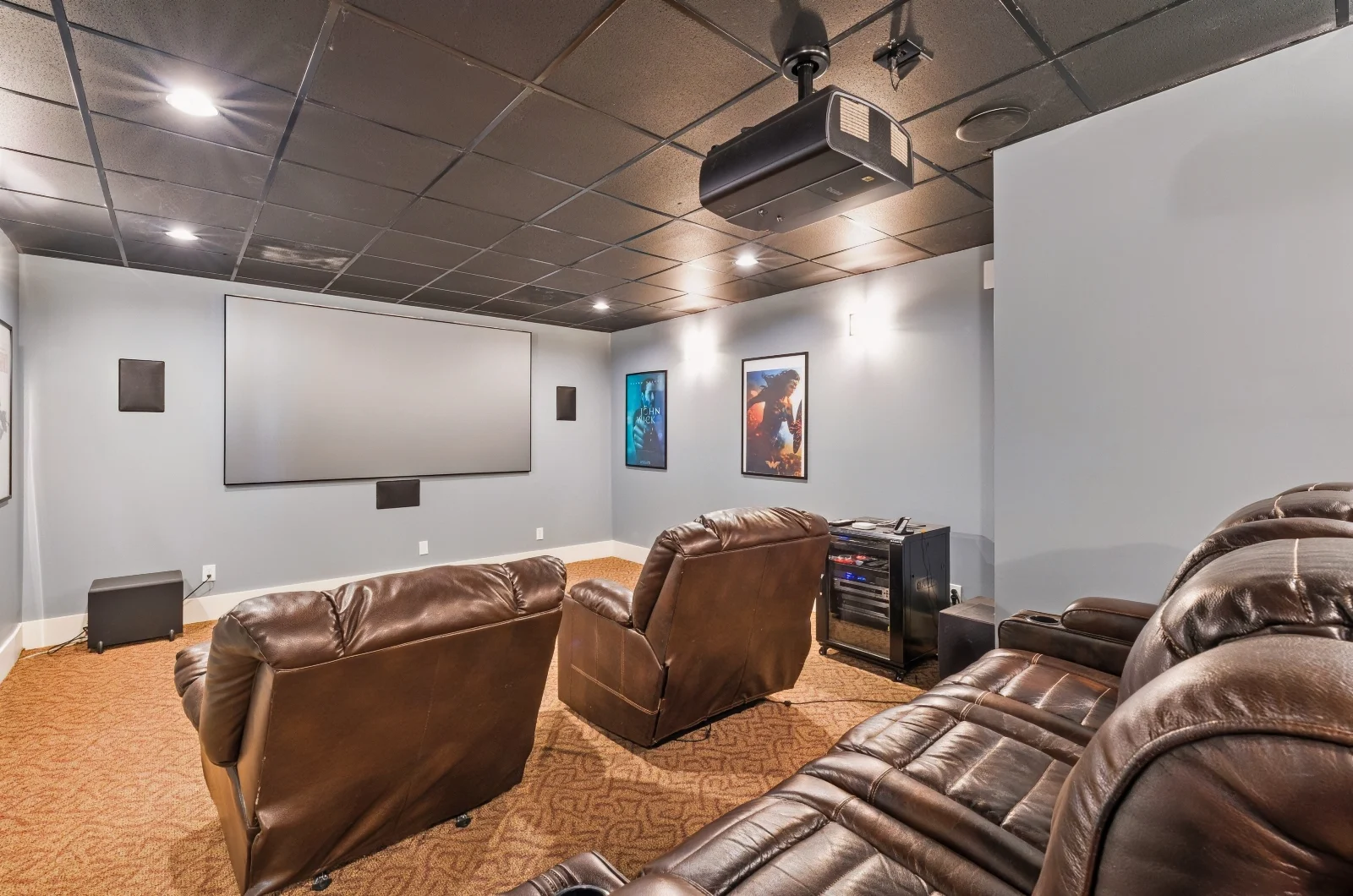
Different home theater builds call for different treatment approaches. The decision depends on whether the space is dedicated, convertible, commercial-display, or budget-DIY. The table below maps the working trade-offs across four common home theater patterns.
| Home Theater Type | Treatment Approach | Best For | Trade-Off |
|---|---|---|---|
| Custom Residential Build | Floor-to-ceiling stretched fabric wall | Aesthetic continuity, audiophile-grade absorption | Higher upfront fabrication cost |
| Convertible Living Room Theater | 4 to 8 distributed acoustic panels | Multi-use space, removable treatment | Visible panel grid breaks wall plane |
| Smart Home Theater Showroom | Modular fabric wall plus display tech | Demo flexibility, product visibility | Showroom feel rather than lived-in |
| Basement DIY Theater | Standard pre-fab acoustic panels | Budget-conscious smaller rooms | Less aesthetic integration |
The right approach scales with budget, room dedication, and how much the design language matters. For a sister project that took a similar fabric-wall approach in a public performance setting, see the theater acoustics school performance case study. For a music-venue acoustic treatment that handled live performance instead of playback, see the live music venue acoustic treatment case study.
Conclusion: Custom Home Theater Acoustic Fabric Wall
Floor-to-ceiling stretched fabric wall on custom tracks over 1″ dense fiberglass core delivered audiophile-grade absorption across a Clearwater custom home theater, paired with a fiber-optic starlight ceiling for the ambient detail. The fabric wall approach beat panel layouts on both aesthetic continuity and per-square-foot cost at full-room scale. More on the team behind custom home theater builds for homeowners and GCs scoping similar work.
FAQs: Custom Home Theater Acoustic Treatment
What’s the best acoustic treatment for a custom home theater?
Floor-to-ceiling stretched fabric wall on custom tracks over a dense fiberglass core. The fabric face delivers aesthetic continuity with the home interior; the fiberglass underneath delivers the broadband absorption a 5.1 or 7.1 surround playback needs. The Clearwater build used 1″ fiberglass with Guilford of Maine acoustic fabric.
Why use fabric wall instead of acoustic panels in a home theater?
Continuous fabric wall reads as a designer wall plane; panel grids interrupt the wall with visible edges and stamped-on appearance. In a luxury residence where surrounding surfaces are design-magazine quality, that visual discontinuity stands out. Fabric wall delivers the same absorption with no perceived acoustic-gear feel.
Is stretched fabric wall more expensive than acoustic panels?
Below 80 to 100 square feet of treatment, pre-fab panels are usually cheaper. Above that — most full-room home theaters and large conference rooms — fabric wall actually beats panels per square foot because the framing builds once instead of repeating per panel. The Clearwater build came in cheaper than the equivalent panel layout.
Can a fiber-optic starlight ceiling work with acoustic fabric?
Yes — that’s exactly what the Clearwater build did. Fiber-optic strands run behind the acoustic fabric and terminate as pinpoints of light visible through the weave. The acoustic fabric absorbs sound while letting the light through, which gives the room continuous ceiling absorption plus a star-field ambient layer.

Walker Peek|Founder & CEO, Commercial Acoustics
Walker founded Commercial Acoustics in 2013 to bring aerospace-grade engineering discipline to soundproofing, and runs the firm as CEO from its 12,000 sq ft Tampa production facility. The company designs custom acoustic panels, sound membranes, and masking systems for multi-family, hospitality, healthcare, and commercial projects across the US — built around Walker’s invention, Wall Blokker, an EVA-based sound barrier that hits STC 50-plus at roughly $1 per square foot installed.
A Jacksonville native, Walker spent five years at Kennedy Space Center with Craig Technologies before founding Commercial Acoustics — certifying aerospace manufacturing to the AS9100 standard and leading Six Sigma Black Belt process-improvement teams on NASA programs. He is a certified Industrial Noise Control Engineer and the author of Architectural Acoustics: A Practical Handbook.
