
Table of Contents
Project Overview: Theater Acoustics for a School Performance Space
- Project: 32 Custom-Manufactured Acoustic Panels, Baffles, and Clouds
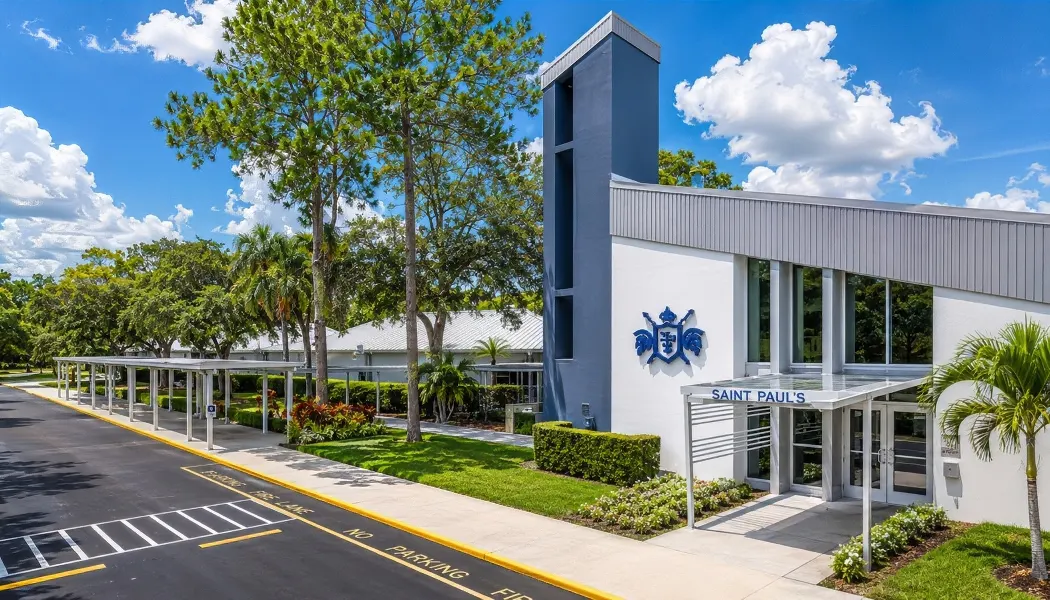
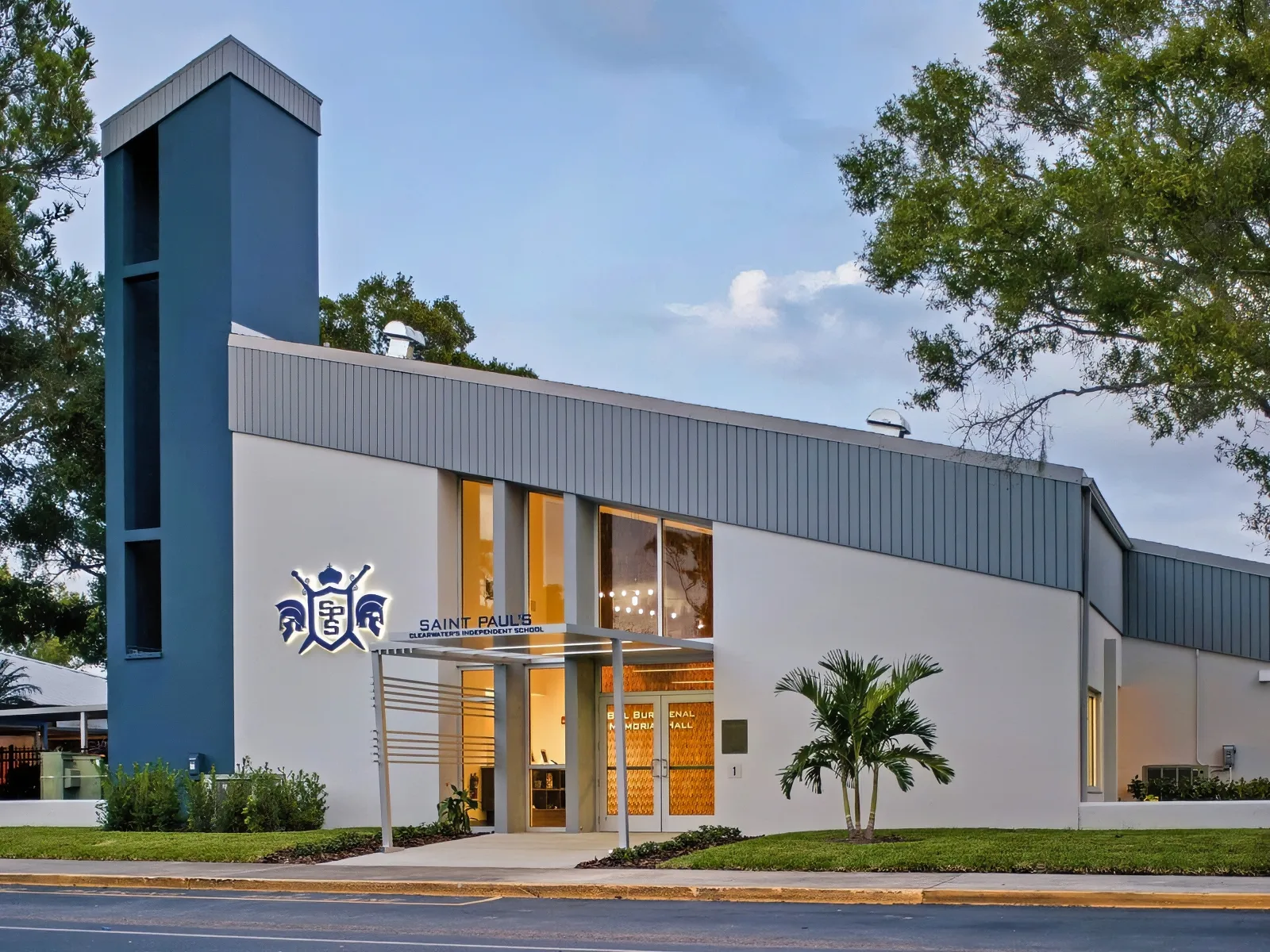
- Location: 1600 St Paul’s Dr, Clearwater, FL 33764
- Facility Type: School Performance Theater, Renovation
- Client: St. Paul’s School (Architect on Their Behalf)
- Spec: 4’x10′ Wood-Framed Panels, Guilford of Maine Fabric Wrap, NRC to Architect Spec
- Timeline: 4-Week Manufacture and Delivery
Why Theater Acoustics Are Different from Other Performance Spaces
Theaters live in a much wider RT60 range than most rooms. A restaurant lands between 0.7 and 1.1 seconds depending on whether the operator wants intimate or lively. A theater can run anywhere from 0.8 to 1.6 seconds, and the right number depends on the program — speech-first venues need tighter reverberation than music-first ones, and most school performance spaces have to handle both.
Two design decisions matter as much as the panel quantity in any theater. First, the floor slope and seat arrangement set whether the audience has direct line-of-sight to the stage; without it, every seat outside the vocal direction sits in a “shadow” and the performance falls apart from the back rows. Second, the ceiling and wall surfaces decide whether the room rings, smears, or actually delivers the performance. Ray diagrams and Sabin calculations handle the math; finish and panel selection handle the execution.
RT60 Targets for School Performance Theaters
- Speech-First (Lecture, Drama): 0.8 to 1.2 seconds RT60
- Music-First (Band, Choir): 1.2 to 1.6 seconds RT60
- Mixed-Use School Theater: 1.0 to 1.4 seconds RT60
- With Reinforced Sound: Tighter end of each window
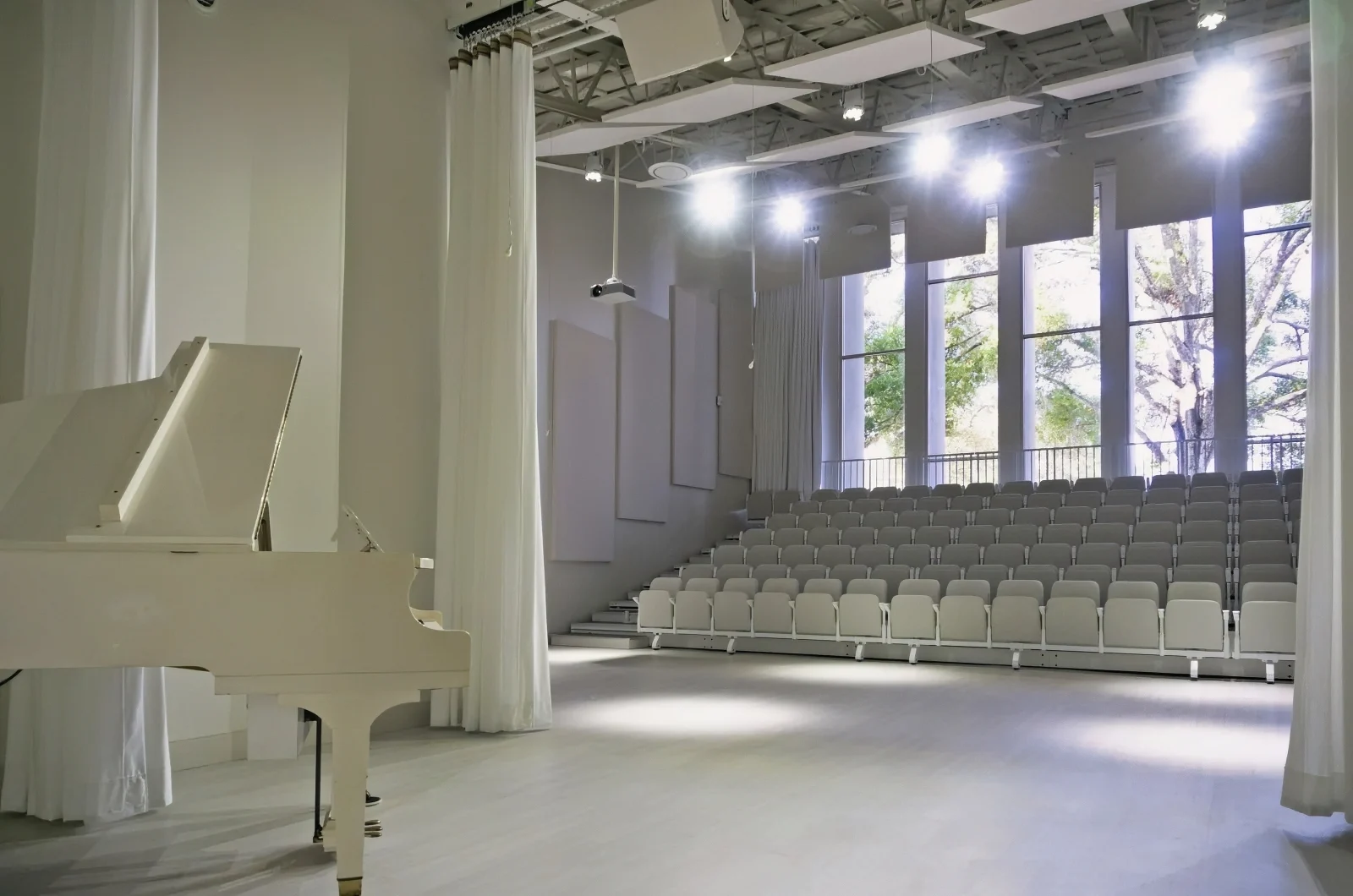
Most school performance theaters land in the mixed-use band because they have to. The same room hosts the spring play one week, the jazz band concert the next, and a graduation speech the week after. Targeting the middle of the 1.0 to 1.4 second window keeps speech intelligible without killing the music’s natural decay.
Reinforced sound systems pull the target tighter on both ends. A microphone-amplified speaker does not need the room to carry the voice; what it needs is for the room not to smear the amplified signal back into itself. When the program is amplified more than acoustic, aim for the lower end of the relevant window.
Custom Acoustic Panel Specification
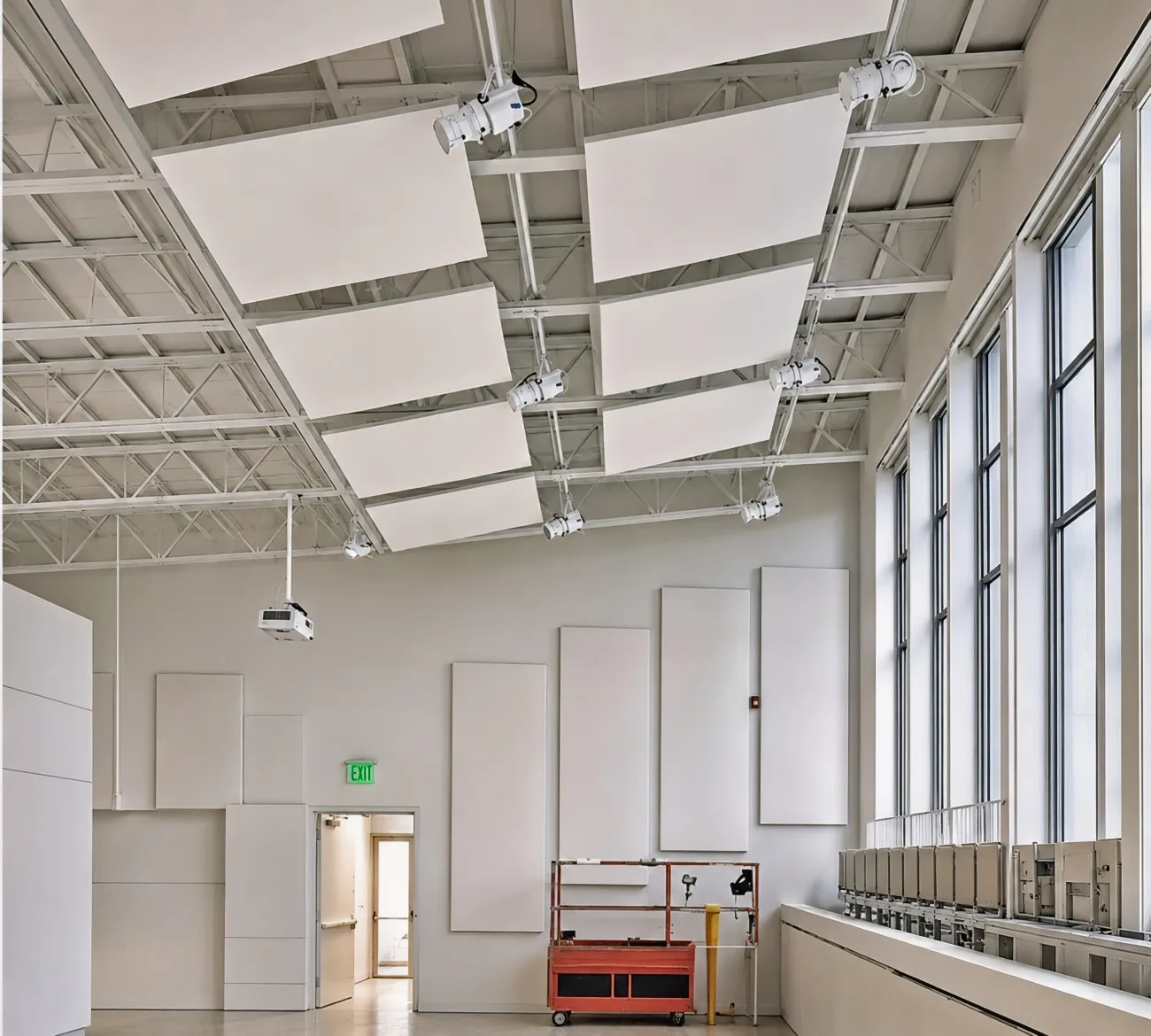
- Panel Size: 4 ft by 10 ft, exceeding standard stock dimensions
- Frame: Wood-framed for tight tolerances and clean edges
- Fabric: Guilford of Maine acoustically-transparent fabric wrap
- NRC: Held to the architect’s published spec across the speech band
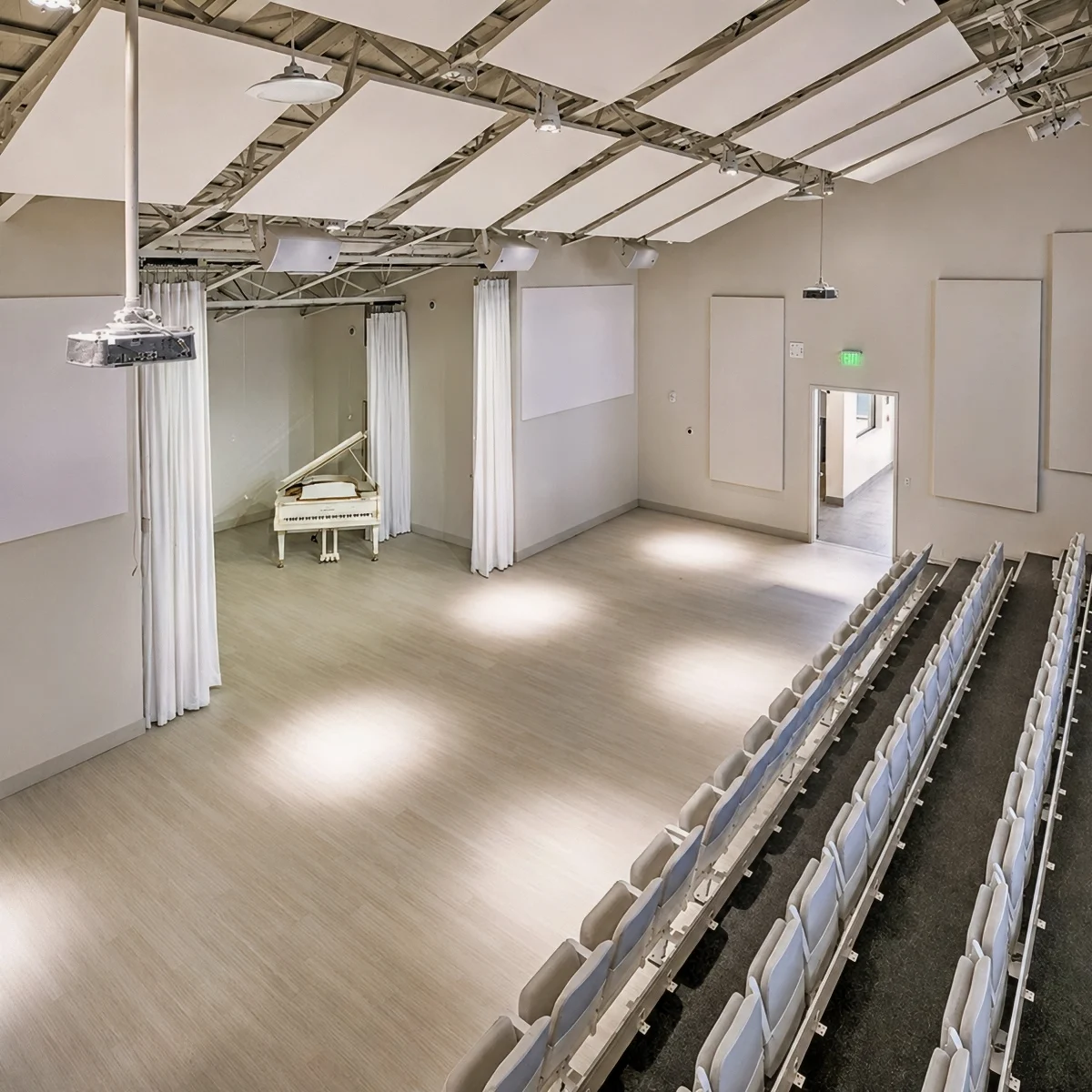
The St. Paul’s panels exceeded standard sizes — 4’×10′ instead of the typical 2’×4′ or 4’×8′ — because the architect’s design called for a panel rhythm that did not work at smaller dimensions. Wood framing maintained the dimensional tolerance the install required and gave the panels clean edges that read well in a performance space where every surface is on display.
Fabric selection is the part that quietly determines whether a panel actually delivers its rated NRC. Guilford of Maine acoustic fabric is the working standard for performance-space wraps because it passes airflow at the speech and music frequencies of interest while still presenting a designer-friendly finish. A vinyl-coated decorative fabric in front of an absorber kills the high-frequency performance and turns an NRC 1.00 product into something closer to NRC 0.6.
Baffles and Clouds for the Ceiling
- Baffles: Vertical absorbers suspended from the ceiling structure
- Clouds: Horizontal absorbers floating above the audience zone
- Coverage: Treats the largest reflective face without taking floor space
- Aesthetic: Visible architecture, designed to read as part of the room
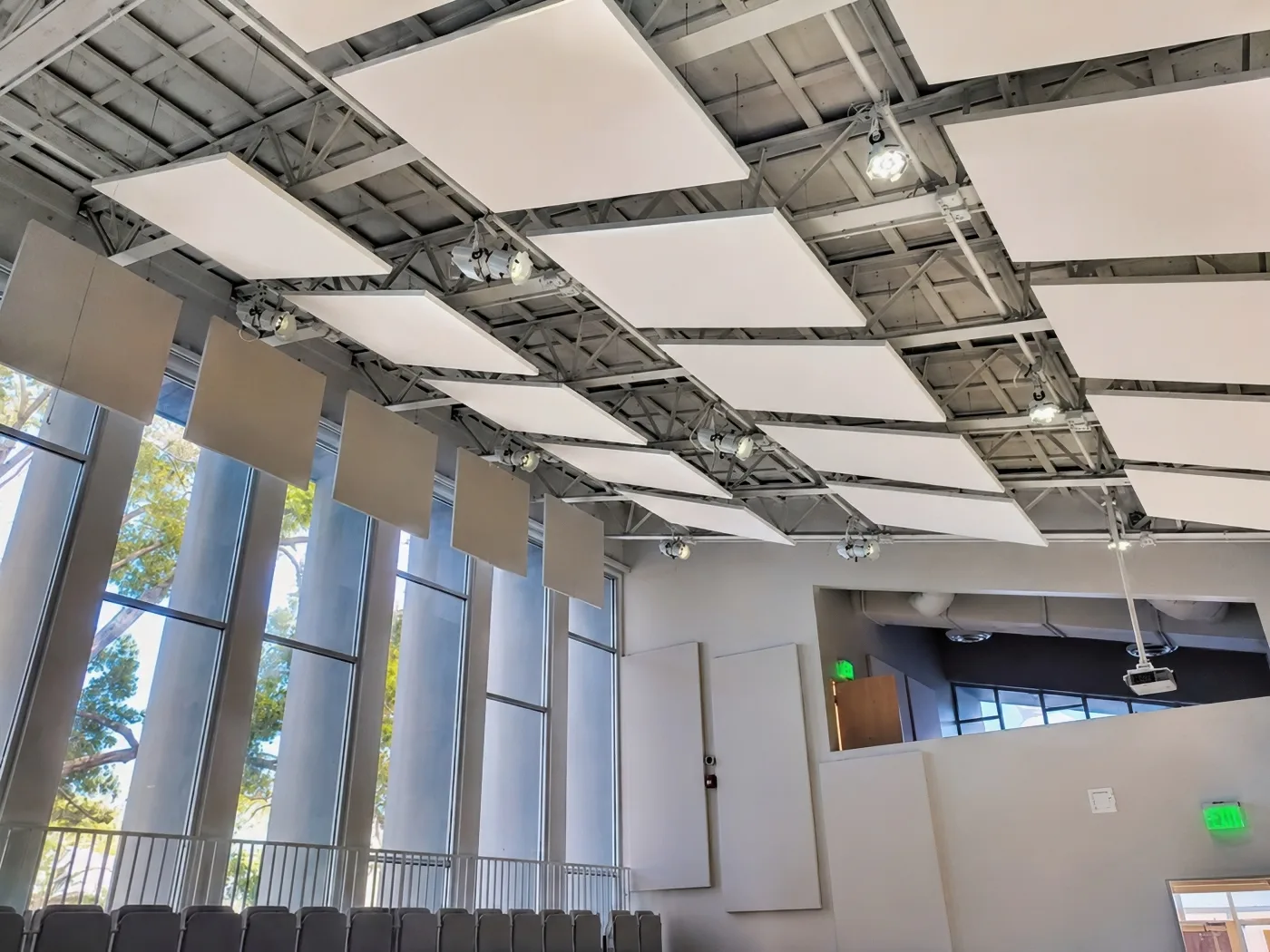
The ceiling is the largest single reflective surface in most theaters and the one absorption tool that does not compete for floor or wall space. Baffles hang vertically and absorb energy on both faces, which is the right move when ceiling height is generous and the architect wants the visible suspension to read as a design element. Clouds run horizontal and float above the audience zone, which is the right move when the room needs to drop reverberation in the seating area specifically.
The St. Paul’s ceiling treatment combined both. Baffles handled the deeper-zone absorption above the stage end of the room; clouds handled the audience-zone reflections that would otherwise hit the back wall and return as smear. The full deeper read on this category of ceiling treatment lives in our specialty ceilings: baffles and clouds guide. The product line itself is the fabric-wrapped acoustic ceiling baffles family.
Theater Acoustic Design Decisions: Slope, Sightlines, Shadow Zones
- Floor Slope: Sloped to maintain audience line-of-sight to the stage
- Row Stagger: Staggered seats need less slope; in-line seats need more
- Shadow Zones: Seats outside the vocal direction lose intelligibility
- Modeling: Ray diagrams trace direct and reflected paths from the stage
The acoustic problem in a theater is half geometry. A flat floor with in-line rows hides the stage behind the heads in front of you and breaks the direct-sound path the performance depends on. Sloping the floor restores the line-of-sight; staggering the rows lets you slope it less. Either way, the goal is the same: every seat in the house gets the direct sound from the stage before any reflected sound reaches it.
“Shadow” zones are the seats that fall outside the natural vocal projection direction of a performer facing forward. A speaker projecting toward the center of the room leaves the deep side aisles in a comparative shadow — same dBA, much worse intelligibility because the high-frequency energy has fallen off. Ray diagrams expose those zones in design review, and the panel and cloud layout can compensate by placing absorption on the surfaces that would otherwise smear the reflected energy into those seats.
Other Theater Acoustics Projects in Florida
- Historic Public Theater: Tampa Theatre stretched-fabric wall, fiberglass core
- Public High School: Eastside High auditorium, full panel package
- Renovation: Chapin Theater, wall panel retrofit
- Performing Arts Center: Largo Central Park, full acoustic enhancement
Florida has been a productive testing ground for theater acoustics work because the climate, the school construction cycle, and the cultural-venue density all push these spaces through renovation more often than other markets. The catalog covers a working spread: a historic downtown theater (Tampa Theatre acoustic renovation), a public high school auditorium (Eastside High auditorium acoustics), and a community theater renovation (Chapin Theater renovation project).
Different room sizes, different programs, same playbook: model the RT60, pick the panel and ceiling treatment combination that hits the target window, hold the NRC spec through fabric selection. The St. Paul’s package sat in the same playbook with a custom-fabrication twist — oversized panels driven by an architect’s design language that did not work at standard sizes.
Conclusion: Theater Acoustics for School Performance Design
The St. Paul’s School performance theater package paired full ceiling treatment (baffles plus clouds) with oversized 4’×10′ wood-framed wall panels wrapped in Guilford of Maine fabric — 32 custom pieces total, manufactured and delivered in a four-week window. The result is a room that holds RT60 inside the mixed-use school theater band where speech stays intelligible and music keeps its natural decay. The deeper acoustic story for any theater is geometry first (floor slope, sightlines, shadow zones), surface treatment second, and getting both right is what separates a working performance space from one that fights the people in it.
FAQs: Theater Acoustics and School Performance Design
What RT60 should a school performance theater target?
Mixed-use school theaters typically target 1.0 to 1.4 seconds RT60. Speech-first programs (drama, lectures) prefer the lower end at 0.8 to 1.2 seconds. Music-first programs (band, choir) prefer the higher end at 1.2 to 1.6 seconds. Most school spaces host both, so the middle of the 1.0 to 1.4 second window is the working compromise.
What is the difference between speech and music acoustic targets?
Speech needs tighter reverberation so consonants do not smear together — too much decay and the audience cannot follow the words. Music needs more reverberation so notes have natural decay and the room feels alive. The gap is roughly 0.4 seconds between the two windows, which is why a single space serving both programs always carries some compromise.
When do you need ceiling baffles versus wall panels in a theater?
The ceiling is usually the largest single reflective surface in a theater, so baffles or clouds get the most absorption per square foot of treatment. Wall panels handle reflections that ceiling treatment cannot reach — typically the back wall and side walls in the rear seating area. Most theater packages combine both. The St. Paul’s project used 32 custom pieces across both surfaces.
Can acoustic panels be custom-manufactured oversized?
Yes. Standard acoustic panel sizes are 2’x4′ and 4’x8′. Custom sizes up to 4’x10′ (and larger with engineering review) are available when an architect’s design language requires a panel rhythm that does not work at standard sizes. Wood framing handles the tolerances; the NRC spec is held by fabric selection and core material rather than dimension.

Walker Peek|Founder & CEO, Commercial Acoustics
Walker founded Commercial Acoustics in 2013 to bring aerospace-grade engineering discipline to soundproofing, and runs the firm as CEO from its 12,000 sq ft Tampa production facility. The company designs custom acoustic panels, sound membranes, and masking systems for multi-family, hospitality, healthcare, and commercial projects across the US — built around Walker’s invention, Wall Blokker, an EVA-based sound barrier that hits STC 50-plus at roughly $1 per square foot installed.
A Jacksonville native, Walker spent five years at Kennedy Space Center with Craig Technologies before founding Commercial Acoustics — certifying aerospace manufacturing to the AS9100 standard and leading Six Sigma Black Belt process-improvement teams on NASA programs. He is a certified Industrial Noise Control Engineer and the author of Architectural Acoustics: A Practical Handbook.
