Table of Contents
Project Overview: Home Music and Recording Studio Soundproofing
- Project: Home Music and Recording Studio Soundproofing in a Garage Conversion
- Location: Tampa Bay Area, FL
- Facility Type: Two-Car Garage Converted to Recording Room and Control Room
- Client: Working Band, In-Home Studio Build
- Existing Construction: Older Garage Frame, Concrete Slab, No Acoustic Treatment
- Acoustic Target: STC 65 Walls and 0.3-Second RT60 in Recording Room
- Scope: Floating Floor, Wall Blokker Pro, Foam Absorption, RWAR Control Room
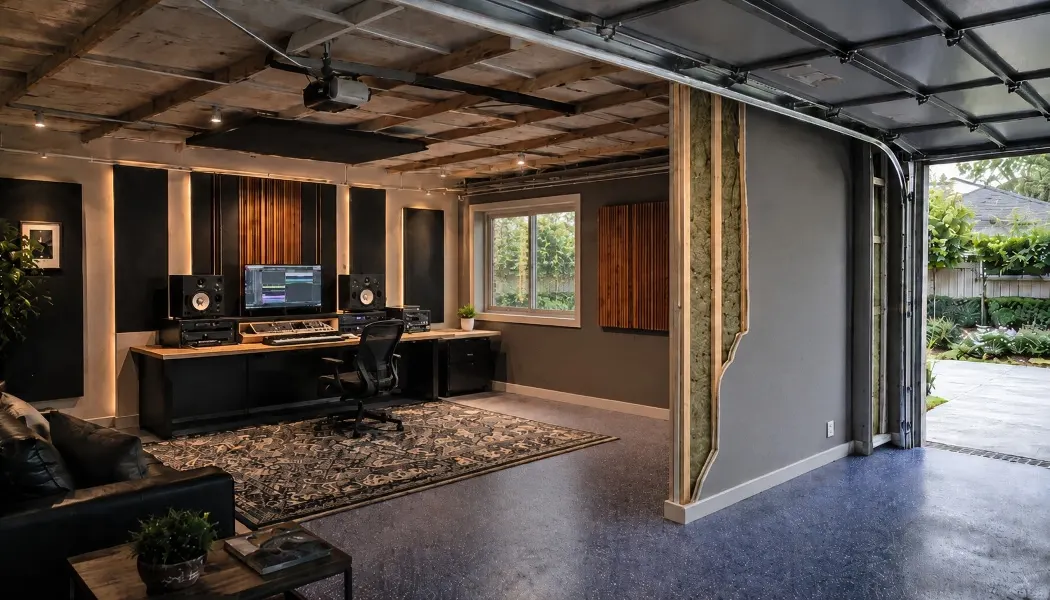
This was a working band’s in-home studio built into a two-car garage on a mid-sized budget. Wall Blokker Pro between studs and plywood hit STC 65 for sound blocking, a floating-floor assembly broke the structure-borne path to the slab, and 4-inch foam panels drove the recording room to RT60 0.3 seconds. Total build came in around $5,500.
The Two-Car Garage Studio Build
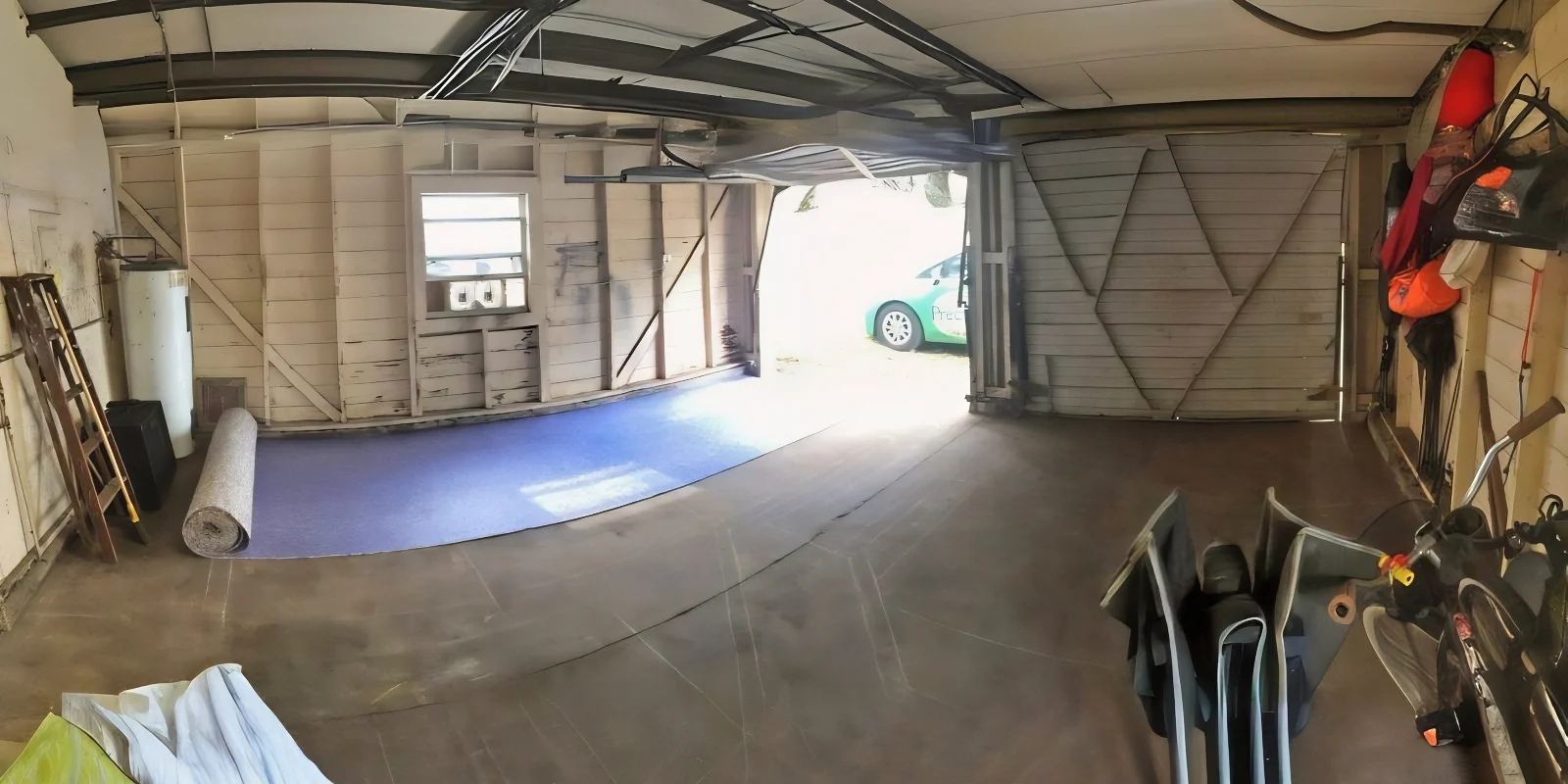
A working band came to Commercial Acoustics in April 2016 to design an in-home studio with proper sound blocking and recording-grade absorption on a mid-sized budget. The space they had was a two-car garage just off the main house, an older structure with planks in good condition and a concrete slab as the only original floor.
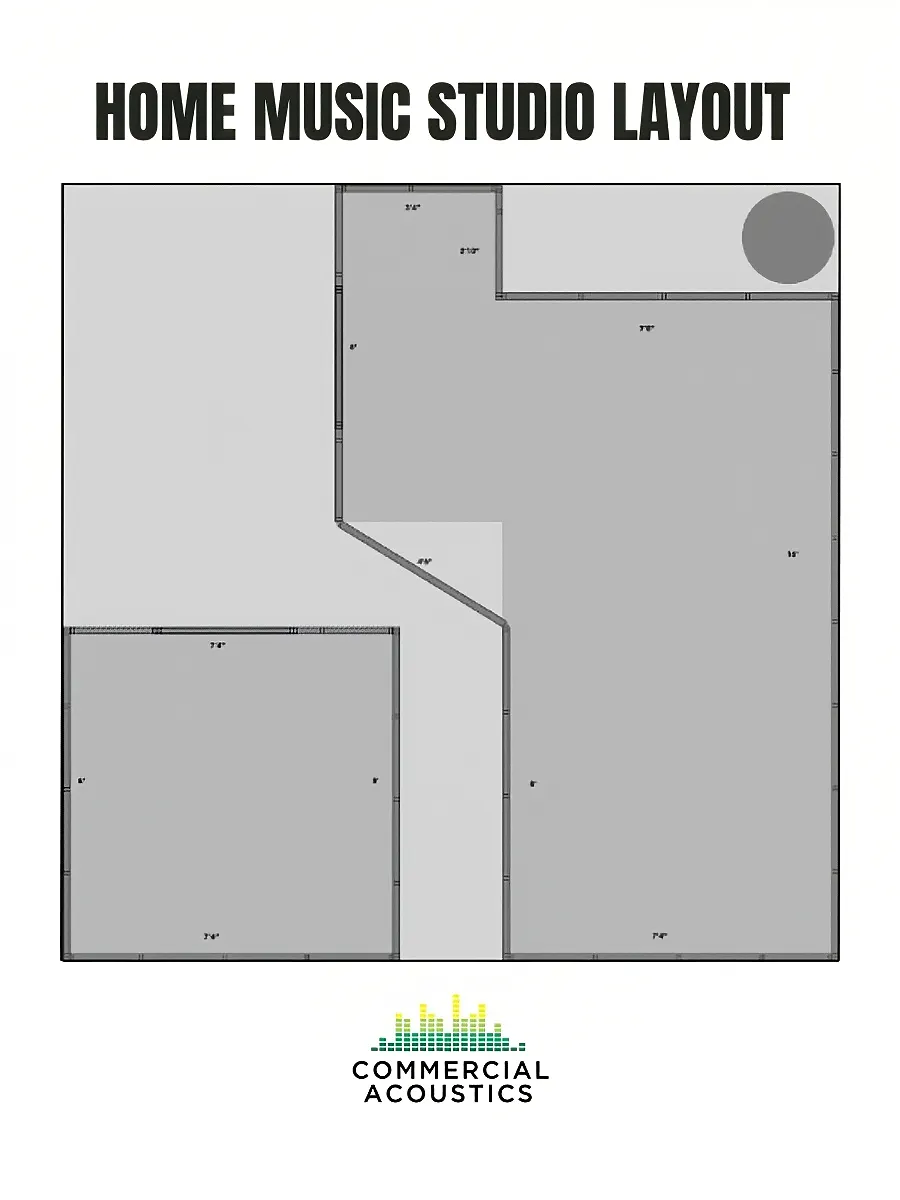
The design split the garage into two rooms. A larger recording room for daytime tracking when noise ordinances run looser, and a smaller control room reinforced to handle high-amplitude mixing and editing at any hour. The control room was placed entirely inside the garage shell, which set up a room-within-a-room (RWAR) condition that cut sound transmission to the surrounding neighborhood.
Why Home Music Studios Demand Studio-Grade STC
- Working SPL: Drums and guitar amps run 100 to 115 dB at the source
- Neighbor Threshold: Most residential noise ordinances target 45 to 55 dB at the property line
- STC Math: 50-plus dB of attenuation required for late-night usability
- Practical Target: STC 60 to 65 for working home studios
Home music studios are the highest STC requirement most residential builders ever encounter. A drum kit at full volume puts roughly 60 dB more energy into the wall than a normal conversation, and that energy has to drop below 50 dB at the property line to avoid noise complaints. The STC calculator walks the math for any room volume and target threshold.
STC 65 is the working target for music studios in residential settings. It is the difference between a band that can rehearse at any hour and a band that quits playing at 9 PM because the neighbors started calling. The same math applies to home recording studios, home music rooms, and home practice spaces.
Wall Blokker Pro: Building Toward STC 65
- Frame: Studs spaced ~23.5 inches OC to seat 24-inch foam panels
- Membrane: Wall Blokker Pro between studs and plywood finish
- Finish Surface: Plywood selected over drywall for cost control
- Result: STC ~65 across the control room shell
Wall Blokker Pro went between the studs and the plywood finish on the control room shell, the layer that took the assembly from code-minimum framing to studio-grade STC 65. The room-within-a-room geometry let the team apply the membrane to the inner control room exterior only, keeping cost down without sacrificing acoustic performance.
Plywood instead of drywall was a budget decision. Heavy drywall would have added another point or two of STC for the same labor, but in this RWAR arrangement the outer garage shell was already doing serious blocking work. Plywood reads the right rough-edged aesthetic for a working music studio and finished the assembly at the target STC.
Floor and Ceiling Spec: Garage to Studio
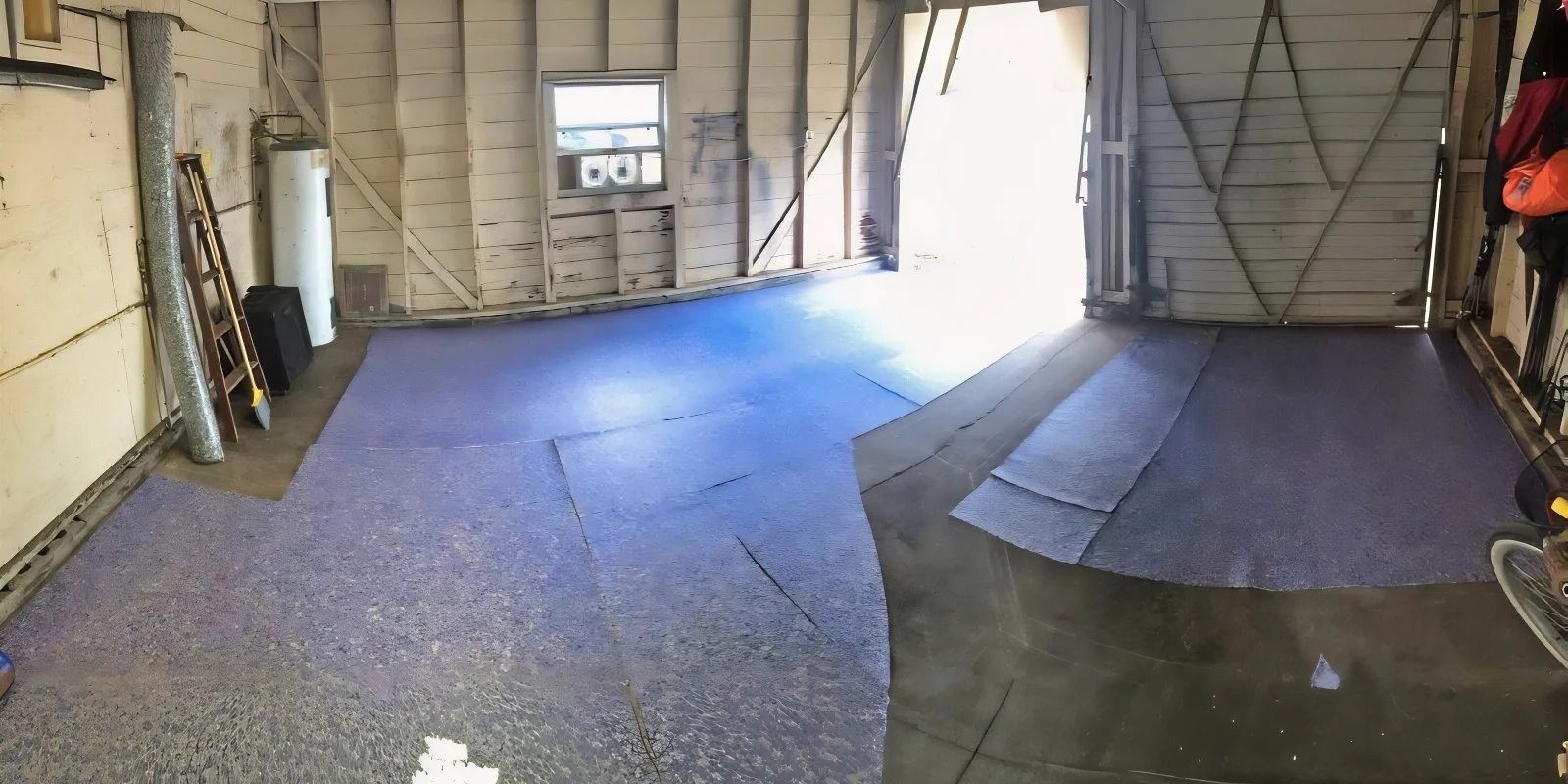
- Floor Decoupling: Carpet cushioning rolled directly over the concrete slab
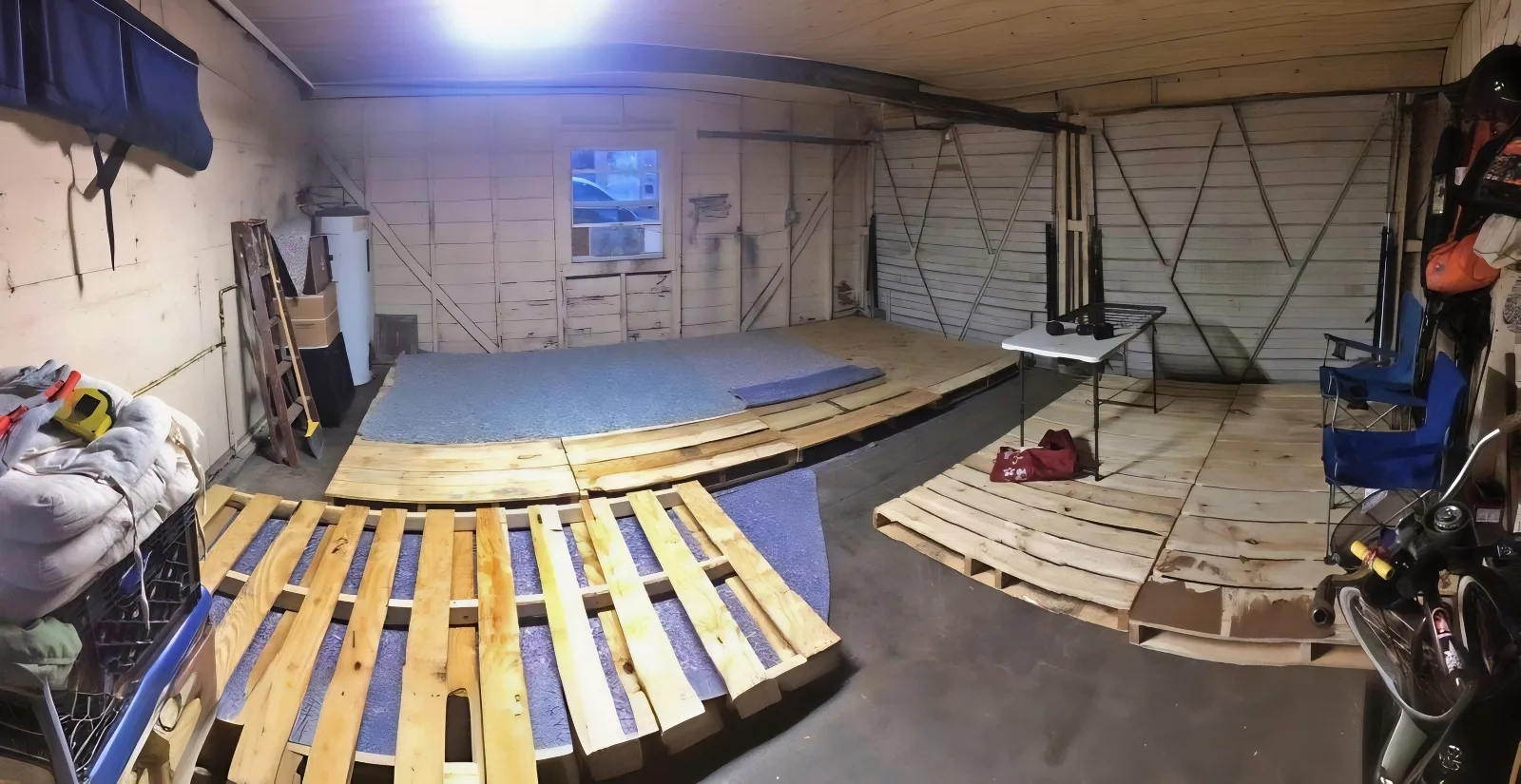
- Floating Floor: 4×8 shipping pallets topped with carpet padding and plywood
- Ceiling Path: Foam panels installed against existing structure
- Foundation Note: Garage on separate foundation from main house, reducing structure-borne path
The floor work was the simplest layer to get wrong. Concrete slabs transmit drum-kick and bass-amp energy directly into the surrounding structure, and a studio built on a bare slab usually fails the late-night neighbor test no matter how good the walls read. Carpet cushioning rolled over the slab broke the first contact path.
4×8 shipping pallets topped with carpet padding and plywood created the floating floor that the studio actually sat on. The pallets put an air gap and a layer of compressible material between the studio floor and the slab below, which is the budget version of a proper floating floor stack. The garage being on its own foundation, separated from the main house, removed the worst structure-borne path before the build started.
Foam Absorption: Driving RT60 to 0.3 Seconds
- Product: 4-inch thick, 24-inch wide foam panels
- Coverage: Between studs on walls, across ceiling, thick carpet on floor
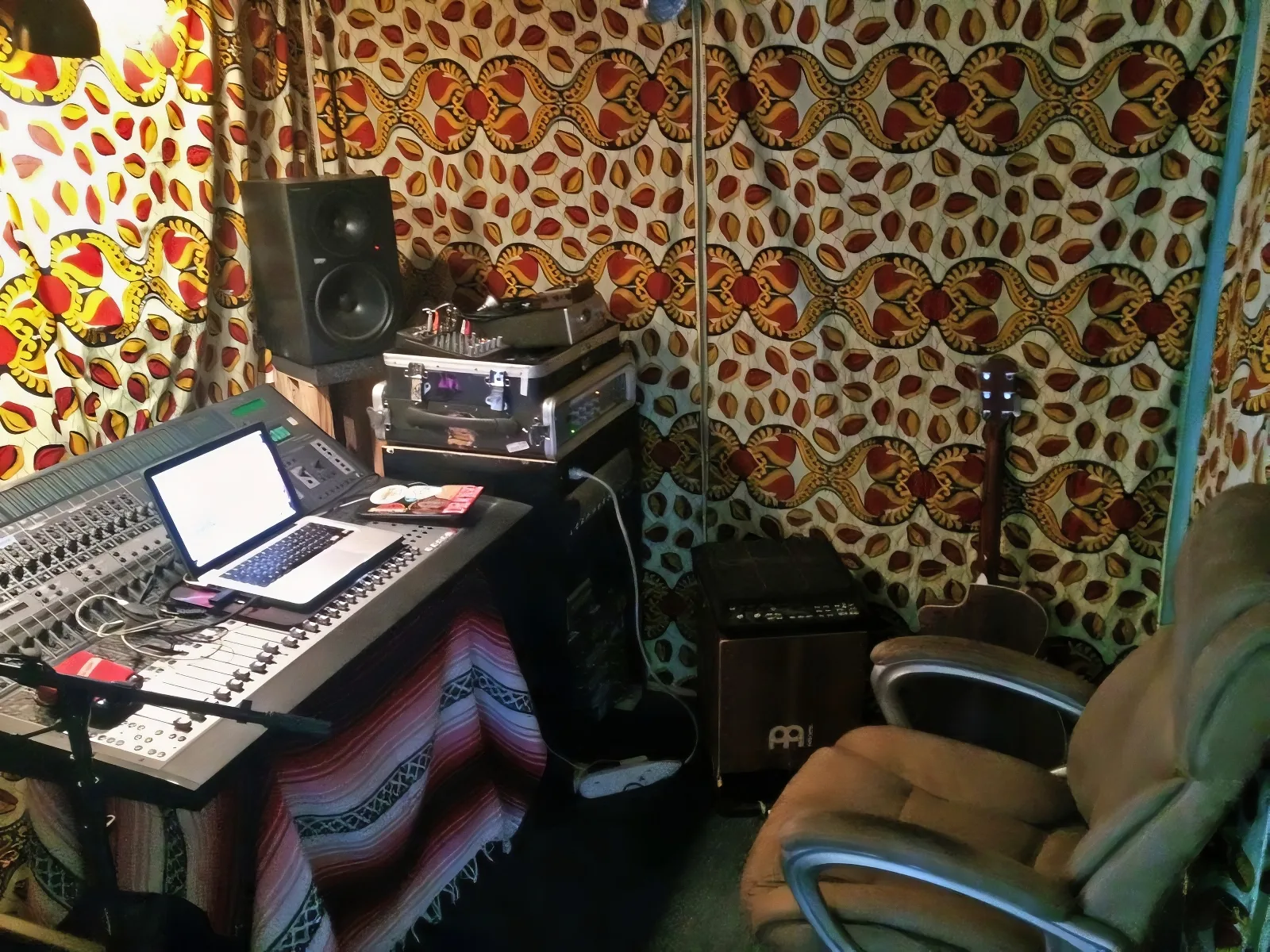
- Fabric Finish: African wax print fabric over the foam for visual integration
- Result: RT60 ~0.3 seconds in the recording room, near “dead space”
The foam panels were sized at 4 inches thick to handle the speech and mid-frequency band that drives recording-room intelligibility. 24-inch panel width was the reason for the 23.5-inch stud spacing decision earlier in the framing stage. Coverage ran between every stud, across the ceiling plane, and thick carpet absorbed the floor reflections that foam cannot reach.
African wax print fabric finished the visible foam surface. The fabric had to be acoustically transparent so sound could pass through to the foam for absorption, and the band wanted a finish that read like a working studio rather than a soft white panel. RT60 came in around 0.3 seconds, which qualifies as a near-dead space and the right environment for clean recording takes. The music room soundproofing reference walks the same calculation.
Cost and Buildout: What This Studio Took
- Total Cost: Approximately $5,500 across all materials and labor
- Foam Panels: Largest single line item in the budget
- Wood Framing and Membrane: Second-largest budget line
- Sound-Blocking Install: One full day, two installers
The build came in at roughly $5,500 with the client doing most of the framing himself. Home music studios range anywhere from $2,000 for the lightest treatment to six figures for proper purpose-built tracking rooms, and the mid-thousands range is where most working musicians land if they want real STC blocking and recording-grade absorption together.
The framing and flooring took several days for the client to handle directly. The acoustic membrane and foam install took one full day with two installers. The path to STC 50 reference covers the lower-cost variant if budget is the constraint, while this build documents the STC 65 endpoint.
Conclusion: Home Music and Recording Studio Soundproofing
The garage-to-studio build shows what STC 65 and RT60 0.3 seconds actually look like in a real residential space on a real budget. Wall Blokker Pro for the blocking, floating floor for the structure-borne path, foam absorption for the recording room reverb. The same playbook scales to any home music studio, recording studio, or music room build. Meet the engineers who walked this project.
FAQs: Home Music and Recording Studio Soundproofing
What STC do you need for a home music studio?
Most home music studios target STC 60 to 65 on exterior walls so that band-volume content does not bleed to neighbors at any hour. Lower STC values work for quiet practice rooms, but full-band recording typically needs the STC 60-plus range.
How much does soundproofing a home recording studio cost?
A working band budget for a garage-scale home recording studio lands in the $4,000 to $8,000 range when the client handles the framing. Custom built-in-place studios with separate foundations and floating floors run significantly higher.
Can you soundproof a music studio in a garage?
Yes, and a detached garage is one of the better starting points because the structure already sits on a separate foundation from the main house. The garage shell becomes the outer room in a room-within-a-room build, which is the standard music studio design pattern.
What RT60 should a recording room target?
Most recording rooms target RT60 in the 0.2 to 0.4 second range. Below 0.2 seconds the room reads acoustically dead and recordings come out lifeless. Above 0.5 seconds the room adds its own coloration to the take. 0.3 seconds is a common working number.

Walker Peek|Founder & CEO, Commercial Acoustics
Walker founded Commercial Acoustics in 2013 to bring aerospace-grade engineering discipline to soundproofing, and runs the firm as CEO from its 12,000 sq ft Tampa production facility. The company designs custom acoustic panels, sound membranes, and masking systems for multi-family, hospitality, healthcare, and commercial projects across the US — built around Walker’s invention, Wall Blokker, an EVA-based sound barrier that hits STC 50-plus at roughly $1 per square foot installed.
A Jacksonville native, Walker spent five years at Kennedy Space Center with Craig Technologies before founding Commercial Acoustics — certifying aerospace manufacturing to the AS9100 standard and leading Six Sigma Black Belt process-improvement teams on NASA programs. He is a certified Industrial Noise Control Engineer and the author of Architectural Acoustics: A Practical Handbook.
