
Table of Contents
Project Overview: Media Room Drywall Soundproofing
- Project: Custom-Home Media Room Drywall Soundproofing
- Location: Westshore Blvd, Tampa, FL 33611
- Facility Type: Custom Luxury Home, Dedicated Media Room
- Client: Custom Home Build, Private Owner
- Existing Construction: 2×4 Studs at 16 inch OC with 1/2 inch Drywall, STC 32
- Objective: Hit STC 41 on Media Room Demising Walls
- Scope: Wall Blokker Pro Membrane Layer Behind Drywall, Three Sensitive Rooms
This project ran during the framing-to-drywall stage of a Westshore custom home build, which is the right moment to add a soundproofing membrane to a media room wall. Retrofitting acoustic membrane after the finish drywall is already up costs roughly four times as much for the same STC lift.
The Westshore Custom Home and the Media Room Build
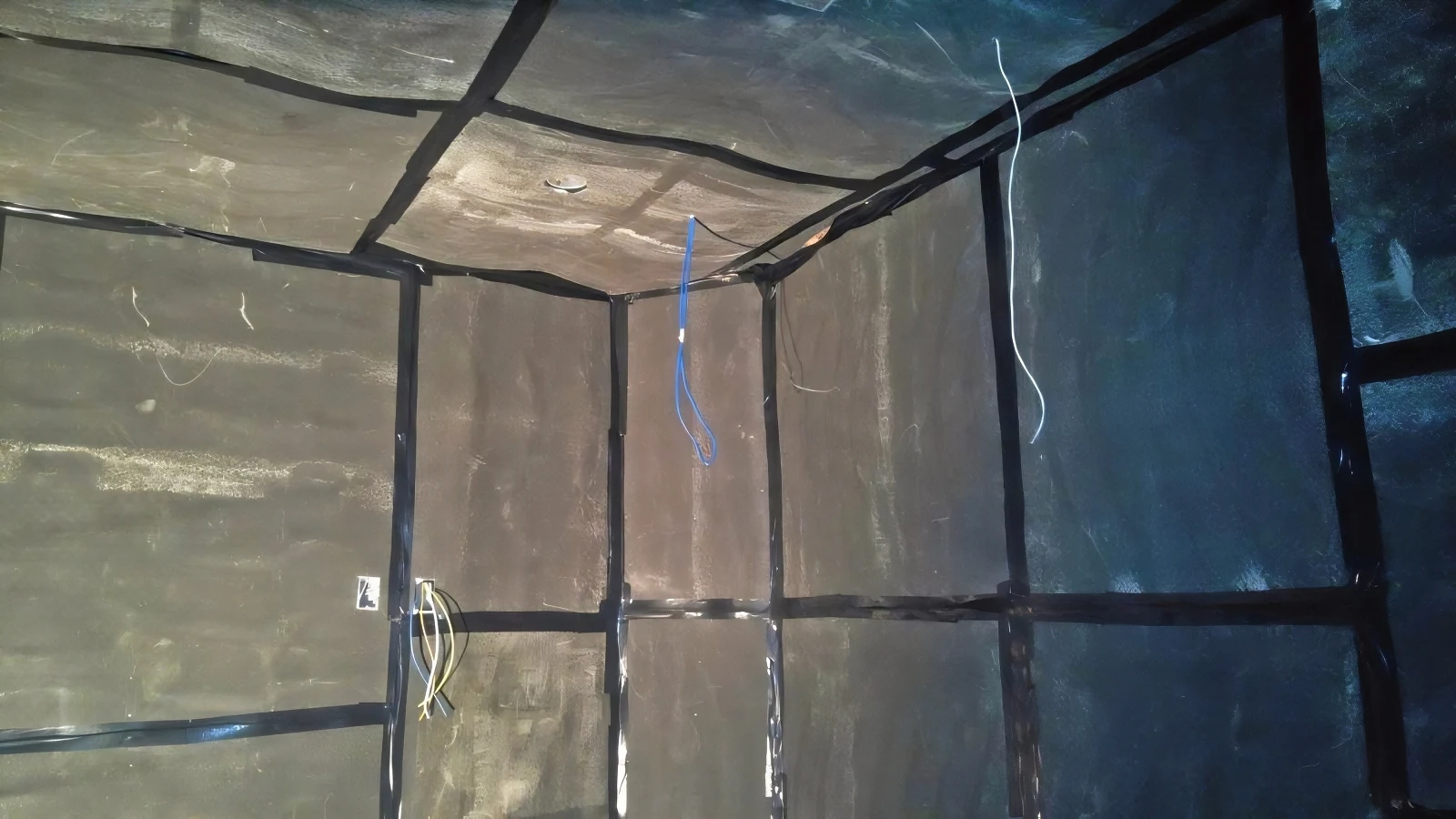
The custom home sat on Westshore Boulevard in Tampa, a 2024 build with the standard high-end residential frame: 2×4 studs at 16 inches on center, half-inch drywall on each side, and no acoustic treatment in the wall cavity. The plan called for a dedicated media room with a 7.1 system and the kind of low-end content that travels through standard drywall like an open door.
The owner flagged the noise transfer concern before framing closed. That timing turned a 1,200-dollar membrane line item into the difference between a usable home theater and a series of family arguments after every late-night viewing.
Why Standard 2×4 + Drywall Hits Only STC 32
- Stud Spacing: 16 inch OC creates standing wave coupling between cavities
- Cavity Insulation: Standard fiberglass adds maybe 3 points of STC
- Drywall Mass: 1/2 inch gypsum gives ~2.5 lb per sq ft per side
- Result: Lab STC 32, field STC often lower
STC 32 is what you get when a builder follows residential code without thinking acoustically. It is enough to keep conversational speech from bleeding between rooms at normal volume, and not nearly enough to block media-room content or a late-night action movie. The STC calculator walks the math for any wall assembly.
The 9-point lift to STC 41 puts the wall into loud-speech-inaudible territory and cuts most of the speech-band content the family would otherwise hear through the demising wall. It does not handle full-band low-frequency bass content, which is its own conversation involving structural isolation.
Wall Blokker Pro Behind the Drywall: 9-Point STC Lift
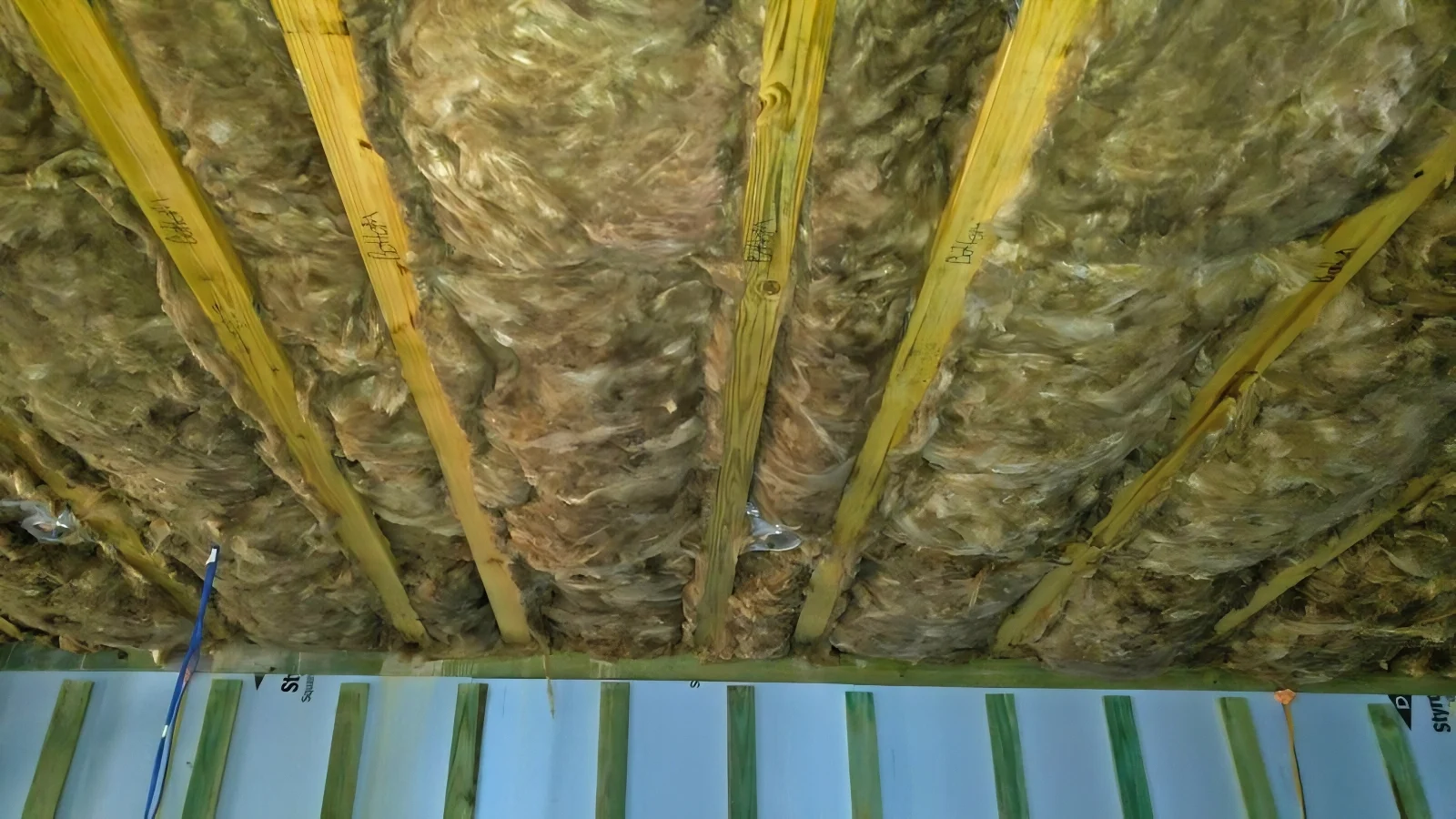
- Product: Wall Blokker Pro mass-loaded membrane
- Mass: 1 lb per sq ft, decoupled from the stud
- Lab Performance: 9-point STC gain over the baseline
- Layer Position: Behind the finish drywall, against the stud face
Wall Blokker Pro sits between the stud face and the finish drywall, adding decoupled mass to a wall assembly that otherwise resonates as a single coupled system. Mass at the right position in the wall is what blocks airborne sound, and right means decoupled from the stud, not stapled to it.
Nine points of STC lift is real money in a custom home build. A separate Clearwater home theater build covers what happens after the wall is built, on the acoustic finish side rather than the construction side.
Wall Assembly Spec: Frame + Membrane + Drywall
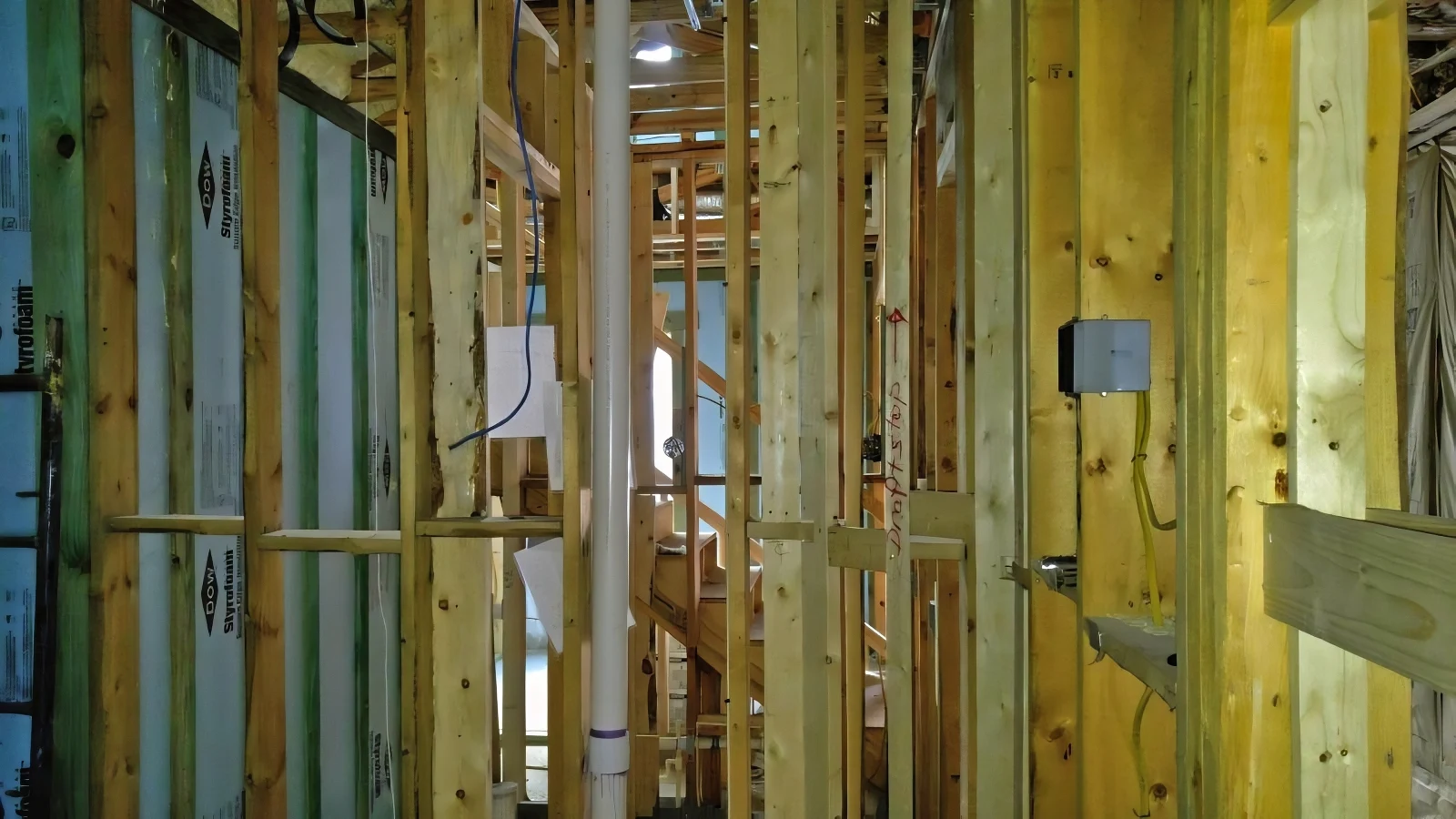
- Frame: 2×4 studs at 16 inch OC, no spacing changes
- Insulation: R-13 fiberglass batts in the cavity
- Membrane Layer: Wall Blokker Pro behind the finish drywall
- Finish: 1/2 inch drywall, standard mud and tape
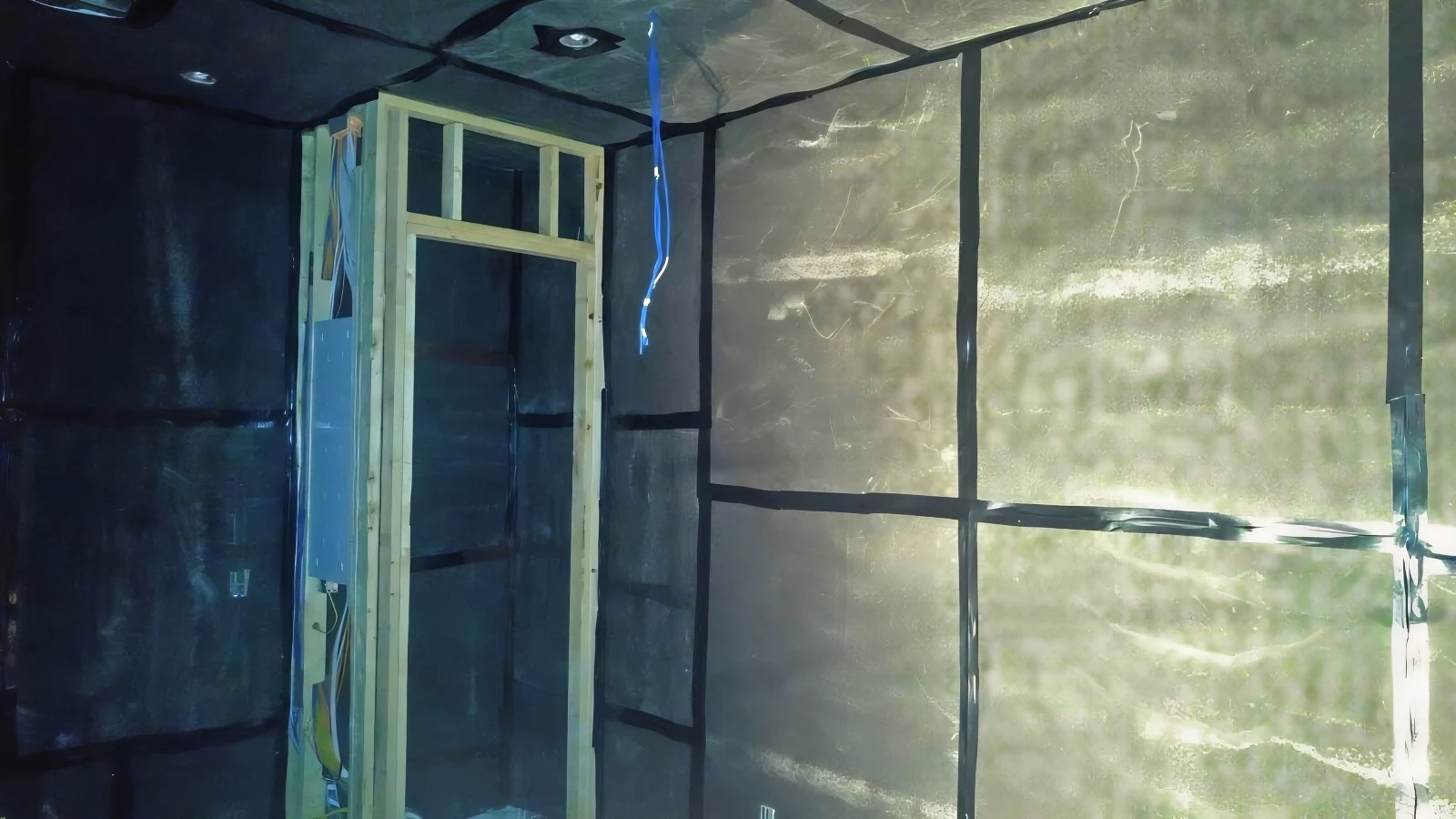
The assembly kept everything the framing crew was already doing and added one new step. Wall Blokker Pro hung against the stud face with cap-head fasteners, then the drywall installer worked over it as usual. No framing changes, no decoupling clips, no resilient channel — the membrane carries the acoustic lift on its own.
That matters in a custom home where the GC is already managing a dozen subs and will not tolerate a wall assembly that demands a separate acoustic crew. Wall Blokker Pro reads as a building-paper layer to the drywall installer and gets installed without negotiation.
Install Sequence: Drywall Layer Last
- Step 1: Frame, electrical, and low-voltage rough-in
- Step 2: Insulation in the wall cavity
- Step 3: Wall Blokker Pro hung against the stud face
- Step 4: Finish drywall over the membrane
The membrane layer slots between insulation and drywall in the standard residential sequence. No trade has to wait, no work gets done twice. The same acoustic membrane went up in the home office and master bedroom for consistency across the three sensitive rooms.
The total acoustic work added roughly four hours of labor across the three rooms. Materials ran a few hundred dollars per room plus the labor add. The same STC lift retrofitted after finish drywall would have run the demolition-and-rebuild route, which is a thousand-dollar-per-room number rather than a hundred.
What STC 41 Means for the Resident
- Conversational Speech: Inaudible through the demising wall
- Loud Speech and Music: Faintly audible, not intelligible
- TV Content (Mid-Range): Greatly attenuated through the wall
- Low-Frequency Bass: Still audible, requires further structural isolation
STC 41 catches most of what a typical custom-home resident actually wants quieted: the spouse’s late-night news anchor, the kid’s online gaming voice chat, the music from the home office. The STC rating chart shows what each value blocks across speech and music content.
For most custom-home media rooms, STC 41 is the right target. Going to STC 50 starts to require structural isolation, decoupled studs, isolation clips, and double drywall, which roughly triples the wall cost. The path to STC 50 is documented separately for owners who want the full ride.
Conclusion: Media Room Drywall Soundproofing
The Westshore media room is the case for adding a membrane layer during framing, before finish drywall closes the wall. Nine points of STC lift on a standard 2×4 assembly, installed without changing the trade sequence, cost less than a single piece of high-end home theater equipment. Start a conversation about your project before drywall goes up.
FAQs: Media Room Drywall Soundproofing
What STC do I need for a custom-home media room wall?
Most custom-home media rooms hit a good user experience at STC 41 on the demising walls. That blocks speech and most mid-range content. For full theater-grade isolation including bass, the target moves to STC 50 with decoupled framing.
Can you add soundproofing membrane to existing drywall, or only during framing?
Both work, but cost and result differ. During-framing membrane install adds one labor step and runs a few hundred dollars per room. Retrofit after finish drywall requires removing the existing drywall first, which roughly quadruples the project cost.
Does Wall Blokker Pro work with 1/2-inch drywall or do I need 5/8-inch?
Standard 1/2-inch finish drywall is fine for STC 41. Upgrading to 5/8-inch Type X over the membrane pushes the assembly closer to STC 45 with no other changes. Most residential GCs already stock 5/8-inch as a code-compliant fire option.
Do I need to soundproof the ceiling and floor too, or just the walls?
Walls are the priority for speech and mid-range content. Ceiling assemblies matter when there is a room above or below the media space and use different products. Floor isolation handles bass and impact noise and runs as a separate project.

Walker Peek|Founder & CEO, Commercial Acoustics
Walker founded Commercial Acoustics in 2013 to bring aerospace-grade engineering discipline to soundproofing, and runs the firm as CEO from its 12,000 sq ft Tampa production facility. The company designs custom acoustic panels, sound membranes, and masking systems for multi-family, hospitality, healthcare, and commercial projects across the US — built around Walker’s invention, Wall Blokker, an EVA-based sound barrier that hits STC 50-plus at roughly $1 per square foot installed.
A Jacksonville native, Walker spent five years at Kennedy Space Center with Craig Technologies before founding Commercial Acoustics — certifying aerospace manufacturing to the AS9100 standard and leading Six Sigma Black Belt process-improvement teams on NASA programs. He is a certified Industrial Noise Control Engineer and the author of Architectural Acoustics: A Practical Handbook.
