
Table of Contents
Project Overview: Office Floor Vibration Assessment
- Project: Office Floor Vibration Field Assessment per ISO 10137
- Client: Commercial property management firm (Providence One)
- Location: Lake Mary, FL (multi-story commercial office)
- Floor System: 3″ concrete on 3-1/4″ corrugated deck, W21x44 beams at 10 ft
- Standard: ISO 10137 serviceability of buildings against vibrations
- Result: Class 3 perceptible, one magnitude below ISO action limit
The Providence One building in Lake Mary was getting acoustic complaints that were not actually acoustic. Occupants on a specific floor reported persistent low-frequency vibration in the slab. One employee was taking motion sickness medication just to make it through the workday. A structural engineer had already cleared the building for safety. The question was whether the floor met serviceability standards for human comfort, not whether it would fall down.
The property manager retained Commercial Acoustics to run a field vibration assessment under ISO 10137, the international standard for floor vibration serviceability. The scope was straightforward: measure what the occupants were actually feeling, place the result on the ISO scale, and recommend a tiered mitigation path that fit the constraints of an occupied tenant space.
Why Office Floor Vibration Is Different from Acoustic Noise
Most office acoustic complaints map to airborne noise, reverberation, or speech privacy. Floor vibration sits in a different physical regime. The energy travels through the structure as low-frequency motion in the 4 to 8 Hz band, not as airborne sound waves. Occupants feel it in the soles of their feet, in their chairs, and on their desks, not in their ears.
The standard tools for acoustic work do not apply. An STC rating measures sound transmission, not slab oscillation. A sound level meter does not capture vertical acceleration. Floor vibration requires accelerometers, a data acquisition unit, and a different reference standard altogether.
That mismatch is why footfall vibration complaints often bounce around for months before anyone correctly diagnoses them. The HVAC contractor checks the equipment. The structural engineer checks the load. The acoustic consultant runs an RT60 test. None of those find the problem because the problem is not in any of those disciplines.
Field Test Setup: Instrumentation and Method
- DAQ: Crystal Instruments Spider 20 data acquisition unit
- Sensors: Four PCB Piezotronics single-axis accelerometers (393B04)
- Axis: Vertical acceleration in m/s², the axis ISO 10137 weights for human response
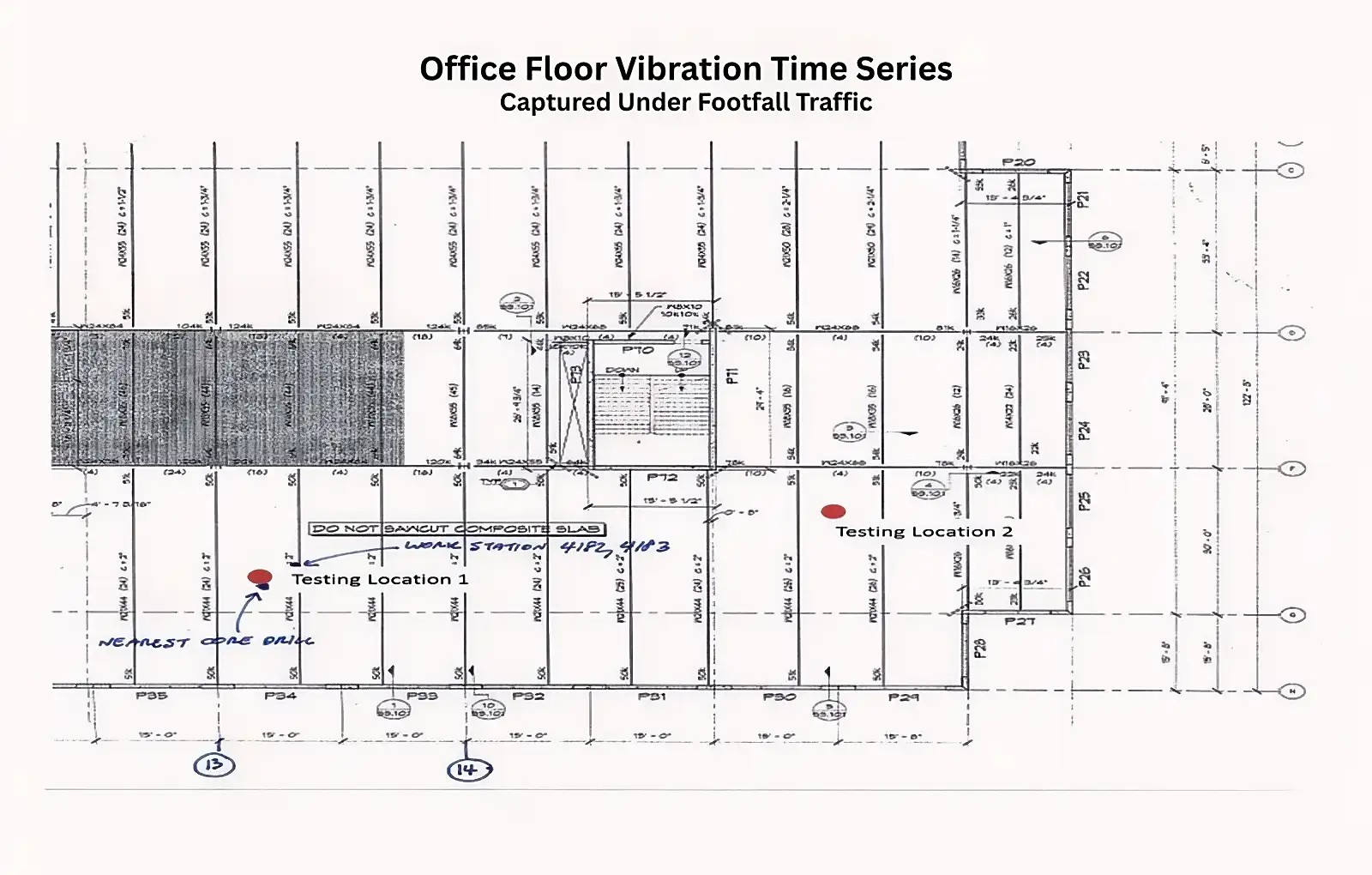
- Locations: Workstation 4183 at mid-span between beams (worst case), plus a comparison point near the central core
- Capture: Continuous recording across peak-traffic and quiet windows
Mid-span on a steel-deck composite floor is where the deflection peaks. Putting an accelerometer there captures the worst case the occupants are feeling. Putting a second sensor near the central core (over the columns) gives a low-vibration baseline for comparison. The delta between the two tells the engineer whether the issue is the floor system as a whole or a localized condition.
Findings: Class 3 Perceptible Under ISO 10137
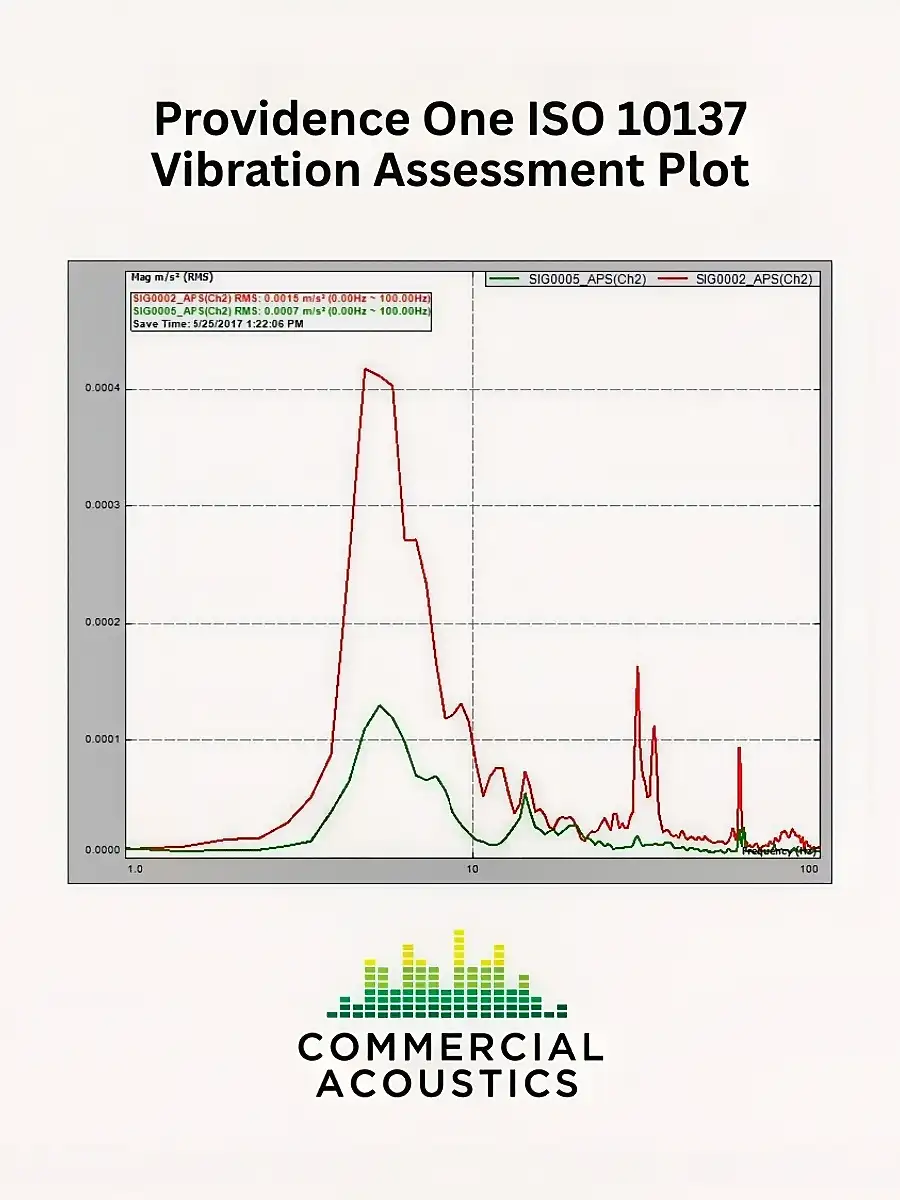
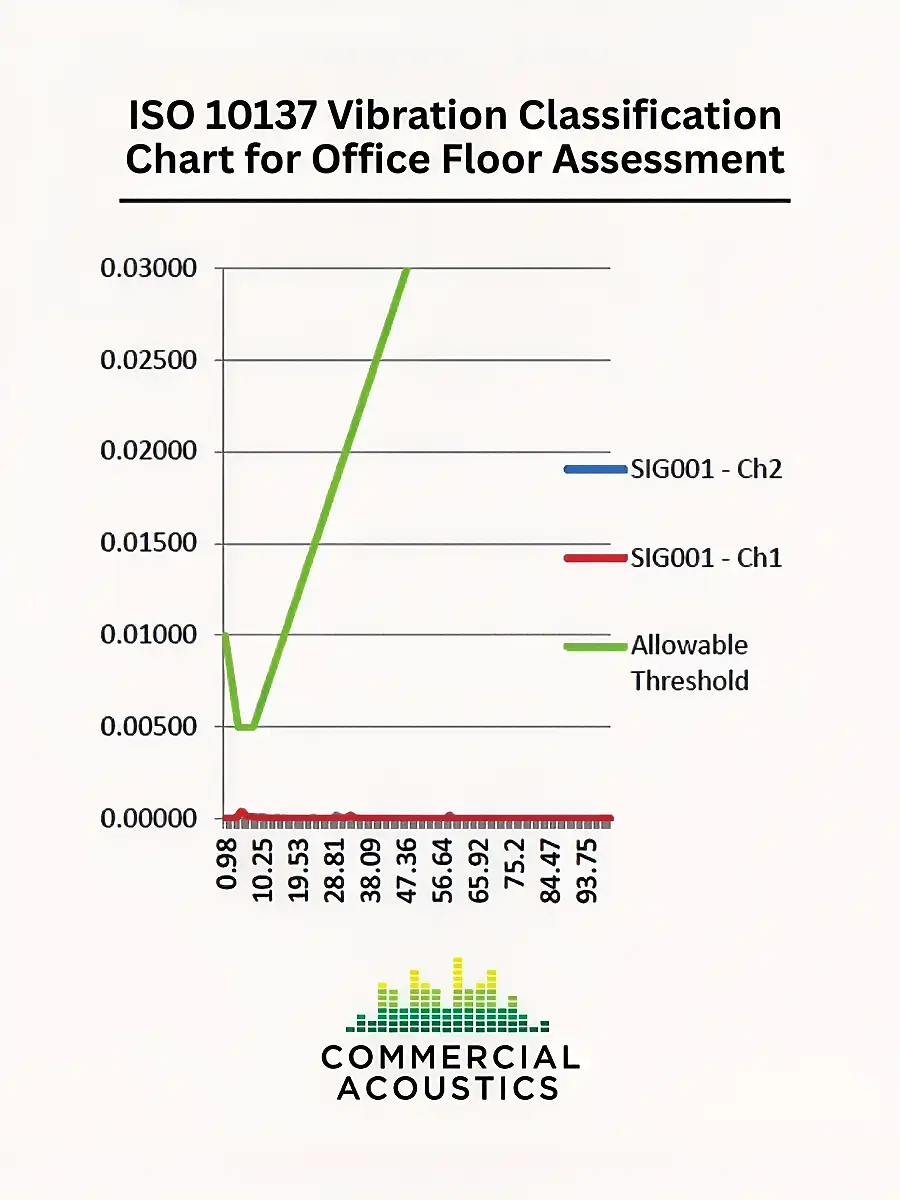
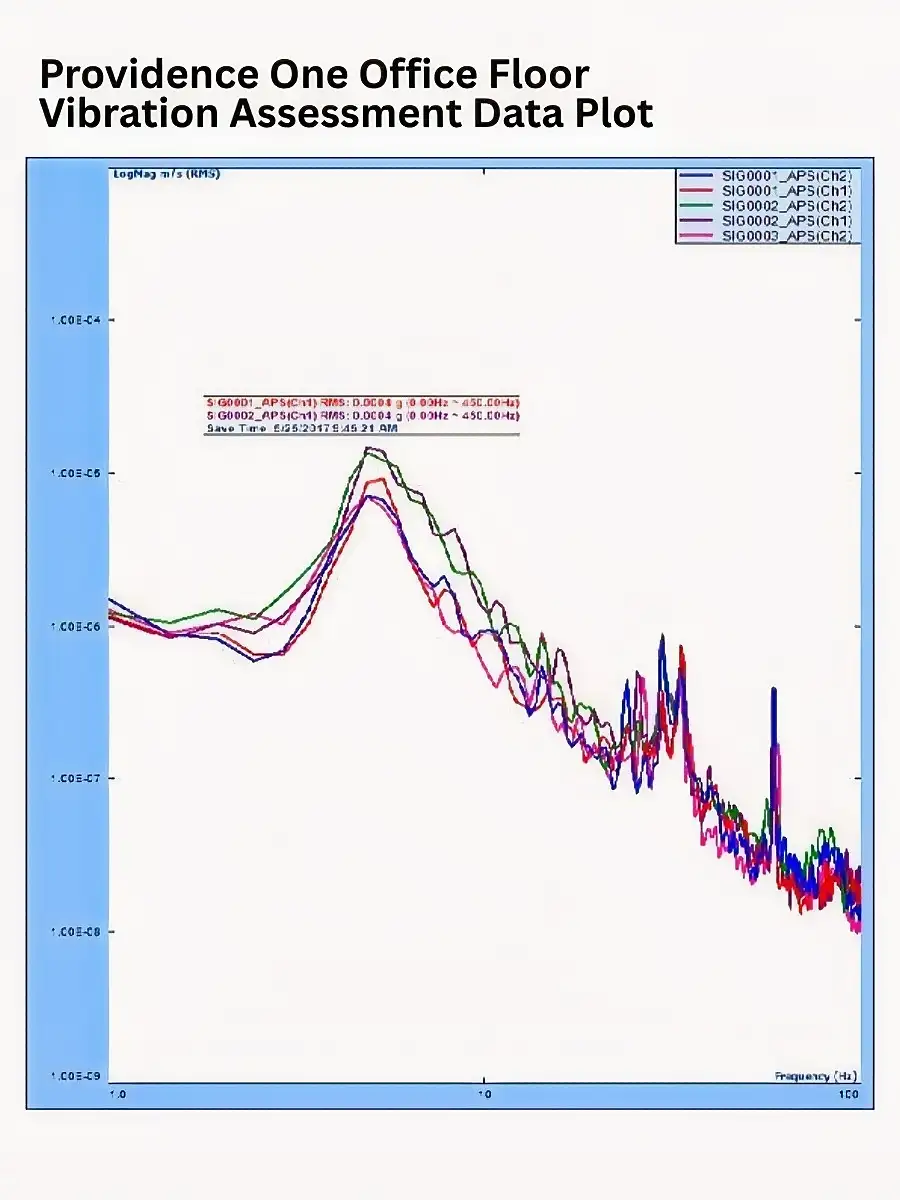
Peak vibration at the mid-span location landed in ISO 10137 Class 3, which is the band labeled distinctly perceptible but not strongly perceptible. The magnitude ran approximately one order of magnitude below the action limit for office spaces.
That sounds like good news on paper. It is not good news to the occupant. ISO classes describe statistical perception across a population. An individual sensitive to motion can be deeply uncomfortable at a level a less sensitive coworker does not notice. The standard does not exempt the building owner from the complaint just because the magnitude is under the action limit. It frames the conversation about what mitigation is reasonable.
The second test location near the central core measured substantially lower vibration, confirming that the problem is mid-span deflection of the floor system, not a building-wide issue. That diagnosis drives the mitigation strategy.
ISO 10137 Vibration Classes for Office Floors
ISO 10137 maps vibration magnitude to perceptibility classes. The table below summarizes how each class translates into the lived occupant experience in an office.
Where the Vibration Came From: Footfall, Not Mechanical
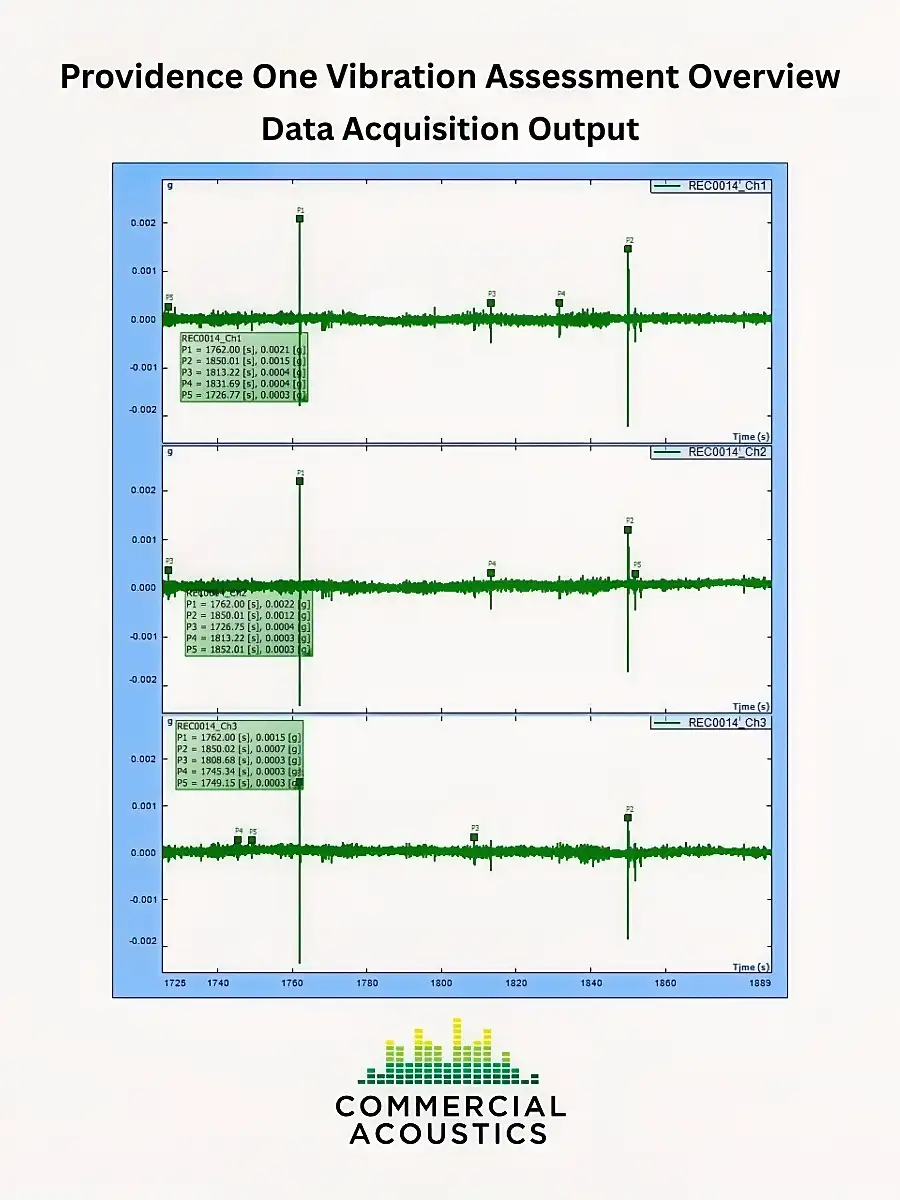
The first diagnostic question on any floor vibration complaint is whether the source is mechanical or human. HVAC fans, pumps, and rotating equipment produce continuous periodic signatures. Footfall produces irregular pulses that follow occupant traffic patterns.
The recorded data at Providence One showed irregular pulses with peak intensity during 8:44 to 10:44 AM, the morning arrival window. There were no periodic mechanical signatures. The vibration was occupant footfall on a floor system that lacked the mass and stiffness to absorb it. Under-loading made it worse: the building had not reached full occupancy, and an under-loaded floor responds more dynamically than a fully-loaded one because there is less mass to damp the motion.
The Three-Tier Mitigation Playbook
- Topical Underlayment: Vibration-reducing mat or pad under finished flooring in high-traffic corridors
- Occupant Relocation: Move motion-sensitive staff toward corners and over central core beams
- Future Design: Tighter beam spacing, deeper composite section, or specified damping for the next tenant build-out
- Sequencing: Try relocation first (zero cost), then underlayment in worst corridors, then structural changes only at the next major renovation
Mat options for the topical underlayment tier include Pliteq GenieMat FIT and similar high-density elastomer pads. The role of the mat is to decouple footfall from the slab before the energy enters the structure. Coverage area matters as much as the product spec. Isolating one corridor while leaving the adjacent corridor untreated rarely moves the felt vibration enough to satisfy occupants.
For the structural tier, the playbook starts at design. Tightening beam spacing from 10 to 8 feet, deepening the composite section, or adding a damping layer in the floor build-up all reduce mid-span deflection. None of those are retrofitable on an existing occupied building without major work.
What Tenants Should Ask Before Signing a Lease
- Beam Spacing: Request the structural drawings, look for spans wider than 8 feet between primary beams
- Floor System: Composite steel-deck floors over 25 feet of clear span are vibration-prone, ask for the floor depth
- Occupancy Level: Under-loaded buildings vibrate more, confirm the tenant fit-out plan
- Field Test: Request an ISO 10137 walking test before signing, especially for sensitive uses like labs or video editing
- TI Allowance: Negotiate a vibration mitigation budget into the tenant improvement allowance up front
Conclusion: Office Floor Vibration Testing Done Right
Office floor vibration is a real serviceability problem that hides behind acoustic-sounding complaints. The fix is a properly instrumented ISO 10137 field assessment, a clear diagnosis of source and path, and a tiered mitigation plan that respects what an occupied building can actually accommodate. Most complaints land in Class 2 or 3 of the ISO scale, which means they are real but treatable without structural surgery.
If your office is fielding footfall vibration complaints and the structural engineer has already cleared the building for safety, the next call is the team that runs vibration assessments. Talk to a vibration consultant before the next round of complaints turns into a lease dispute.
FAQs: Office Floor Vibration Testing
What is ISO 10137 and how does it apply to office floors?
ISO 10137 is the international standard for serviceability of buildings and walkways against vibration. It defines perceptibility classes 1 through 4 and gives action limits for human comfort in office, residential, and sensitive use spaces. A field assessment compares measured floor acceleration against the class boundaries for the use type.
How do you test office floor vibration?
A vibration consultant places single-axis accelerometers at the worst-case mid-span location and at a low-vibration reference point near the building core, then captures vertical acceleration in meters per second squared across normal occupant traffic. The data acquisition unit logs continuously through peak and quiet windows for accurate comparison to the ISO 10137 limits.
Why does footfall make office floors vibrate?
Steel-deck composite floors with beam spans over 25 feet have natural frequencies in the same 4 to 8 Hz range as human footfall. When the walking cadence matches the floor’s resonance, energy builds up across mid-span and creates the perceptible motion occupants report.
Can you fix office floor vibration without rebuilding the slab?
Yes for Class 2 and most Class 3 cases. Topical underlayment in high-traffic corridors, occupant relocation toward central beams and corners, and selective damping pads under finished flooring all reduce perceived vibration without structural work. Class 4 cases at or above the ISO action limit usually require structural reinforcement.

Walker Peek|Founder & CEO, Commercial Acoustics
Walker founded Commercial Acoustics in 2013 to bring aerospace-grade engineering discipline to soundproofing, and runs the firm as CEO from its 12,000 sq ft Tampa production facility. The company designs custom acoustic panels, sound membranes, and masking systems for multi-family, hospitality, healthcare, and commercial projects across the US — built around Walker’s invention, Wall Blokker, an EVA-based sound barrier that hits STC 50-plus at roughly $1 per square foot installed.
A Jacksonville native, Walker spent five years at Kennedy Space Center with Craig Technologies before founding Commercial Acoustics — certifying aerospace manufacturing to the AS9100 standard and leading Six Sigma Black Belt process-improvement teams on NASA programs. He is a certified Industrial Noise Control Engineer and the author of Architectural Acoustics: A Practical Handbook.
