Table of Contents
What Is Flanking Noise
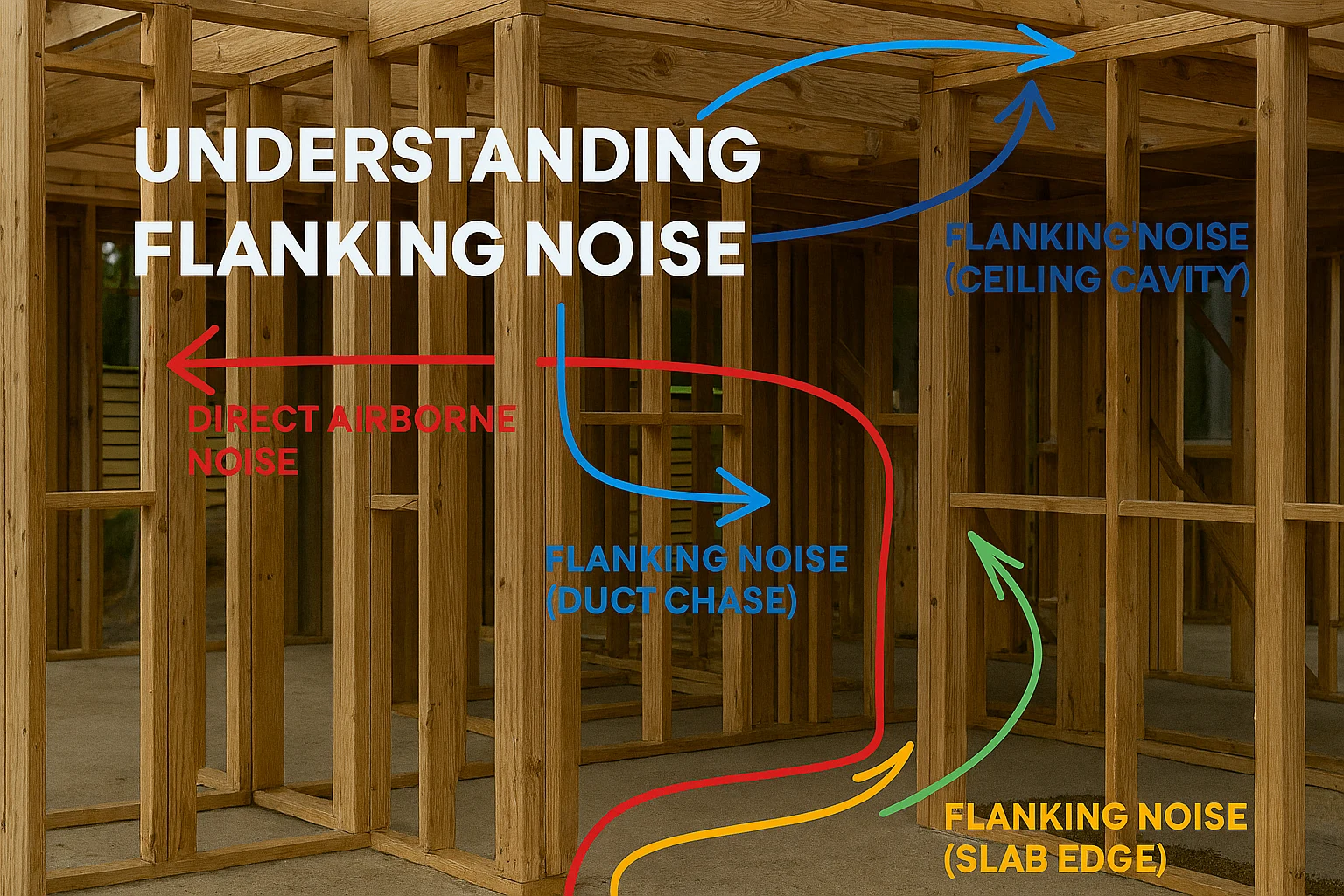
Flanking noise is sound that reaches a space through indirect paths such as ceilings, floors, ducts, or framing instead of passing directly through the separating wall. Even high-performance walls with excellent STC ratings can fail in the field if flanking paths allow sound to travel around them.
In laboratory tests, flanking is minimized to measure the true performance of a partition. But in real-world construction, small gaps, continuous framing, and connected structures let noise bypass barriers and travel throughout the building. These indirect paths are often the difference between a quiet, code-compliant building and one full of complaints.
Why Flanking Noise Matters
Flanking noise is one of the primary reasons field-tested STC results don’t match lab data. A single unsealed gap or shared stud can lower sound isolation by 10 to 20 decibels.
In multifamily, hospitality, and office projects, that loss means audible conversation, reduced privacy, and failed acoustic testing. Controlling flanking is essential to ensure every wall, ceiling, and floor performs as designed.
Common Flanking Paths
- Floor and Ceiling Framing: Sound travels through joists, subfloors, and deck plates that connect rooms vertically.
- Ductwork and Plumbing: Airborne sound moves freely through unlined ducts and pipe chases.
- Doors and Windows: Gaps and lightweight materials create weak points in sound isolation.
- Electrical Outlets and Penetrations: Back-to-back boxes and open chases short-circuit otherwise high-STC walls.
- Continuous Framing Members: Shared studs or top plates carry vibration between spaces.
Understanding these paths allows designers to anticipate and eliminate sound leaks before construction begins.
How Flanking Noise Affects STC Ratings
In lab settings, a wall might achieve an STC 56 rating. Once built on site, with ductwork, doors, and outlets installed, that same wall may perform closer to STC 40.
For example, an 80-decibel sound source behind an STC 55 wall should be reduced to 25 decibels on the other side. But if 40 decibels travel through ductwork or framing, the real isolation is only 40 decibels—cutting effective performance by 15 decibels or more. Flanking noise makes the best designs underperform.
How to Prevent Flanking Noise
Effective flanking control requires detailed planning and tight coordination between trades.
- Decouple Construction: Use resilient channels, sound isolation clips, or staggered studs to break vibration paths.
- Increase Damping: Add sound-damping membranes or compounds between drywall layers to reduce vibration transfer.
- Seal Every Penetration: Apply acoustical sealant and putty pads around pipes, outlets, and joints.
- Control Duct Paths: Line ducts, add bends or flexible sections, and keep openings away from noise sources.
- Vary Construction Types: Change wall or floor assemblies between rooms to minimize resonance and coupling.
Combining these strategies ensures your assemblies perform closer to their laboratory ratings.
Field Testing and Verification
After installation, field testing under ASTM E336 validates real-world performance. These tests measure whether sound isolation meets the design intent and code requirements.
Field verification also identifies hidden flanking paths before occupancy—saving time, avoiding disputes, and ensuring long-term acoustic comfort.
Why Early Coordination Is Critical
Most flanking issues start in design. Coordinating with structural, mechanical, and electrical teams early allows you to isolate noisy systems, separate framing, and seal penetrations before drywall ever goes up.
When acoustics are considered alongside structure and MEP systems, flanking noise can be eliminated at the source rather than fixed later at greater cost.
Conclusion: Building Quieter, Code-Compliant Spaces
Flanking noise is often invisible until it becomes expensive to fix. It can turn an STC 55 wall into an STC 40 performer, even when the design appears perfect on paper. Once noise finds a path around your assemblies, comfort and compliance quickly drop.
By combining decoupling, damping, and airtight sealing, you can stop sound from sneaking through floors, ceilings, and framing connections. Partnering with Commercial Acoustics ensures your projects are designed, tested, and built to deliver verified sound isolation in the field—not just on paper. Understanding flanking noise early is the key to achieving reliable, repeatable, and code-compliant acoustic results in any space.
FAQs: Flanking Noise
What is flanking noise?
Flanking noise is sound that bypasses walls or floors by traveling through indirect paths like framing, ductwork, or ceilings.
Why does flanking noise reduce STC performance?
It allows sound to take alternate routes around the tested assembly, lowering overall isolation by up to 20 decibels.
How can I stop flanking noise?
Use resilient channels or clips, add damping layers, and seal every opening or penetration with acoustical sealant.
Does modular construction increase flanking noise?
Yes. Load-bearing framing and continuous joints can transmit vibration between modules unless isolated properly.
Can Commercial Acoustics help me prevent flanking noise?
Yes. Through design consulting, field testing, and material recommendations, Commercial Acoustics helps ensure every project meets its sound isolation goals.
