Table of Contents
What Is an STC Rating?
- Definition: STC (Sound Transmission Class) measures how well a partition blocks airborne sound between adjacent spaces.
- Scale: The higher the STC, the better the sound isolation performance.
- Purpose: Used to compare wall, door, and window assemblies in architectural and acoustic design.
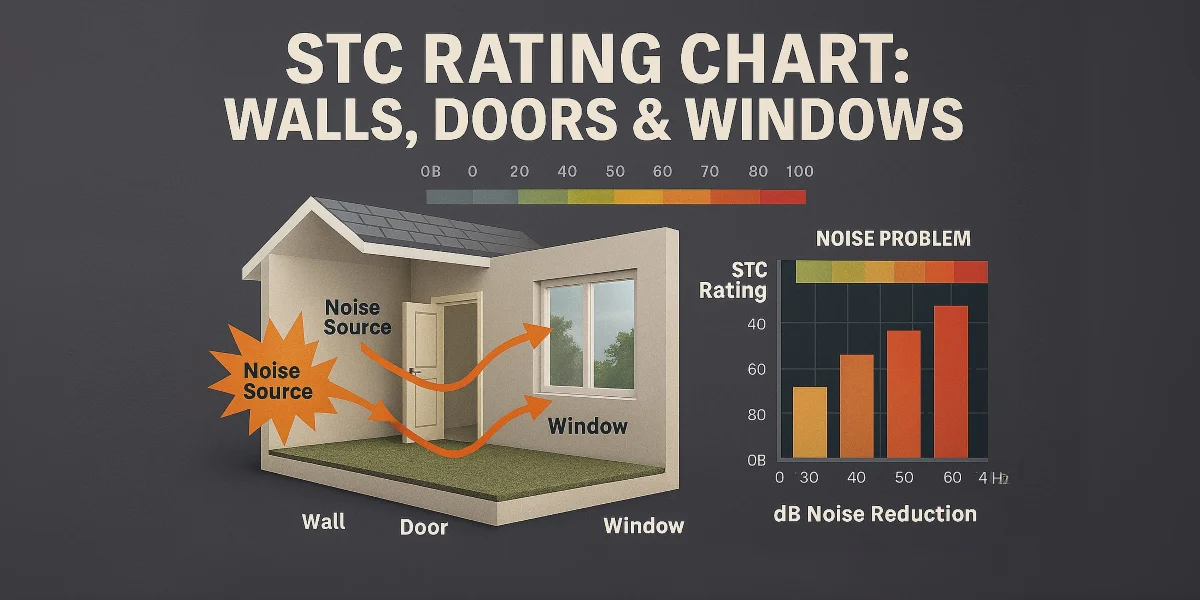
STC ratings help architects and engineers evaluate how effectively walls and partitions reduce noise transfer. Use the chart below to identify assemblies that meet specific performance goals for privacy, comfort, or code compliance in multi-family, hospitality, and office projects.
STC Rating Chart – Typical Assemblies
| Assembly Type | Construction Example | Typical STC | Notes / Application |
|---|---|---|---|
| Single ½” drywall, wood studs 16″ o.c. | Basic residential wall | 33–35 | Allows normal conversation to pass through; minimal isolation. |
| Double ½” drywall, insulation, wood studs | Standard multifamily wall | 40–42 | Meets basic privacy standards for attached units or offices. |
| Double ⅝” drywall, insulation, resilient channel | Enhanced privacy wall | 50–52 | Meets IBC code minimum between dwelling units. |
| ⅝” drywall + Wall Blokker membrane each side | Tested membrane system | 54–56 | High-performance wall with minimal added thickness. |
| Staggered stud wall, ⅝” drywall each side | Decoupled framing | 55–60 | Excellent for hospitality, offices, or classrooms. |
| Double stud wall, insulation, ⅝” drywall | Fully separated framing | 60–65 | Superior sound control for recording or media rooms. |
| 20-gauge load-bearing stud wall + sound membrane | Structural assembly | 52 | Achieves code-level performance with heavy framing. |
| Solid core wood door (1¾”) | Interior door | 30–35 | Blocks moderate noise but limited speech privacy. |
| Acoustic door (laminated or sealed frame) | STC 45–50 door | 45–50 | Ideal for offices, hospitals, and theater entrances. |
| Double-glazed window (¼” + ¼”) | Standard insulated glazing | 32–35 | Reduces outdoor and street noise moderately. |
| Laminated acoustic glazing (¼” + ⅜”) | Sound-rated window | 40–44 | Blocks highway and urban noise effectively. |
Choosing the Right STC Rating
- STC 30–35: Basic separation; normal conversation clearly audible.
- STC 40–45: Moderate privacy; raised voices heard faintly.
- STC 50–55: Code minimum for multi-family; loud speech barely audible.
- STC 60+: High privacy; recommended for theaters, hospitals, and studios.
Each 10-point increase in STC roughly halves the sound energy that passes through a wall. Selecting the right assembly early in design prevents costly retrofits and ensures comfort across different project types.

Field vs. Laboratory Ratings
- Lab STC (LSTC): Measured under perfect test conditions with sealed joints.
- Field STC (FSTC): Real-world measurement that reflects workmanship and flanking paths.
Field STC ratings often test 2–5 points lower than laboratory results due to installation gaps, unsealed penetrations, or shared framing paths. Learn how to avoid these issues in our Resilient Channel: Best Uses & Worst Mistakes guide.
Conclusion: Building Walls That Deliver Real-World Sound Control
The STC rating chart provides a reliable reference for understanding how different assemblies perform in blocking sound. By selecting materials and configurations that meet your project’s target STC, you can prevent noise complaints, improve tenant satisfaction, and ensure lasting value. Pairing tested assemblies with proper detailing and quality workmanship leads to dependable field results—making every project quieter, more comfortable, and code-compliant from day one.
FAQs: STC Rating Chart
What STC rating is required by code?
The International Building Code requires a minimum of STC 50 between dwelling units (or 45 in field testing). Higher ratings may be specified for hotels, hospitals, or classrooms to meet performance standards.
What STC rating blocks normal conversation?
Walls rated STC 45–50 block most normal conversation, while STC 55+ eliminates clear speech transfer and ensures acoustic privacy.
What’s the difference between STC and NRC?
STC measures how well a partition blocks airborne sound transmission, while NRC measures how much sound a surface absorbs within a room. Both affect perceived noise but in different ways.
Can a wall exceed STC 70?
Yes, but it typically requires double-stud or masonry construction, multiple layers of dense board, and complete decoupling between framing systems. Such assemblies are used in studios or performance spaces.
Can Commercial Acoustics help design STC-rated walls?
Yes. Our acoustic specialists provide lab-tested assemblies, material recommendations, and field testing services to help you achieve target STC ratings efficiently and consistently.
