
Table of Contents
Why Pickleball Noise Is So Hard to Ignore
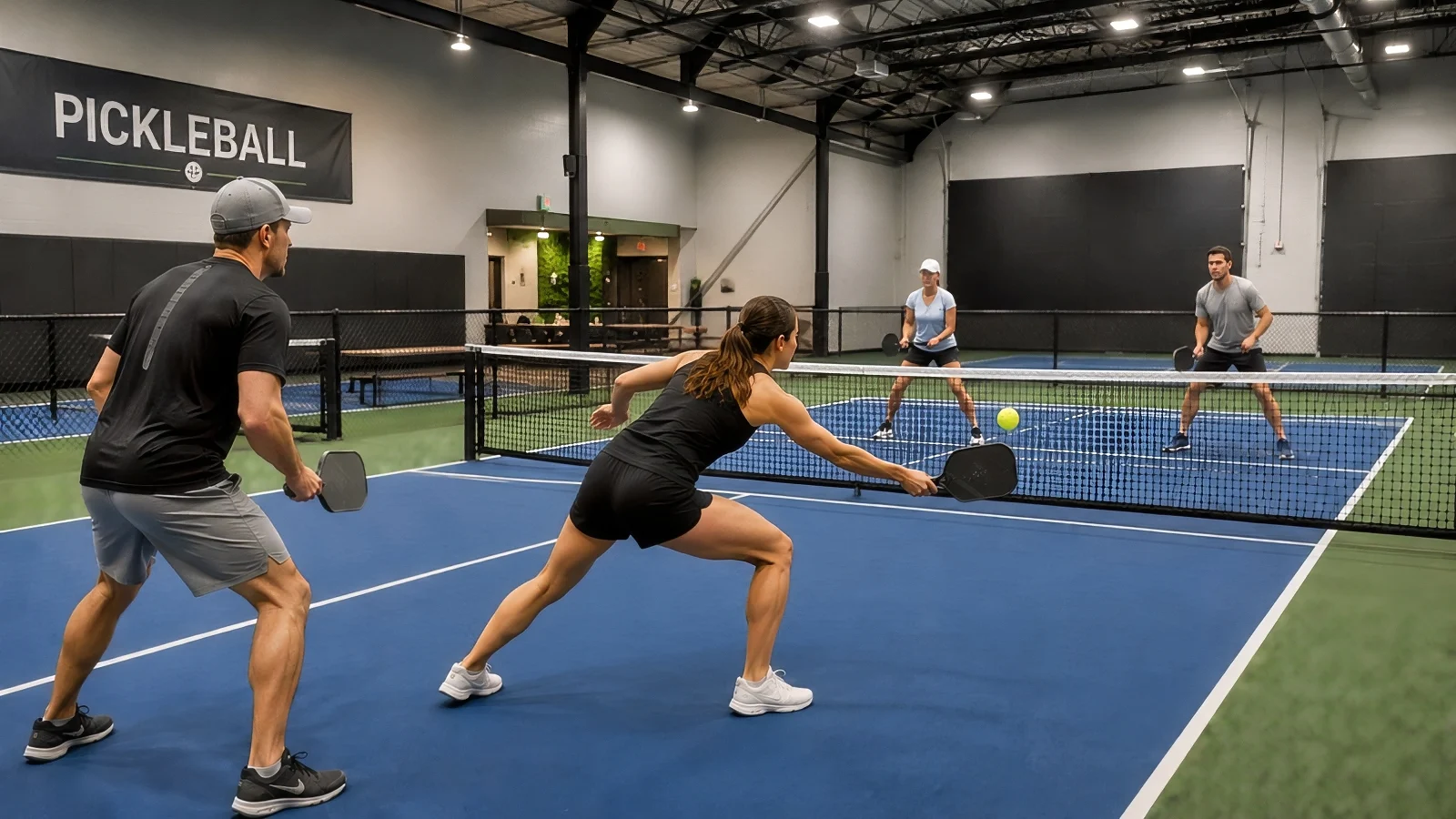
Pickleball has become the fastest-growing sport in America—and the most-litigated. Across the country, neighbors are filing complaints, suing HOAs, petitioning city councils, and forcing public courts to close because of one specific sound: the sharp, high-pitched pop of a polymer paddle hitting a plastic ball, repeating roughly every two seconds for hours at a time. The nonprofit Quiet Communities has tracked how pickleball noise lawsuits are spreading like wildfire across municipalities nationwide.
What makes pickleball noise so contentious isn’t its raw loudness (it’s only 70–80 dBA at the source)—it’s the frequency content and repetition rate. The pop lives in the 1–4 kHz range where human ears are most sensitive, it’s percussive and impulsive, and it happens hundreds of times per game. This guide covers 10 prioritized strategies for soundproofing a pickleball court—five for indoor facilities and five for outdoor courts—each with real performance specs (STC, NRC, NC, dBA) you can hand to an architect, contractor, or municipal planning board.
Just How Loud Is Pickleball?
The paddle-on-ball pop measures roughly 70–80 dBA at the point of impact—not extraordinarily loud in absolute terms. The problem is what those numbers look like at the listener position: the constant, high-frequency, impulsive pop carries across open space far more aggressively than steady-state sound at the same level. Peer-reviewed work from the Acoustical Society of America confirms that impulsive sounds like the pickleball pop annoy listeners more than steady-state sound at the same decibel level — which is why a 70 dBA reading from a court can drive complaints that 70 dBA from traffic does not. The chart below shows what untreated and properly treated courts deliver at a typical 100-foot residential property line.
The gap between the red and green rows is what proper court treatment buys you: dropping a 60–70 dBA neighbor-position level into the 45–55 dBA band where it sits below most municipal noise ordinances and stops triggering complaints. Two things make pickleball noise harder to control than its dBA number suggests. First, it’s impulsive and repetitive—the sharp pop pattern hits the ear differently than equivalent steady-state sound. Second, it’s high-frequency—the 1–4 kHz spectrum carries clearly over distance and through standard fencing in ways low-frequency sound doesn’t. The strategies below address both.
10 Soundproofing Strategies in Priority Order
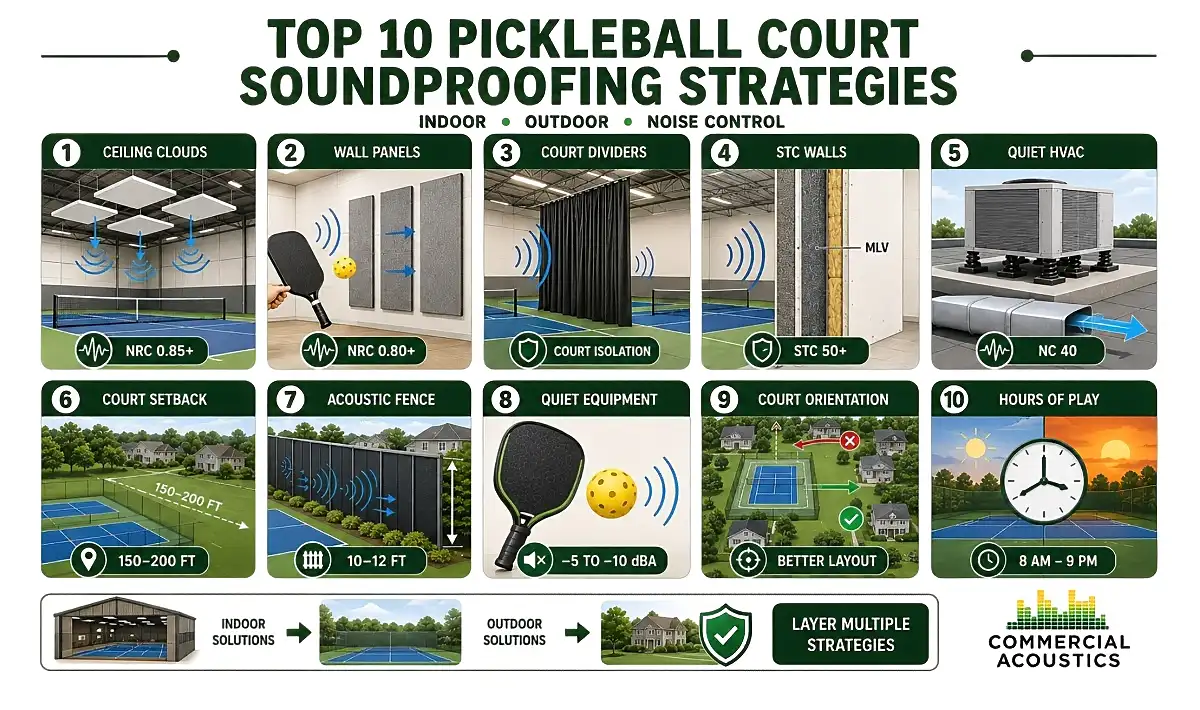
Pickleball acoustics split cleanly into two problem domains with different fixes. Strategies 1–5 cover indoor facilities (clubs, warehouses, dedicated indoor courts), where reverberation control is the main challenge. Strategies 6–10 cover outdoor courts, where the issue is sound propagation to nearby homes and how to keep your court permit intact. Every strategy includes target specs (STC, NRC, NC, dBA) so you can spec against a real benchmark.
1. Install Acoustic Ceiling Clouds or Baffles Indoor
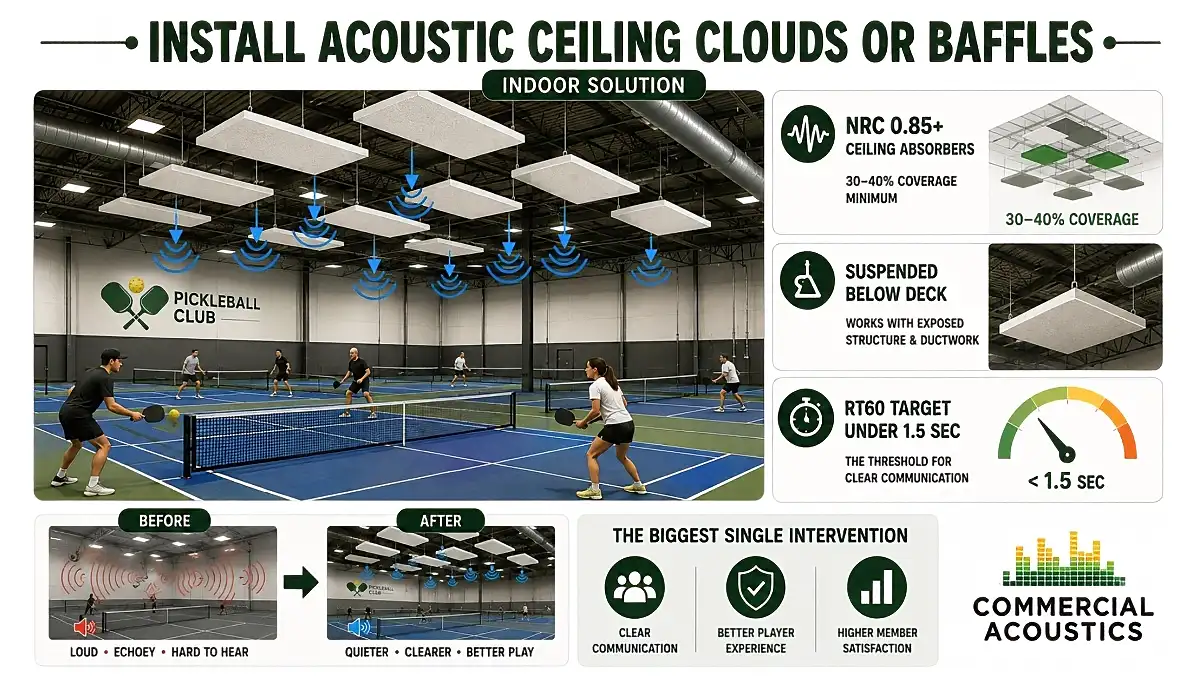
- NRC 0.85+ ceiling absorbers: 30–40% coverage minimum for converted warehouse facilities.
- Suspended below the deck: works with exposed structure and ductwork.
- RT60 target under 1.5 seconds: the threshold for clear communication between players.
Most indoor pickleball facilities live in converted warehouses or repurposed industrial spaces—soaring ceilings, concrete floors, and almost no built-in absorption. The pop of paddle on ball, multiplied across six courts running simultaneously, builds into a wall of high-frequency noise that drives players (and the front desk) crazy by hour two. Ceiling treatment is the biggest single intervention. See our overview of specialty ceilings.
2. Add Wall Panels at First Reflection Points Indoor
- NRC 0.80+ panels: placed at the first reflection points behind courts.
- 15–20% targeted wall coverage: focused placement beats scattered coverage.
- Tuned for 1–4 kHz absorption: the frequency band where the paddle pop lives.
The signature pickleball pop sits in the 1–4 kHz range—the sharp, high-pitched register that wall absorbers are most effective against. Targeted panels at first-reflection points behind each court catch the pop before it builds across the entire facility.
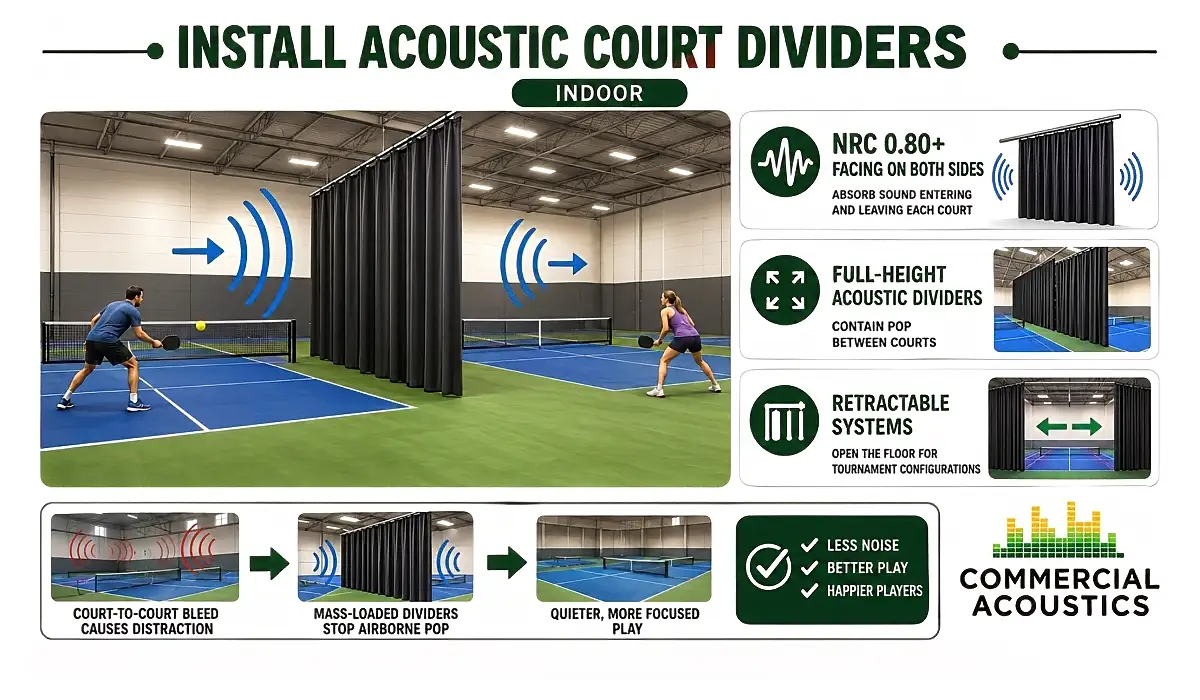
3. Install Acoustic Court Dividers Indoor
- Full-height acoustic curtain or panel dividers: contain pop between courts.
- NRC 0.80+ facing on both sides: absorb sound entering and leaving each court.
- Retractable systems for tournament configurations: open the floor for show courts as needed.
Court-to-court bleed determines whether one court’s aggressive rally disrupts the league match three lanes over. Mass-loaded dividers stop the airborne pop at the source; absorptive facing keeps each court from becoming its own resonant chamber.
4. Build STC 50+ Demising Walls for Shared Buildings Indoor
- STC 50 minimum for shared-tenant walls: STC 55+ adjacent to residential.
- Walls extend deck-to-deck: sound flanks easily above suspended ceiling tile.
- Mass-loaded vinyl in the assembly: added mass for low-frequency control.
Indoor pickleball facilities frequently open in strip-mall or mixed-use buildings where airborne sound transmission to neighboring tenants becomes the dominant complaint. See our STC rating chart for assembly performance.
5. Tame HVAC & Mechanical Noise Indoor
- NC 40 target for the facility: background noise criterion for indoor court spaces.
- Vibration isolators under rooftop units: prevent structure-borne transmission.
- Duct silencers on long supply runs: kill the whoosh before it reaches the courts.
Indoor pickleball facilities run their HVAC hard—large volumes, active bodies, year-round cooling. If the background mechanical noise is loud, players talk and shout over it, which adds to the perceived volume even more. A quiet HVAC is invisible work that compounds the value of every other acoustic intervention.
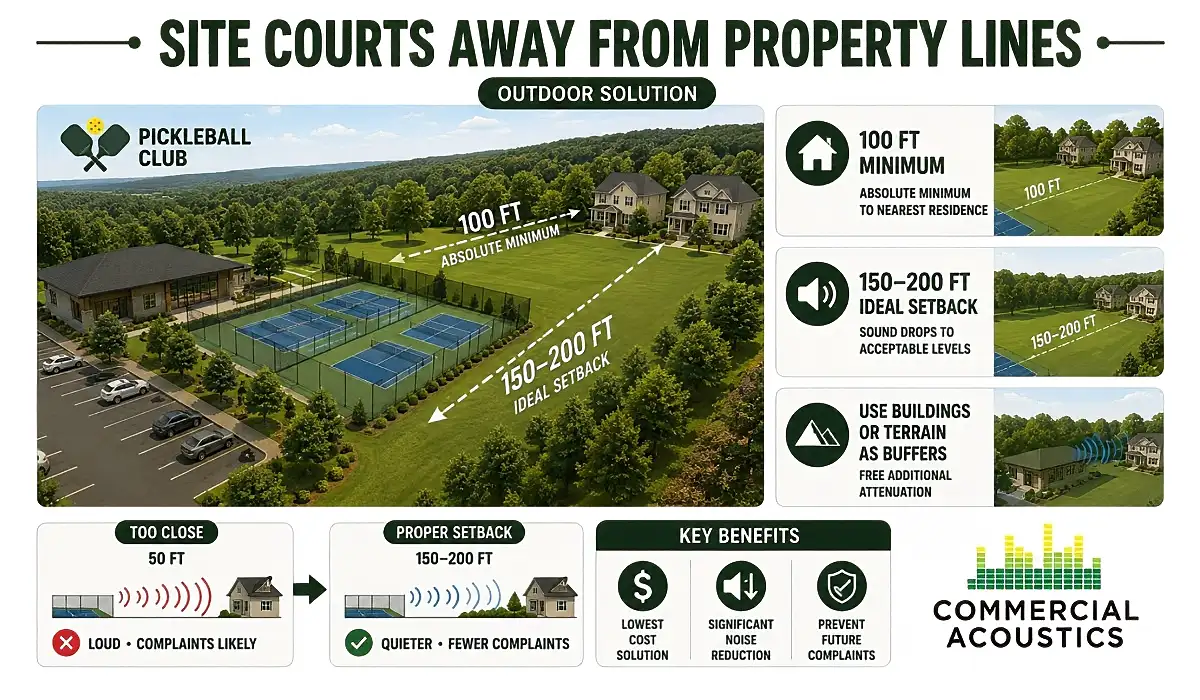
6. Site Courts Away from Property Lines (Setback Design) Outdoor
- 100 ft absolute minimum to nearest residence: below this, complaints are nearly guaranteed.
- 150–200 ft for proper attenuation: the threshold where sound drops to acceptable residential levels.
- Use existing buildings or terrain as buffers: free additional attenuation if available.
Distance is the cheapest soundproofing you’ll ever buy. Sound drops roughly 6 dB for every doubling of distance in open air, which means a court 100 ft from a home delivers half the perceived loudness of a court at 50 ft. Site planning at the design stage prevents most of the problems retrofit treatment is later expected to solve. For background on the decibel scale, see Decibels Explained.
7. Install Mass-Loaded Acoustic Fencing & Sound Barriers Outdoor
- Minimum 10–12 ft barrier height: partial-height fencing leaks heavily over the top.
- Mass-loaded vinyl core with absorptive face: blocks and absorbs rather than just deflects.
- Wrap the full perimeter: sound diffracts around partial barriers and reaches the protected side.
A standard chain-link fence with windscreen blocks almost nothing acoustically. Real acoustic fencing—mass-loaded panels with sound-absorbing facing on the court side—can deliver 8–15 dB of attenuation at the residential property line. Critical: barriers have to be taller than the line-of-sight between paddle and receiver, otherwise sound diffracts over the top.
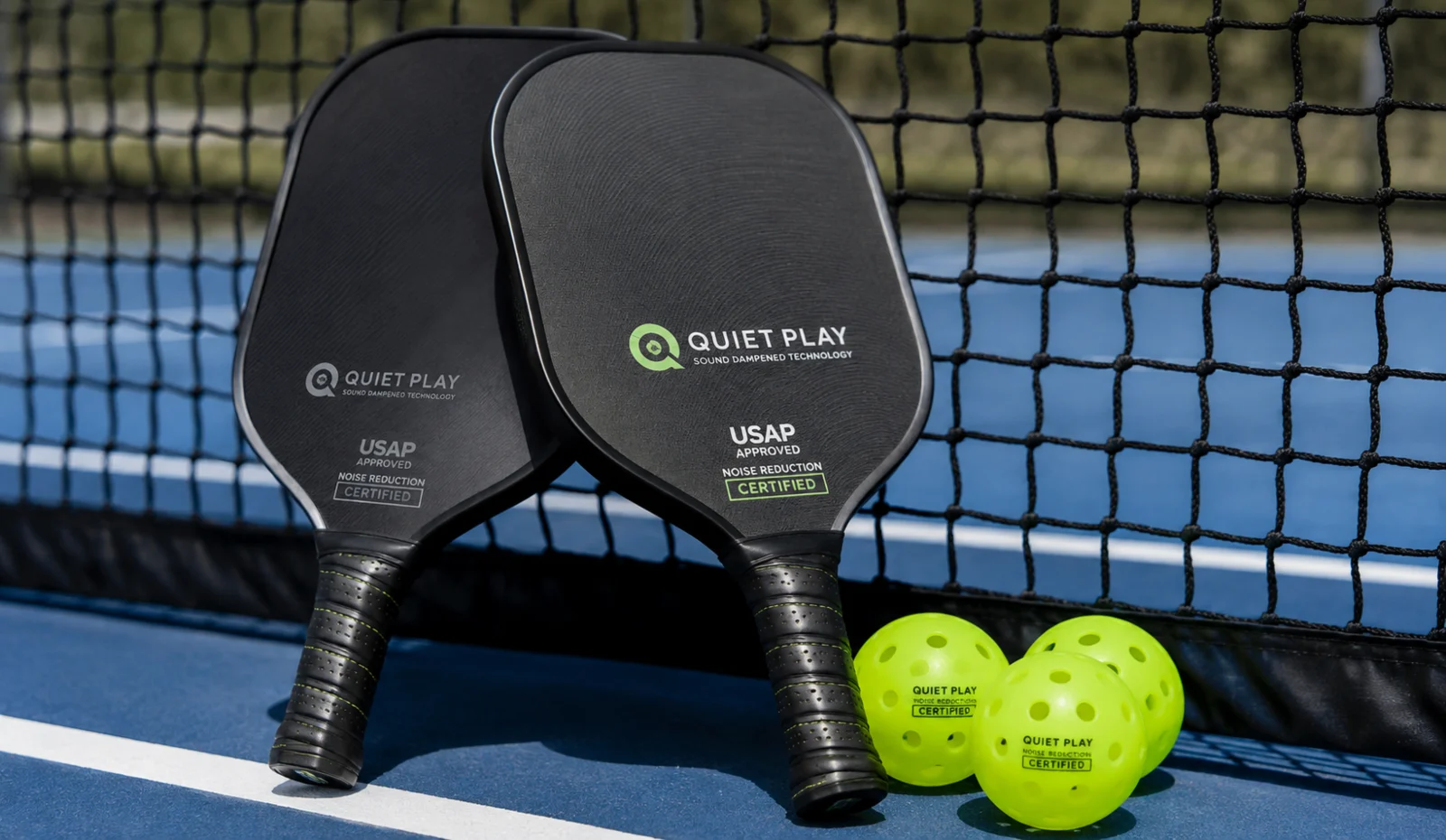
8. Specify Quiet Paddles & Balls (Gear-Based Mitigation) Outdoor
- USA Pickleball “Quiet Category” approved paddles: certified for noise reduction at source.
- Foam-core or low-decibel balls: reduce impact dBA by 5–10 at the source.
- 5–10 dBA at source = significant at distance: a small at-source reduction compounds across attenuation.
Pickleball is the only sport where you can meaningfully reduce noise at the source by changing the equipment. USA Pickleball maintains a list of quiet-category paddles tested specifically for reduced acoustic output, and several manufacturers now make low-decibel ball options. Mandating quiet gear on noise-sensitive courts is often the cheapest single intervention—and it’s the only one that addresses the source instead of the path.
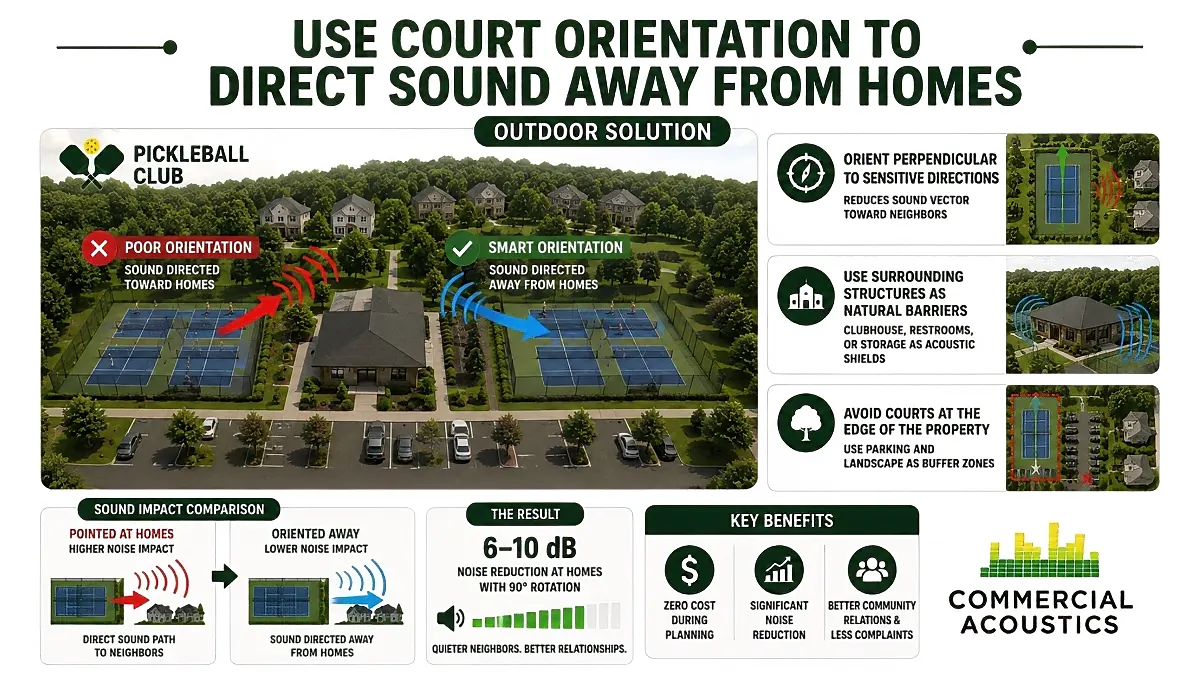
9. Use Court Orientation to Direct Sound Away from Homes Outdoor
- Orient the long axis perpendicular to sensitive directions: reduces sound vector toward neighbors.
- Use surrounding structures as natural barriers: the clubhouse, restrooms, or storage as acoustic shields.
- Avoid courts at the edge of the property: use parking and landscape as buffer zones.
The direction a player swings dictates where the sound projects most strongly. A court whose long axis points at the nearest residential property line sends acoustic energy directly at the neighbors who care most. Rotating court orientation 90 degrees can shift the dominant noise vector by 6–10 dB at adjacent homes—at zero cost during planning.
10. Establish Hours of Play & Operational Policies Outdoor
- Restrict play to 8 am–9 pm: aligns with most municipal daytime noise ordinance windows.
- Limit early-morning and post-sunset use: when sensitivity to noise is highest.
- Coordinate with HOA and municipal noise covenants: document compliance for any future complaint.
Behavioral policy is the cheapest soundproofing tool available and the one most owners skip. Most jurisdictions allow higher noise levels during defined daytime windows; staying inside those windows often resolves complaints by itself. For HOA-managed or municipal courts, posting hours and enforcing them is the difference between an operating permit you keep and one you renegotiate annually.
Pickleball Court Soundproofing Cheat Sheet
Use this matrix to match strategies to your court type and budget. Indoor moves dominate the first half; Outdoor moves dominate the second. Green cells are quick wins (low cost or easy install); red cells flag the structural moves worth planning around early.
Game, Set, Quiet
Pickleball acoustics are equal parts physics and politics. Get the technical work right—indoor absorption, outdoor setbacks, quiet gear, real fencing—and you keep the courts open, the neighbors quiet, and the operating permit unchallenged. Skip it, and you end up in front of a planning board explaining why the lawsuits are not your fault. We help facility owners, HOAs, and municipal planning teams design pickleball courts that don’t make headlines. Reach out anytime.
FAQs: Soundproofing a Pickleball Court
How loud is pickleball?
Paddle-on-ball measures 70–80 dBA at impact. At a typical 100-foot residential property line, an untreated court delivers 60–70 dBA—about the level of a vacuum cleaner running constantly. Proper treatment drops that to 45–55 dBA.
Why do neighbors complain about pickleball more than other sports?
Two reasons: frequency and repetition. The paddle pop sits in the 1–4 kHz range where human ears are most sensitive, and it repeats every two seconds for hours. That’s perceived as far more disruptive than steady-state sound at the same dBA.
Do quiet paddles really make a difference?
Yes. USA Pickleball’s quiet-category paddles and low-decibel balls reduce the impact dBA by 5–10 at the source. That sounds small, but a 5–10 dBA reduction at source compounds across distance and barriers—often the difference between complaints and silence.
How far should an outdoor pickleball court be from a home?
100 feet is the absolute minimum; 150–200 feet is the threshold for sound to attenuate to acceptable residential levels without aggressive treatment. Distance is the cheapest soundproofing available and the easiest to get right at the planning stage.

Walker Peek|Founder & CEO, Commercial Acoustics
Walker founded Commercial Acoustics in 2013 to bring aerospace-grade engineering discipline to soundproofing, and runs the firm as CEO from its 12,000 sq ft Tampa production facility. The company designs custom acoustic panels, sound membranes, and masking systems for multi-family, hospitality, healthcare, and commercial projects across the US — built around Walker’s invention, Wall Blokker, an EVA-based sound barrier that hits STC 50-plus at roughly $1 per square foot installed.
A Jacksonville native, Walker spent five years at Kennedy Space Center with Craig Technologies before founding Commercial Acoustics — certifying aerospace manufacturing to the AS9100 standard and leading Six Sigma Black Belt process-improvement teams on NASA programs. He is a certified Industrial Noise Control Engineer and the author of Architectural Acoustics: A Practical Handbook.
