

Table of Contents
Why STC 50 Matters in Modern Construction
Every building has a sound story—how noise moves, echoes, and fades within its walls. For architects and contractors, controlling that story means understanding how to meet and exceed STC 50, the benchmark for acoustic comfort and code compliance. Hitting this target ensures walls not only meet regulatory standards but also deliver the kind of privacy and quiet that residents and guests expect.
In multifamily, hospitality, and commercial projects, a properly rated wall assembly can make the difference between satisfied tenants and years of noise complaints. Achieving an STC rating of 50+ isn’t about overbuilding or adding unnecessary cost—it’s about applying proven acoustic principles in a smart, efficient way that balances mass, flexibility, and airtight construction.

Understanding STC 50 & Its Real-World Implications
- Defines Acoustic Separation: STC (Sound Transmission Class) measures how effectively a wall blocks airborne noise.
- Sets the Code Standard: The International Building Code (IBC) mandates STC 50 minimum for multifamily and hotel walls.
- Delivers Noticeable Comfort: Walls rated at STC 50 make normal conversation inaudible between rooms.
The STC rating reflects real-world livability. A wall rated at 35 might allow full speech to pass through, while a wall at 50 reduces it to faint murmur—barely perceptible. For projects that involve sleeping, working, or private conversation, STC 50 is the baseline for acoustic performance. Beyond comfort, it’s a practical necessity for code compliance and long-term occupant satisfaction.
Wall Assemblies That Achieve STC 50+
- Single-Stud with Insulation: 25-gauge steel studs at 24″ on center, batt insulation, and double ⅝” drywall on both sides.
- Double-Stud Assembly: Two separate stud walls with insulation in between, capable of achieving STC 55–60.
- Resilient Channel System: Single-stud framing with resilient channels and dual drywall layers for improved decoupling.
Each of these wall types meets or surpasses the STC 50 benchmark when properly detailed and sealed. The secret isn’t in the number of layers alone—it’s in reducing the pathways that sound can travel. Small penetrations, like outlets or unsealed gaps, can drop ratings by several points. Using acoustical sealant at all joints and around wall perimeters can make the difference between failing and passing an STC field test.
Design Strategies to Improve Acoustic Performance
- Add Mass Where It Counts: Extra drywall layers or denser gypsum boards increase isolation.
- Break the Sound Path: Decoupling walls with resilient channels or double framing controls vibration.
- Seal for Precision: Use acoustical caulk around penetrations, seams, and perimeter joints.
Designing for sound isolation is as much about planning as it is about product selection. For example, switching from 20-gauge to 25-gauge studs can improve flexibility and add 4–7 STC points. Likewise, a few tubes of sealant can outperform costly “acoustic upgrades.” The goal is to create assemblies that perform predictably, resist flanking noise, and maintain consistent results across hundreds of walls in a large project.
Verifying STC Ratings Through Testing
- ASTM E90 Lab Testing: Controlled environment test that measures sound transmission loss.
- ASTM E336 Field Testing: On-site testing to confirm performance after installation.
- ASTC (Apparent STC): Accounts for flanking and real-world conditions in occupied buildings.
Even the best wall design can underperform if construction tolerances slip. Field verification ensures that the installed assemblies match lab results. Testing typically involves measuring sound levels between source and receiving rooms using calibrated microphones and speakers. Acoustic consultants then calculate the true STC value, identifying any weaknesses caused by penetrations, ductwork, or framing inconsistencies.
Cost-Effective Ways to Reach STC 50+
- Optimize Stud Selection: 25-gauge steel studs flex more effectively than heavier gauges.
- Use Quality Insulation: Fiberglass or mineral wool batts absorb mid and high frequencies.
- Plan for Flanking Noise: Address ceilings, floors, and mechanical penetrations early in design.
Achieving an STC rating of 50+ doesn’t require exotic materials or massive expense—it requires precision. By optimizing stud spacing, using standard materials intelligently, and sealing correctly, builders can consistently meet acoustic targets without overspending. Each decision during design and installation compounds to deliver measurable results, ensuring your project performs acoustically and financially.
Why Wall Blokker Is the Most Effective Path to STC 50+
- Delivers Proven STC Gains: Wall Blokker adds 10–12 STC points to standard wall assemblies.
- Simplifies Installation: Rolls install up to four times faster than drywall, saving schedule time.
- Reduces Cost: Outperforms multiple drywall layers at a fraction of the material and labor cost.
When it comes to achieving an STC rating of 50+, few materials match the performance and value of Wall Blokker. This mass-loaded polymer membrane installs directly over studs, creating a dense yet flexible barrier that improves sound isolation without increasing wall thickness. It offers a faster, more affordable path to high acoustic ratings compared to bulky double-stud or multi-layer drywall systems.
Tested across dozens of wall assemblies—including wood, metal, and CMU—Wall Blokker delivers consistent results. While STC ratings depend on the full wall design, assemblies using Wall Blokker have achieved STC 55–60 in multifamily and hospitality applications, and 65+ in theater or studio builds. For verified data, view our STC Lab Test Results.
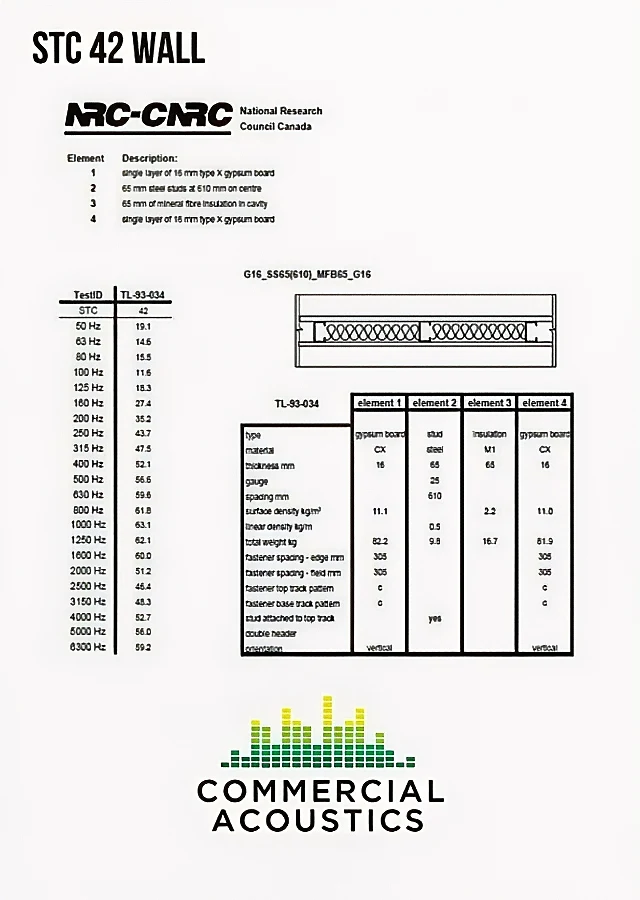
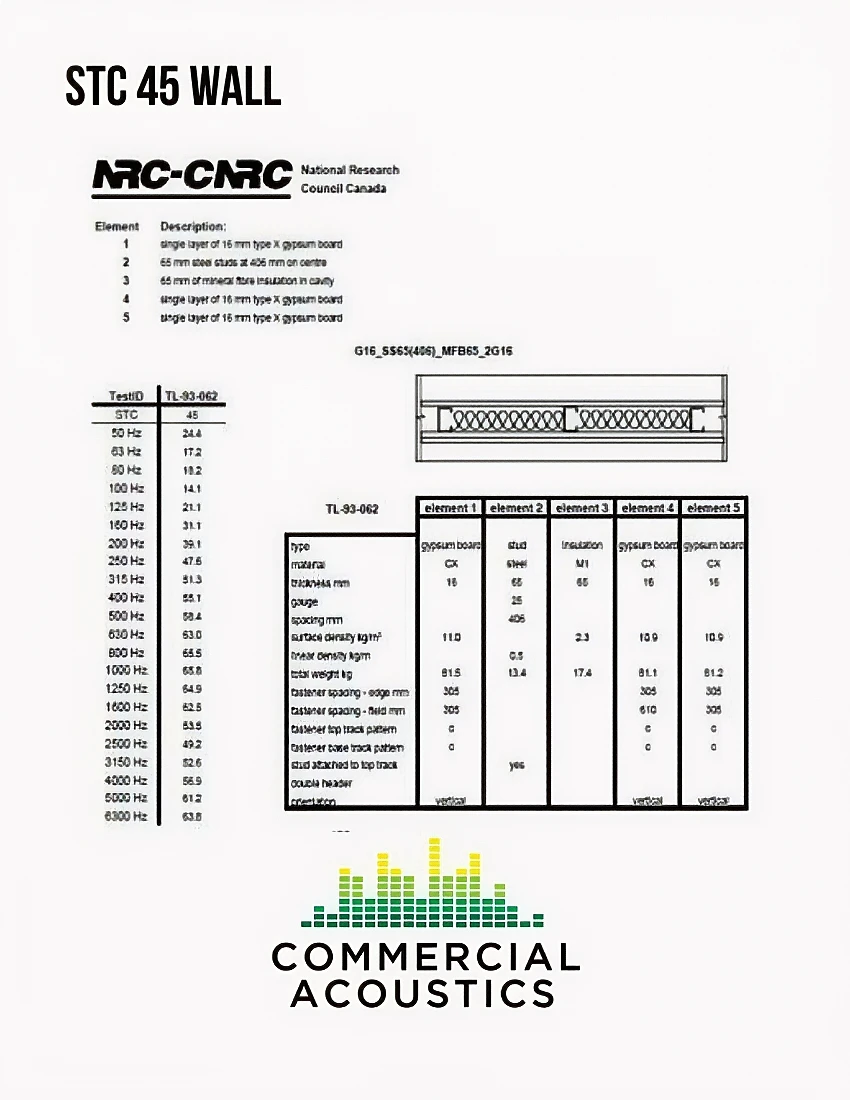
By comparison, adding another drywall layer might raise a wall’s rating from STC 42 to 45, but a single layer of Wall Blokker can boost performance by 10–12 STC points, reaching or exceeding code-required levels in one step.
Wall Blokker: Simple, Fast & Precise Installation
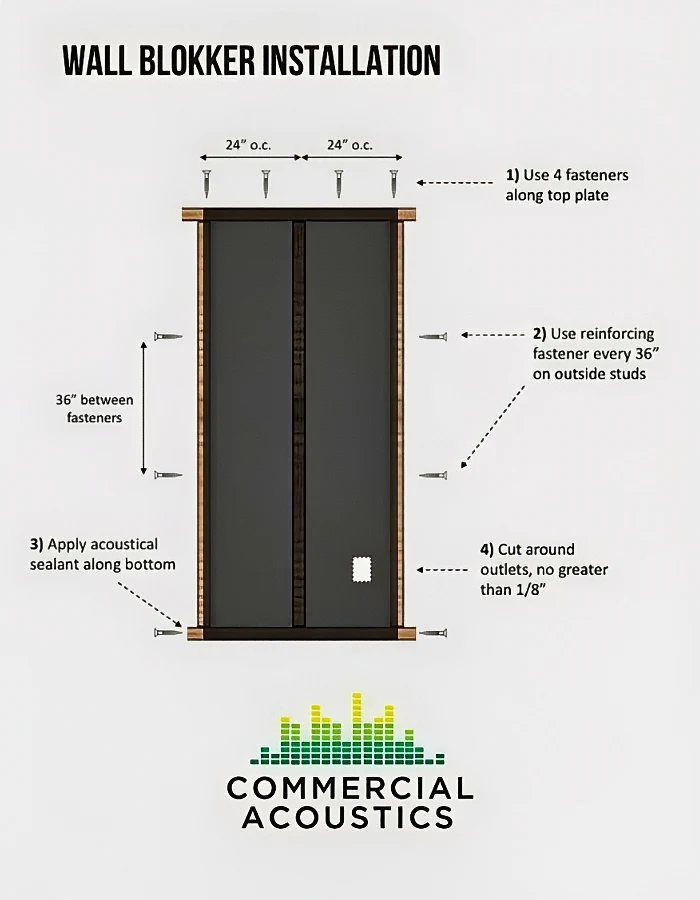
- Installs 3–4x Faster Than Drywall: Rolls mount directly to studs with staples or self-tapping screws.
- No Seams or Taping Needed: 4-foot-wide rolls align with standard 16″ or 24″ stud spacing.
- Custom Lengths Available: Sheets are cut to size—up to 35 feet—to eliminate horizontal joints.
Installing Wall Blokker is a fast, clean, and efficient process. The membrane unrolls directly over framing after inspection, reducing installation time and labor by up to fourfold compared to multi-layer drywall. Because it’s engineered for precise fit, Wall Blokker requires no seam taping or special tools. For hotel and multifamily projects, this streamlined installation can remove weeks from the critical path while maintaining consistent, high-performance sound isolation.
Conclusion: Building Beyond the Minimum
Achieving an STC 50+ wall is no longer an optional design feature—it’s a competitive advantage. Builders and architects who prioritize acoustic performance create spaces that feel more private, comfortable, and refined. While building codes set the baseline, true acoustic quality comes from careful detailing and proactive testing.
To simplify the design process, use our STC Calculator to model wall assemblies and predict their performance before construction begins. Reaching STC 50+ is the standard; exceeding it is how great projects stand out.
FAQs: Achieving STC 50+ in Wall Assemblies
What does STC 50 mean in a wall assembly?
It indicates that typical speech and everyday noise won’t transfer between adjacent spaces—meeting minimum IBC acoustic code requirements.
How can I reach STC 50 without doubling my wall thickness?
Use batt insulation, two layers of drywall, and resilient channels. Seal every seam and gap with acoustical caulk for consistent results.
Why do STC field tests sometimes score lower than lab tests?
Construction tolerances, flanking noise, and small leaks often reduce real-world performance. Proper sealing and attention to detail are key.
Is STC 50 enough for luxury projects?
In most cases, yes—but hotels, studios, and high-end residences often target STC 55–60 for complete privacy.
Where can I test my wall’s STC performance?
Hire an acoustic consultant to perform ASTM E336 testing. They’ll measure actual sound loss between rooms to confirm compliance and document results.
