Table of Contents
Project Overview: Dance Studio Soundproofing
- Project: AIIC Field Test for a Second-Floor Dance Studio in a Mixed-Use Building
- Location: South Florida (project anonymized)
- Facility Type: 2nd-Floor Dance Studio Above Ground-Floor Commercial Tenants
- Client: Architectural Firm on Behalf of the Building Owner
- Issue: Ground-Floor Tenant Foot-Fall Noise Transfer Concerns
- Scope: ASTM E1007 AIIC Field Test, Mitigation Spec, Tenant Guidance
Why Dance Studios Are Acoustically Difficult
Dance studios sit at the intersection of two acoustic problems most other building types only have one of. Foot-fall and movement generate structure-borne noise that travels straight down through the floor assembly into whatever space sits below. Music systems and instructor cues add airborne noise on top.
Both axes have to be addressed for a dance studio to coexist with neighbors. A wall assembly rated for STC 50 stops most airborne speech and music. It does almost nothing for the impact noise of 30 dancers landing in unison. The deeper read on the difference lives in our airborne vs structure-borne noise guide.
Mixed-use commercial buildings make this worse. Multi-family buildings have IIC code minimums (AIIC 45 in the field) that builders have to plan around. Commercial-on-commercial stacking has no code minimum, which means the studio operator and the ground-floor tenant inherit whatever the original construction delivered.
The ASTM E1007 AIIC Field Test
- Standard: ASTM E1007 impact insulation standard for in-place AIIC measurement
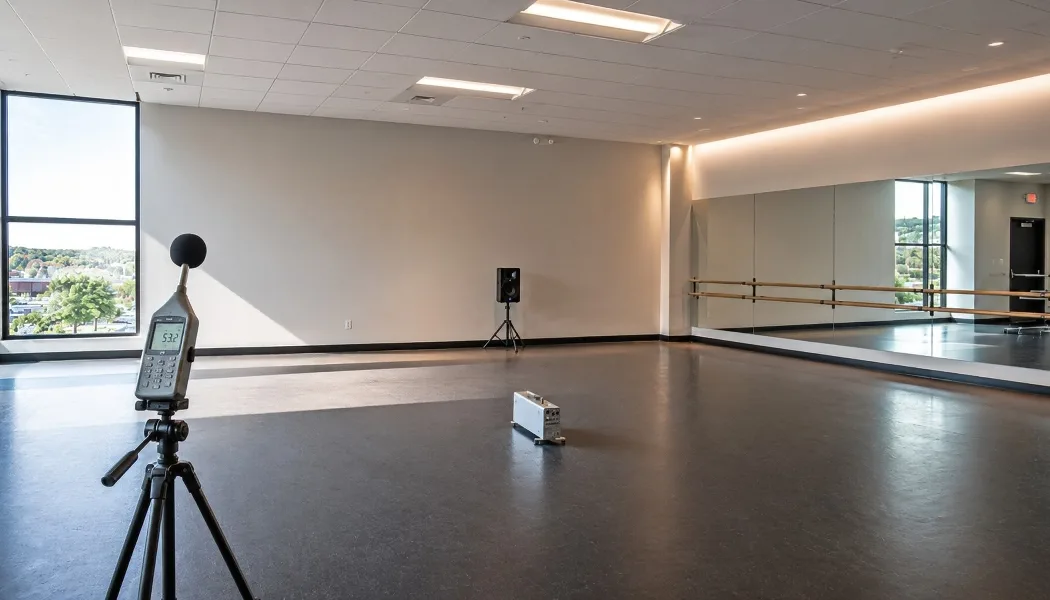
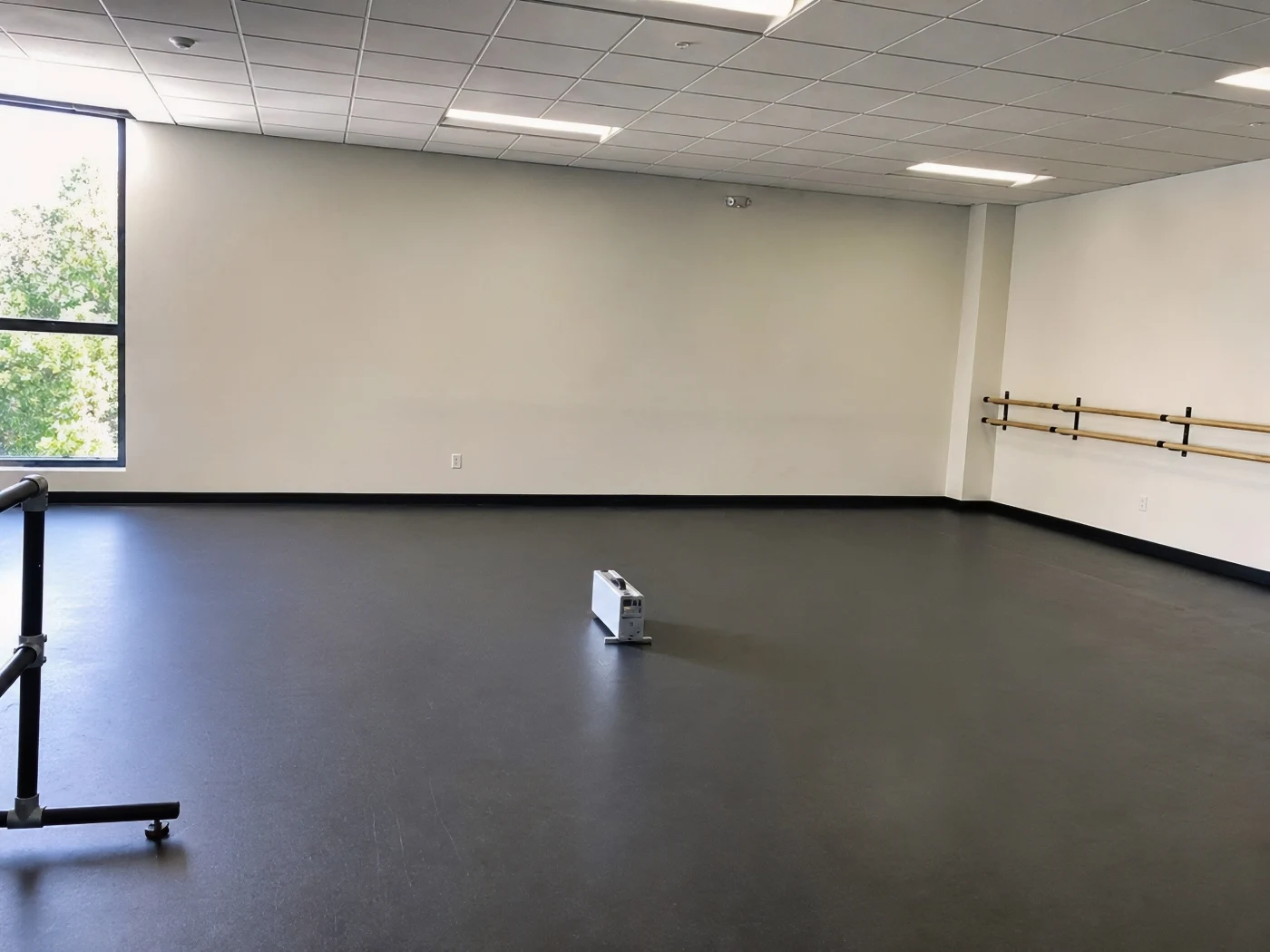
- Source: Standardized tapping machine on the dance studio floor
- Receive: Class 1 SPL meter in the ground-floor commercial space below
- Timing: Off-hours run to keep background noise out of the measurement
ASTM E1007 is the standard test for measuring impact noise transmission between vertically stacked spaces in an actual building, and the same method supports fitness floor impact testing when gyms or studios sit above another tenant. The tapping machine generates standardized impact pulses on the floor above. The meter on the receive side captures how much of that energy makes it through the floor-ceiling assembly. The delta becomes the AIIC number.
Off-hours timing matters because impact tests run quiet relative to the ambient noise of an active commercial building. Running the test during business hours lets HVAC, traffic, and other tenants contaminate the measurement. Off-hours tests are repeatable, which is what makes pre/post comparison possible after any mitigation work.
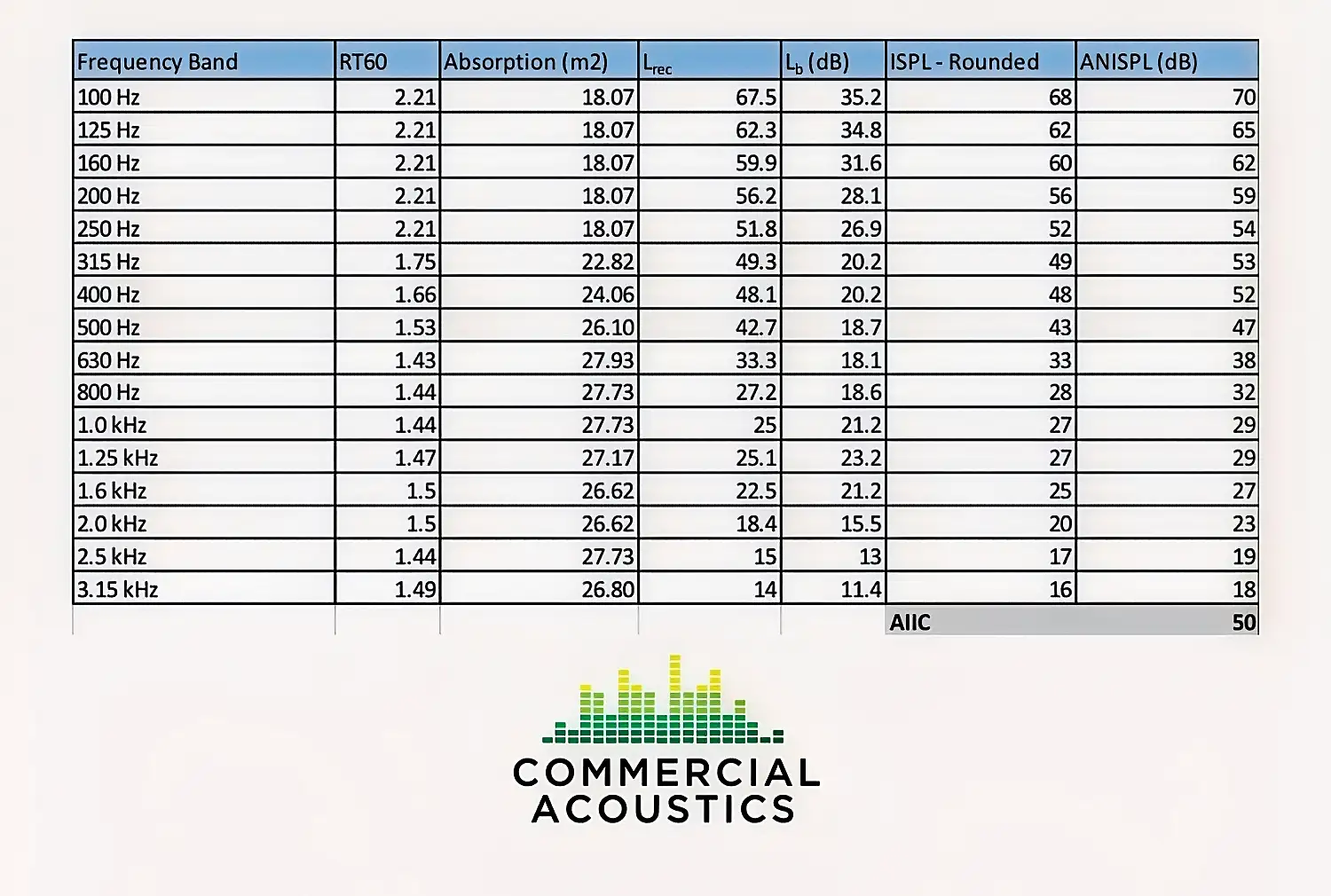
Test Results: AIIC 50
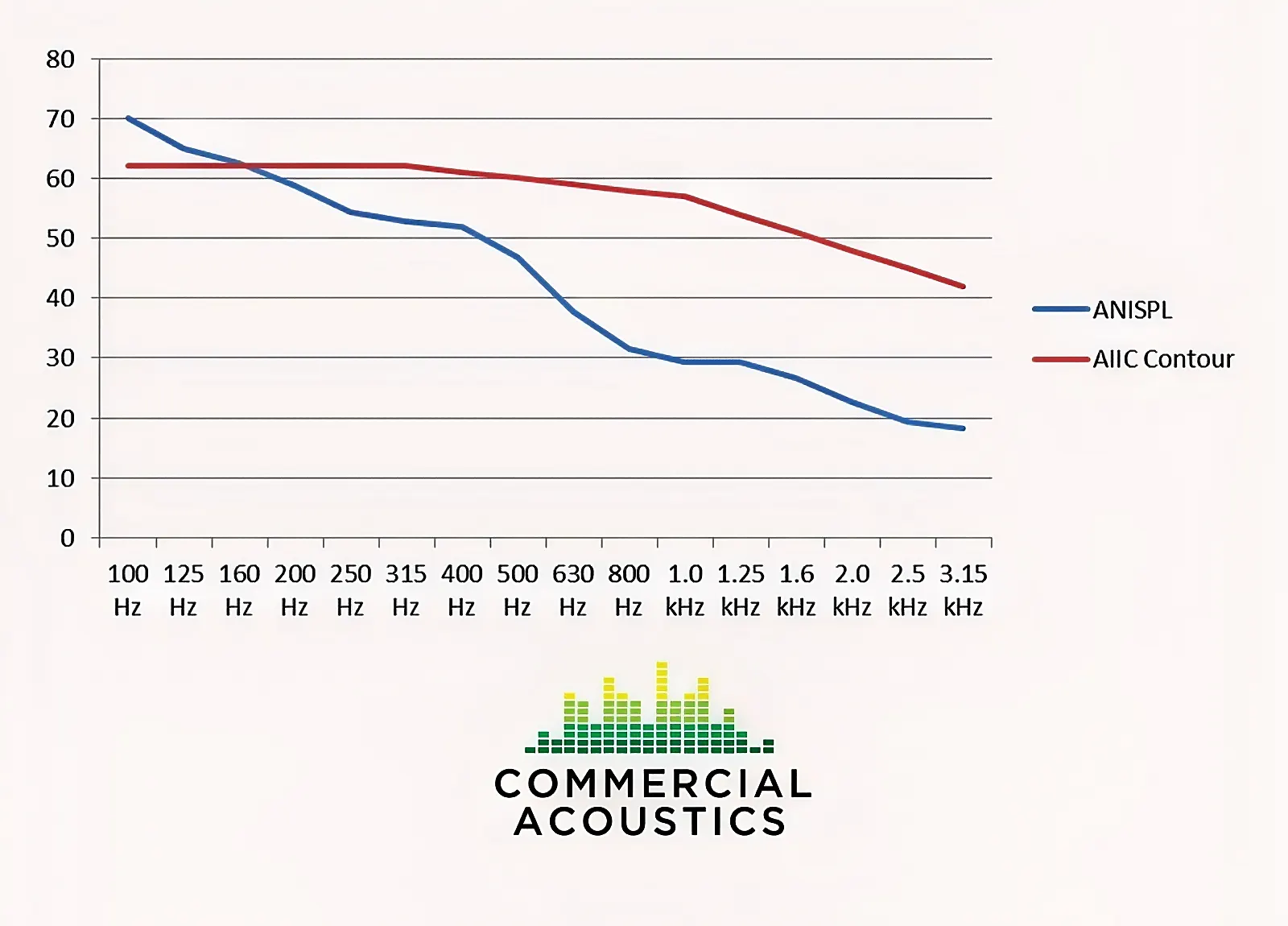
- Measured AIIC: 50 (above the AIIC 45 multi-family code baseline)
- Assembly Verdict: Existing floor-ceiling design is adequate
- Implication: Impact transfer to ground-floor space is within usable range
- Headroom: Margin available for future tenant accommodations
AIIC 50 places this assembly above the multi-family code baseline. It is not silent transfer, but it is the working floor for shared-vertical commercial use. The architect now has a defensible measurement to share with the prospective ground-floor tenant during lease conversations.
Mitigation Options for the Ground-Floor Tenant
- Resilient Drywall Ceiling: Decoupled gypsum on IIC clips or hat channel
- Acoustic Drop Tile: Suspended ceiling tile with rated NRC and IIC absorption
- Underlayment Above: Floor Blokker or equivalent underlayment on the studio side
- Tenant Selection: Property management vetting future ground-floor uses
The most cost-effective mitigation for the ground floor is a decoupled drywall ceiling on resilient clips. Adding a single layer of resiliently mounted gypsum below the existing structure adds 5 to 10 AIIC points of additional impact protection without disturbing the dance studio above.
The product side of the underlayment math runs through the Floor Blokker acoustic underlayment line, which adds rated impact absorption directly under the studio’s finished floor.
Dance Studio Soundproofing Targets by Setting
Dance studio AIIC targets shift with the building type and the tenant pattern below. Mixed-use commercial buildings with passive ground-floor tenants need the most isolation. Standalone studios need the least. The table below maps the working windows across four common settings.
| Setting | AIIC Target | Why It Matters | Recommended Treatment |
|---|---|---|---|
| Mixed-Use Commercial Studio (Tenants Below) | AIIC 50+ | Ground-tenant satisfaction, foot-fall control | Resilient ceiling plus acoustic drop tile |
| Multi-Family Above Dance Studio | AIIC 45 (code minimum) | Building code baseline for residential | Acoustic underlayment plus decoupled ceiling |
| Standalone Dance Studio | AIIC 35 to 45 | Self-contained, no neighbor below | Standard wall and floor assembly |
| Studio Above Active Tenant (Gym, Studio) | AIIC 40 to 45 | Both spaces tolerate some noise | Modest decoupling on the studio side |
The South Florida project landed at AIIC 50, which sits at the upper edge of the mixed-use commercial target. That gave the architect room to reassure the prospective ground-floor tenant without committing to an immediate retrofit.
Conclusion: Dance Studio Soundproofing
An ASTM E1007 AIIC field test on a second-floor South Florida dance studio returned a 50 reading — above the multi-family code baseline and inside the working window for mixed-use commercial buildings. Resilient ceiling plus acoustic drop tile remain the cheapest mitigation path for any ground-floor tenant who needs more headroom.
FAQs: Dance Studio Soundproofing
What AIIC should a dance studio target?
Mixed-use commercial dance studios target AIIC 50+ when ground-floor tenants are below. Multi-family above-dance assemblies target AIIC 45 minimum per code. Standalone studios with no neighbor below can run lower at AIIC 35 to 45.
What test measures dance studio impact noise?
ASTM E1007 measures field Apparent Impact Insulation Class. A standardized tapping machine runs on the studio floor while a Class 1 SPL meter reads the receive side below. The delta becomes the AIIC number.
How do you reduce foot-fall noise from a dance studio?
The cheapest path is a resilient drywall ceiling on IIC clips below the studio floor, paired with an acoustic drop tile. Floor Blokker underlayment on the studio side adds another rated impact-absorption layer when bigger reductions are needed.
Why are dance studios harder to soundproof than other rooms?
Dance studios generate two kinds of noise at once. Foot-fall and movement create structure-borne impact noise that travels through the floor assembly. Music and instructor cues create airborne noise on top. Both have to be addressed.

Walker Peek|Founder & CEO, Commercial Acoustics
Walker founded Commercial Acoustics in 2013 to bring aerospace-grade engineering discipline to soundproofing, and runs the firm as CEO from its 12,000 sq ft Tampa production facility. The company designs custom acoustic panels, sound membranes, and masking systems for multi-family, hospitality, healthcare, and commercial projects across the US — built around Walker’s invention, Wall Blokker, an EVA-based sound barrier that hits STC 50-plus at roughly $1 per square foot installed.
A Jacksonville native, Walker spent five years at Kennedy Space Center with Craig Technologies before founding Commercial Acoustics — certifying aerospace manufacturing to the AS9100 standard and leading Six Sigma Black Belt process-improvement teams on NASA programs. He is a certified Industrial Noise Control Engineer and the author of Architectural Acoustics: A Practical Handbook.
