
Table of Contents
Project Overview: Creative Agency Office Acoustic Ceiling Panels
- Project: Creative Agency Office Acoustic Ceiling Panel Installation
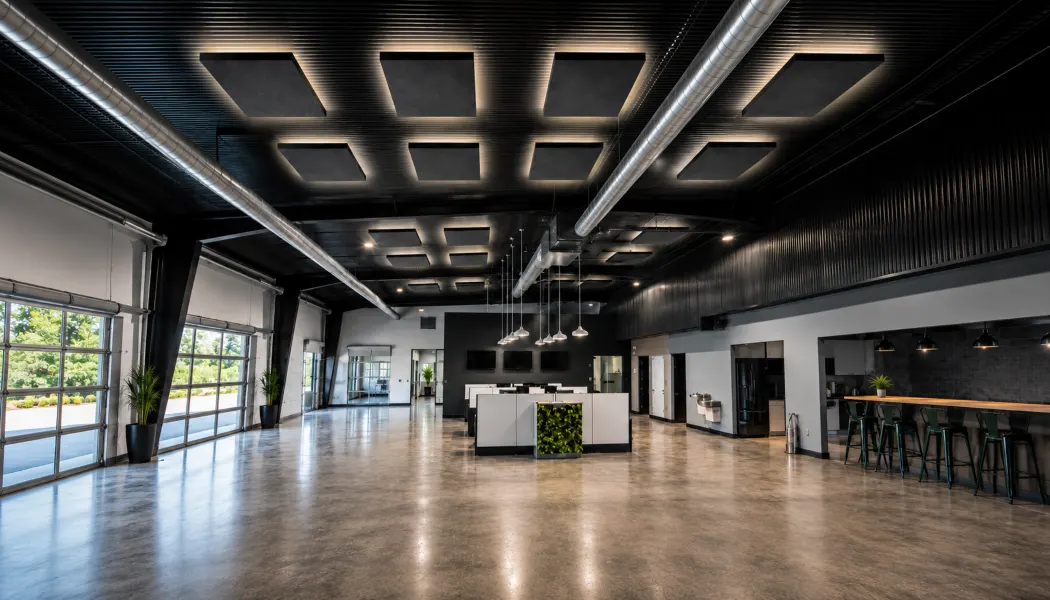
- Facility Type: Open-Plan Digital Media Marketing Office
- Client: Digital Media Marketing Agency (GrabAds)
- Issue: Hard Sealed Surfaces Caused Cross-Desk Communication Failure
- Scope: Acoustic Ceiling Panel Selection, Coverage Layout, Installation
- Outcome: Cross-Desk Speech Intelligibility Restored, Reverberation Cut
Why Open-Plan Creative Offices Are Loud
Creative agencies and digital media offices are usually built around the same finish palette. Polished concrete floors, exposed-deck ceilings, glass conference rooms, and minimal soft material on the walls. The aesthetic is intentional and reads as modern, but every one of those surfaces reflects sound rather than absorbing it.
Open-plan layouts compound the problem. Removing internal walls increases collaboration in theory and increases ambient noise in practice. Every phone call, video huddle, and side conversation propagates across the full footprint instead of being contained inside a private office.
The fix is absorption surface area inside the room dedicated to soaking up sound energy instead of bouncing it. The walls are usually full of brand artwork and screens. The ceiling is the one large surface left, which is why office acoustic design almost always lands there.

The Cross-Desk Communication Problem
- Symptom: Coworkers Could Not Communicate Between Desks
- Reverberation Time: Estimated Above 1.0 Seconds at Full Occupancy
- Target RT60: 0.4 to 0.6 Seconds for Open-Plan Office Work
- Productivity Cost: Reduced Output, Lower Morale, Weaker Team Communication
Reverberation time is the metric that drives office speech intelligibility. RT60 measures how long a sound takes to drop by 60 decibels after the source stops. Above 0.7 seconds in an open-plan office, individual phrases overlap with the tail of the previous speaker and the brain has to work harder to decode each sentence.
The cost compounds across an eight-hour workday. Cognitive load goes up, focused work suffers, and informal collaboration drops because nobody wants to start a conversation across the room. The deeper read on how vibration and reverberation actually move through an office lives in our how vibration travels through buildings guide.

Why Ceiling Panels Were the Right Call
- Largest Available Surface: Ceiling Was the Biggest Single Absorber Footprint
- Aesthetic Preservation: Walls and Floor Stayed Untouched
- NRC Range: Class A Panels at NRC 0.85 to 1.00 Selected
- Mounting: Direct-Attach Above Open Workstations
Ceiling treatment beats wall treatment in most offices for two reasons. The ceiling is the largest contiguous surface in a typical workspace, which gives the absorption math the most room to work. The ceiling also carries the lowest aesthetic risk because it is rarely a styling priority for the brand or the design team.
Class A absorption (NRC 0.85 and above) is the right specification window for a busy open-plan office. Lower-NRC panels still help, but the panel count required to hit the target reverberation grows quickly as NRC drops. The deeper math on how panel coverage scales runs through our how many acoustic panels do I need calculator.
The product line behind the install lives at the sound-absorbing acoustic panels page, with NRC ratings, sizes, and finish options on the spec sheet.

Panel Layout and Coverage
- Coverage Target: 20 to 30 Percent of Ceiling Area in Class A Absorption
- Priority Zones: Above the Densest Workstation Clusters
- Layout Pattern: Distributed Array, Not a Single Concentrated Cluster
- Sightlines: Panel Finish Selected to Read as Part of the Ceiling
Distributed coverage matters more than total square footage. A clump of panels above one corner of the room handles that corner and leaves the rest of the office reverberant. Spreading panels across the workstation footprint pulls energy out of the air everywhere a person is sitting.
Workstation density drives the layout map. Areas with the tightest desk packing get the highest panel density because that is where conversation overlap and keyboard noise stack the fastest. Treating the densest zones first delivers the largest perceived improvement per panel.
For a sister project that ran the same coverage logic for telecom conference room privacy instead of an open floor, see the telecom conference room acoustic treatment case study.
Office Acoustic Targets by Workspace Type
Office acoustic targets shift with the floor plan and the kind of work happening in the room. Open-plan creative offices need the most absorption. Private executive offices need the least. The table below maps the working windows across four common workspace types.
| Workspace Type | Ceiling Coverage | Target NRC | Target RT60 |
|---|---|---|---|
| Open-Plan Creative Agency Office | 20 to 30 percent | 0.85 to 1.00 | 0.4 to 0.6 sec |
| Conference / Meeting Room | 15 to 25 percent | 0.80 to 0.95 | 0.5 to 0.7 sec |
| Call Center | 25 to 35 percent | 0.85 to 1.00 | 0.4 to 0.5 sec |
| Private Executive Office | 10 to 15 percent | 0.70 to 0.85 | 0.5 to 0.7 sec |
The agency project landed in the open-plan creative row with 20 to 30 percent ceiling coverage and Class A absorption. That gave the room enough headroom to drop reverberation into the cross-desk communication window without wrapping the full ceiling.

Conclusion: Office Acoustic Ceiling Panels
Acoustic ceiling panels are the highest-leverage move available to a creative agency or open-plan office that needs to keep the brand aesthetic intact while restoring cross-desk communication. The digital media agency install dropped reverberation into the working window without touching the concrete, the glass, or the brand artwork that defined the space. Commercial Acoustics can scope a coverage estimate against any specific office footprint.
FAQs: Office Acoustic Ceiling Panels
How much ceiling coverage does an open-plan office need?
Open-plan creative offices need 20 to 30 percent of ceiling area in Class A absorption. Call centers run higher at 25 to 35 percent. Conference rooms hold the working window with 15 to 25 percent coverage. Private executive offices manage with 10 to 15 percent.
What NRC should office ceiling panels target?
Class A panels at NRC 0.85 to 1.00 are the right spec for open-plan offices and call centers. Lower NRC panels still help but require more square footage to hit the same reverberation target. Most office ceiling installs land at NRC 0.90 or above.
Why use ceiling panels instead of wall panels in an office?
The ceiling is usually the largest available surface and carries the lowest aesthetic risk. Walls fill up with screens, signage, and brand artwork the design team needs to keep. Ceilings give the absorption math the most contiguous square footage to work with.
What reverberation time should an open-plan office target?
RT60 of 0.4 to 0.6 seconds is the working window for open-plan office work. Above 0.7 seconds the room overlaps speech and forces cross-desk communication breakdowns. Below 0.3 seconds the room sounds dead and ambient energy drops too far.

Walker Peek|Founder & CEO, Commercial Acoustics
Walker founded Commercial Acoustics in 2013 to bring aerospace-grade engineering discipline to soundproofing, and runs the firm as CEO from its 12,000 sq ft Tampa production facility. The company designs custom acoustic panels, sound membranes, and masking systems for multi-family, hospitality, healthcare, and commercial projects across the US — built around Walker’s invention, Wall Blokker, an EVA-based sound barrier that hits STC 50-plus at roughly $1 per square foot installed.
A Jacksonville native, Walker spent five years at Kennedy Space Center with Craig Technologies before founding Commercial Acoustics — certifying aerospace manufacturing to the AS9100 standard and leading Six Sigma Black Belt process-improvement teams on NASA programs. He is a certified Industrial Noise Control Engineer and the author of Architectural Acoustics: A Practical Handbook.
