

Table of Contents
Why the Acoustic Properties of Sound Matter
Before you can control sound, you have to understand it. The acoustic properties of sound explain how noise behaves, moves, and interacts with the materials around us. Whether you’re designing a recording studio, a classroom, or a multi-family building, understanding these properties helps you predict how sound will carry—and how to manage it effectively.
Every sound can be described by measurable physical traits. Frequency determines its pitch, amplitude defines how loud it is, and duration affects how we perceive it over time. By studying these acoustic properties of sound, acousticians and engineers can diagnose problems and develop solutions that enhance comfort, privacy, and clarity in built environments.
Core Acoustic Properties of Sound
- Frequency (Hz): The pitch of a sound, measured in Hertz
- Amplitude (dB): The loudness or intensity of sound energy
- Duration or Fluctuation (sec): How long a sound persists and how much it varies over time
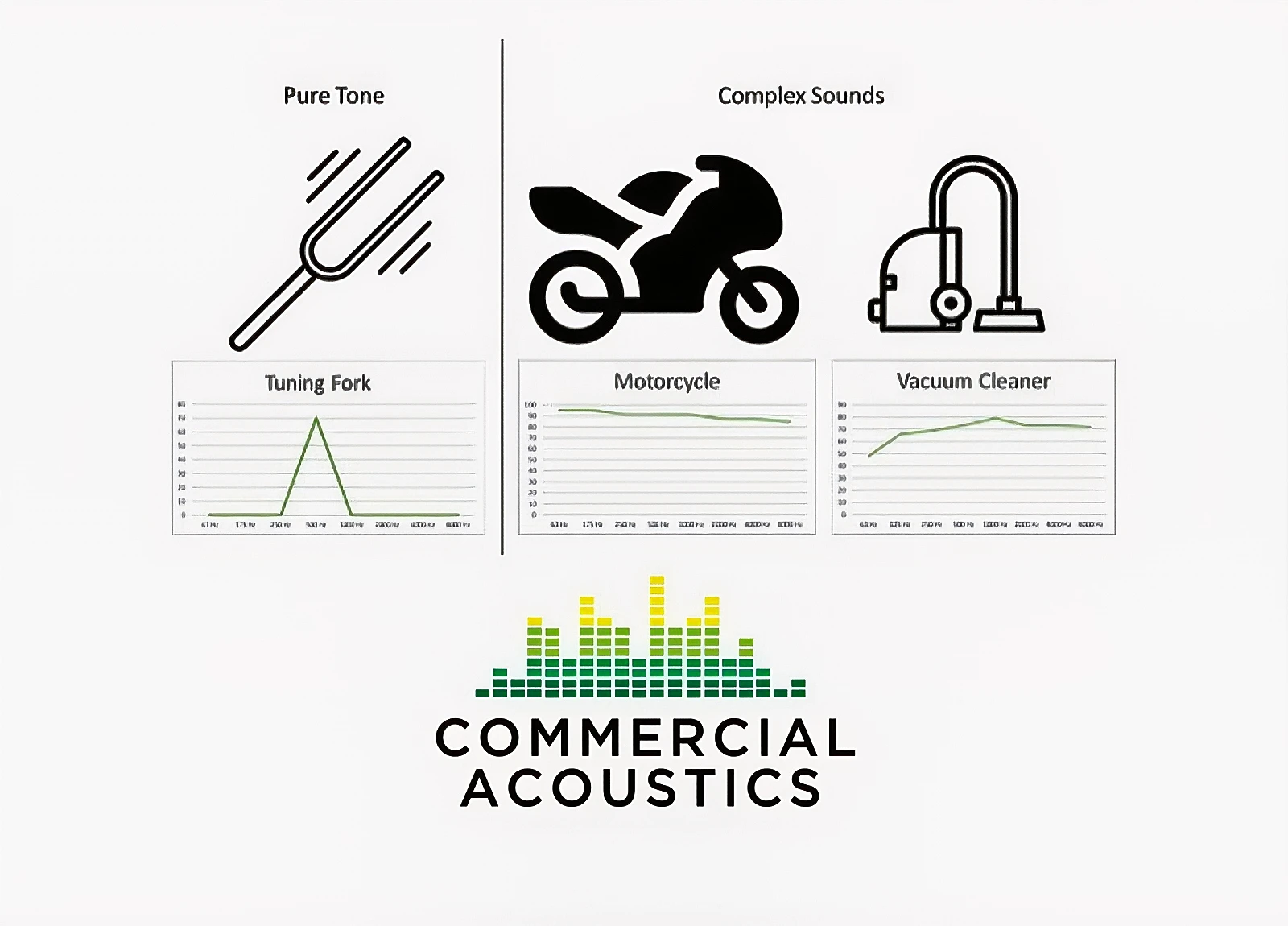
Frequency is what separates a deep rumbling bass note from a high-pitched whistle. Low-frequency sounds—like a foghorn or distant thunder—travel farther and are harder to block, while high-frequency sounds are easier to contain but often more piercing.
Amplitude represents the sound’s energy level, measured in decibels. The higher the amplitude, the louder the sound. Finally, duration plays a huge role in how we perceive annoyance or comfort. A steady fan might fade into the background, but a slamming door or sudden burst of laughter instantly draws our attention.
How Sound Travels Through Different Materials
- Sound Needs a Medium: It moves by vibrating air, wood, water, or metal
- Speed Varies by Density: Sound travels faster through dense materials
- No Air, No Sound: Sound can’t travel in a vacuum or in space
Unlike light waves, which move through empty space, sound waves rely on particles to transfer energy. When sound travels through wood or metal, it moves faster because the particles are packed more tightly. Through air, it slows down. That’s why you might hear a train coming through steel tracks before you hear it in the open air.
This also explains why sound doesn’t exist in space—without a medium to vibrate, the wave has nowhere to go. The acoustic properties of sound depend entirely on the medium it’s moving through.
Additive & Logarithmic Properties of Sound
- Decibels Increase Logarithmically: Every 10 dB equals roughly double the loudness
- Sounds Don’t Add Linearly: Two 80 dB drills don’t make 160 dB
- Relative Differences Matter: Small dB changes can mean big perceived shifts
The decibel scale isn’t linear—it’s logarithmic. That means a small numerical increase represents a large change in perceived loudness. For instance, a 60 dB sound is twice as loud as a 50 dB sound.
You also can’t simply add sound levels together. Two identical 80 dB sources will only increase the total sound by about 3 dB. This is why it takes four power tools operating together to raise sound from 80 to 90 dB, and more than seventy to reach 100 dB. Understanding this relationship is crucial when predicting how noise from multiple sources will combine in real spaces.
How Sound Frequency Shapes Perception
- White Noise: Mix of high and low frequencies, used for masking
- Pink Noise: Emphasizes low frequencies, reducing harshness
- Weighted Measurements: Use dBA to simulate human hearing sensitivity
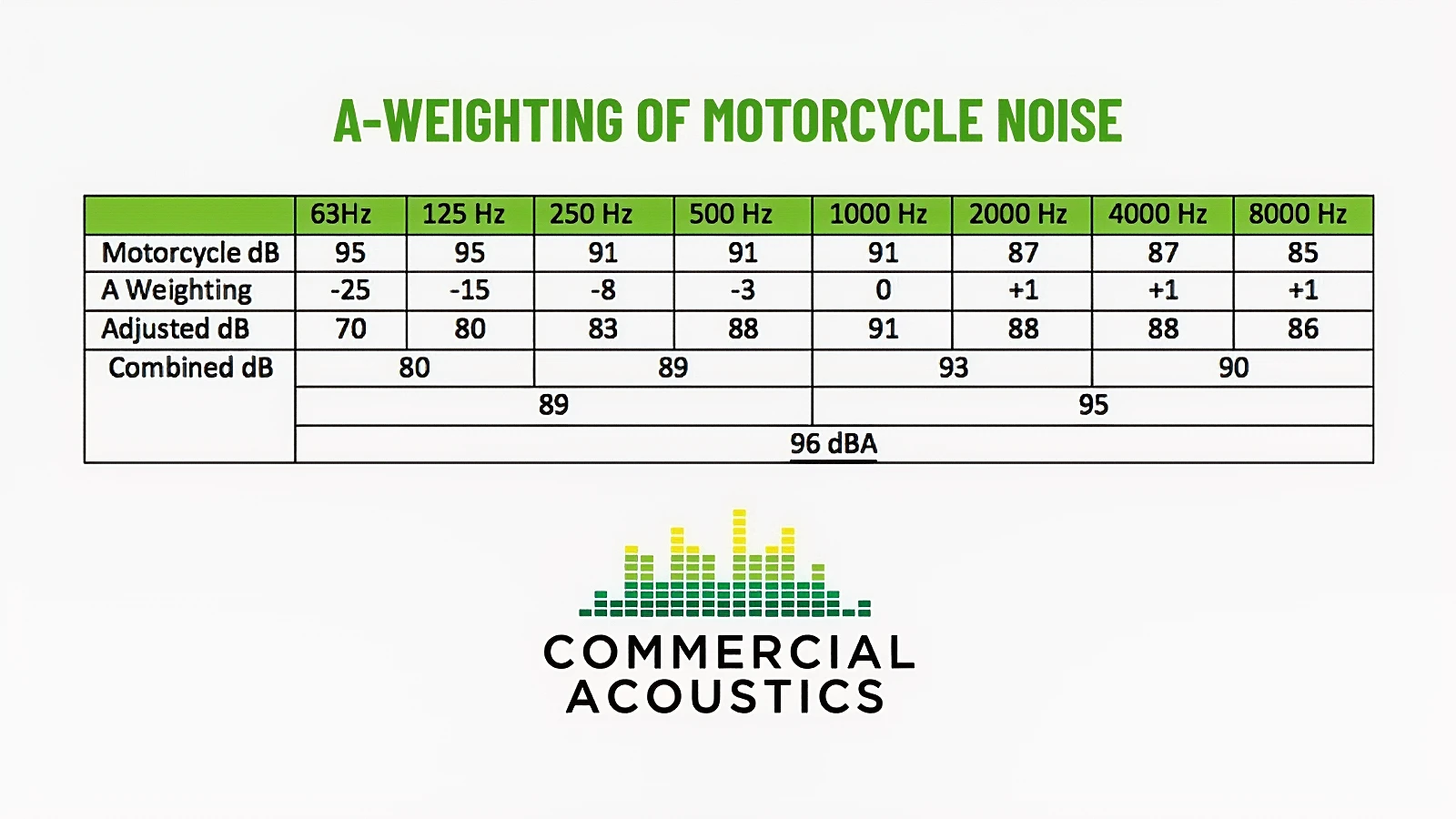
Human ears are not equally sensitive across frequencies. High-pitched sounds are more noticeable, while lower frequencies feel more physical than audible. That’s why acousticians often use the A-weighting system (dBA) to adjust raw sound levels to match how people actually perceive them.
A-weighting reduces the impact of very low frequencies and emphasizes those our ears detect most easily. The resulting single-number value (like 70 dBA) gives a practical way to compare complex sounds—whether it’s a motorcycle, a classroom, or an HVAC system.
The Acoustic Properties of Sound in Design & Construction
- Helps Predict Performance: Know how sound moves through materials
- Improves Comfort & Privacy: Reduce distractions and unwanted noise
- Supports Compliance: Meet building code and acoustic design standards
Understanding the acoustic properties of sound helps architects, engineers, and contractors design better spaces. By predicting how sound behaves—reflecting, absorbing, or transmitting through different materials—you can make informed decisions early in the design process.
Acoustic modeling and field testing bring these properties from theory into reality, ensuring that what looks good on paper performs just as well in the real world. For a scientific overview of why sound requires a medium to travel, see NASA Science: Anatomy of an Electromagnetic Wave.
Conclusion: From Sound Science to Real-World Solutions
The acoustic properties of sound are more than academic—they’re the foundation of every effective soundproofing or acoustic design strategy. By mastering how frequency, amplitude, and duration interact with materials and space, professionals can create environments that sound as good as they look.
At Commercial Acoustics, our team applies these principles to every project, from healthcare facilities to classrooms to multifamily developments. If you need expert analysis or soundproofing design, contact us today to learn how we can help translate the science of sound into measurable performance.
FAQs: Acoustic Properties of Sound
What are the main acoustic properties of sound?
Frequency, amplitude, and duration define how sound behaves. Together they describe how loud a sound is, how high or low it feels, and how it changes over time.
Why can’t sound travel in space?
Sound waves need particles to vibrate. In a vacuum, there’s no medium to carry those vibrations—so no sound can exist.
How does frequency affect soundproofing?
Low frequencies are harder to block because they have longer wavelengths. High frequencies are easier to isolate but often more noticeable to the ear.
What’s the difference between dB and dBA?
dB is the raw sound level, while dBA is adjusted to reflect how humans hear—reducing low-frequency energy and emphasizing mid-to-high ranges.
How do acoustic properties influence building design?
Understanding how sound travels and reflects helps designers choose materials, wall assemblies, and treatments that achieve target noise levels and reverberation times.
