
Table of Contents
Why Law Offices Need Sound Masking
In a law office, confidentiality isn’t just a convenience — it’s a legal requirement. Attorney-client privilege depends on ensuring private conversations stay private, but many firms discover that their offices aren’t built to support true speech privacy. Unlike open commercial offices where overheard chatter is simply distracting, in legal settings it can create ethical concerns and liability risks.
Sound masking has become a trusted solution across industries like healthcare and finance, and it is equally critical in law offices. By introducing a controlled background noise, sound masking reduces speech intelligibility, minimizes cross-talk between rooms, and creates a more secure, comfortable working environment.
Common Noise Issues in Law Offices
- Drop ceilings: Most demising walls stop at the ceiling grid instead of continuing to the deck, leaving gaps where sound easily travels.
- Conference rooms: Client meetings and teleconferences often leak into corridors and adjacent spaces without treatment.
- Private offices: Even closed doors can’t prevent conversations from flanking into neighboring rooms.
These problems are most obvious in offices built with acoustic ceiling tile (ACT). While effective visually, these tiles are thin and porous, offering little resistance to sound transfer. Conversations in one room often carry into the hallway or the office next door.
To determine whether your walls extend to the deck, simply lift a ceiling tile at the perimeter. If the wall stops at the ceiling height, chances are your office will benefit from a properly designed sound masking system.
How Sound Masking Works in Closed Offices
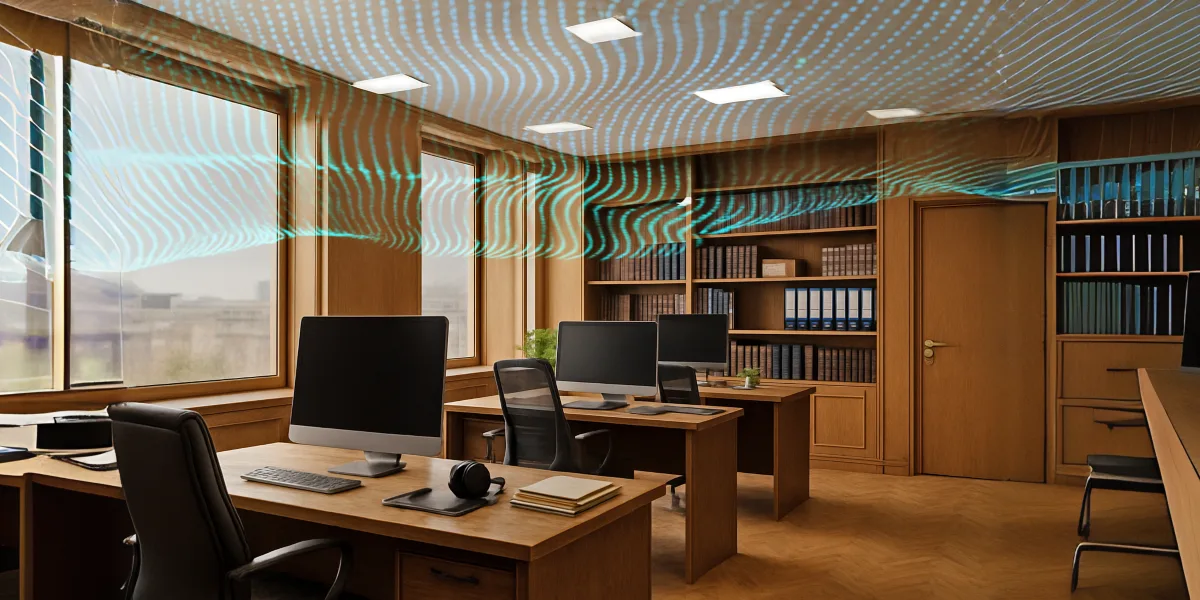
Many assume sound masking only benefits open office layouts, but it is just as important in law offices with closed private offices. Properly installed and tuned, a sound masking system emits a low-level “pink noise” that blends into the background, making speech less intelligible as it passes through ceilings and walls.
Boardrooms and conference rooms deserve special attention. These spaces often host multiple clients or sensitive teleconferences, and without sound masking, conversations may be audible outside. Just as firms invest in IT security to prevent data breaches, they should invest in acoustic security to protect confidential discussions.
Attorney-Client Privilege and Acoustic Privacy
- Boardrooms: Prevent discussions from being overheard in adjacent corridors.
- Private offices: Protect attorney-client conversations from flanking through ceilings and walls.
- Reception areas: Reduce the risk of confidential exchanges being audible to waiting clients.
Attorney-client privilege doesn’t stop at email encryption or secure file storage — it extends to every conversation held within the office. Without proper speech privacy, even unintentional leaks can damage client trust and credibility. Pairing sound masking with STC-rated door sweeps and seals ensures that both ceilings and doors — the two weakest flanking paths — are properly controlled.
Benefits of Sound Masking for Law Offices
- Confidentiality: Protect sensitive discussions & uphold attorney-client privilege.
- Professionalism: Maintain a secure, distraction-free environment for clients and staff.
- Compliance: Align with industry standards for privacy in legal, healthcare, and financial settings.
In industries where privacy is non-negotiable, sound masking offers an efficient, cost-effective way to strengthen acoustic performance. For law firms, it reduces the risk of overheard conversations, enhances workplace comfort, and reinforces the professionalism clients expect.
Conclusion: Build Privacy Into Every Legal Conversation
In today’s legal environment, sound privacy is every bit as important as IT security. Clients expect their conversations to remain confidential, and firms that overlook acoustics risk damaging both trust and reputation. A well-designed sound masking system is not just an add-on — it’s a critical safeguard for attorney-client privilege, workplace focus, and overall professionalism.
By pairing sound masking with complementary upgrades like STC-rated doors, seals, and quality ceiling systems, architects and contractors can deliver offices that perform to the highest standard of speech privacy. For law firms, that means fewer distractions, reduced liability, and spaces that reinforce confidence with every meeting.
Commercial Acoustics has designed and installed sound masking systems in offices, conference centers, and legal facilities nationwide. Request a sound masking design today to ensure your next law office project achieves the privacy, clarity, and performance your clients demand.
FAQs: Sound Masking for Law Offices
Why is sound masking important in law offices?
Because confidentiality is a legal requirement, not just a preference. Sound masking helps ensure attorney-client conversations stay private by reducing speech intelligibility through walls and ceilings.
Can sound masking be used in private offices or only open layouts?
It’s highly effective in both. In private offices, it masks conversations that might otherwise leak through ceilings or doors. In open areas, it keeps background noise consistent and reduces distractions.
How does sound masking improve attorney-client privilege?
By covering speech frequencies with low-level background noise, sound masking prevents confidential discussions from being overheard outside rooms or through shared walls—protecting both trust and compliance.
What areas benefit most from sound masking in a law firm?
Boardrooms, private offices, and reception areas. These spaces handle sensitive discussions daily and are often the weakest points for speech privacy if untreated.
Can sound masking be added after construction?
Yes. It’s one of the easiest acoustic solutions to retrofit. Systems can be installed above ceiling tiles or in open ceilings with minimal disruption to office operations.
