
Table of Contents
What Impacts Real Soundproofing Results
Good soundproofing isn’t just about adding mass or throwing insulation into a wall. The real challenge is making sure sound doesn’t find another way around. Two factors determine whether your design actually performs in the field — flanking and workmanship.
Flanking refers to sound slipping through the cracks — literally. It’s when noise bypasses the main barrier and travels through ceilings, ducts, gaps, or framing connections. Workmanship is everything that happens on-site: whether seals are applied, channels are installed properly, and the fine details match the drawings. Together, these two principles determine if your wall performs like an STC 55… or a hollow door.
Flanking Paths: The Sound You Didn’t Plan For
Sound doesn’t respect straight lines. It finds the path of least resistance — around corners, through ceilings, and between materials that share structure. That’s flanking. The “1% Rule” in acoustics says even a one-percent opening can let 50% of the sound energy pass through. So, a single missed gap can undo an entire wall’s rating (see our STC Rules of Thumb).
In offices, sound flanking often occurs when walls stop at the ceiling grid or when ACT tiles sit below an open plenum. In multifamily buildings, noise can travel through electrical boxes or shared joists instead of the wall itself. Adding more drywall or insulation won’t solve the issue—you have to seal the path. Rather than stacking materials, a more effective fix is to use high-CAC ceiling tiles with light hoods and HVAC boots, or incorporate a sound masking system to maintain speech privacy and reduce cross-talk between spaces.
Key Flanking Fixes:
- Extend partitions to the deck or slab above.
- Avoid back-to-back outlets and use putty pads.
- Add seals and door sweeps to improve perimeter control.
- Use lined ductwork and acoustic boots to close off return paths.
- Replace low-CAC ceiling tiles with high-performance options.
Real-World Example: A Tampa law office built with 10-foot partitions and suspended ceilings had persistent sound bleed between conference rooms. Instead of rebuilding, our team extended the walls to the deck, sealed all HVAC boots with acoustic caulk, and installed high-CAC ceiling tiles. STC improved by over 12 points, and private meetings stayed private.

Workmanship: Where Soundproofing Lives or Dies
Even the best acoustic design will fail if field installation cuts corners. Every trade on-site — drywallers, electricians, HVAC installers — can either protect or ruin a wall’s acoustic performance. Poor workmanship typically shows up in the form of missing sealant, overdriven screws, or improperly hung resilient channel.
Even the best acoustic design will fail if field installation cuts corners. Every trade on-site — drywallers, electricians, HVAC installers — can either protect or ruin a wall’s acoustic performance. Poor workmanship typically shows up in the form of missing sealant, overdriven screws, or improperly hung resilient channel.
Workmanship Best Practices:
- Train installers on acoustic details before drywall goes up.
- Inspect resilient channel orientation, spacing, and fastener length.
- Verify all penetrations are sealed with acoustical caulk, not general-purpose sealant.
- Confirm doors and seals are properly adjusted before turnover.
Acoustic design is science — but soundproofing in the field is craft. And craft comes down to workmanship.
Real-World Example: A midrise apartment project in Orlando specified resilient channel walls between units. But once residents moved in, noise complaints poured in. A field inspection revealed the RC channels were installed upside-down, and several screws had been driven directly into studs — “grounding” the system. The fix involved selective rework and a cost that could’ve been avoided with better supervision.
Resilient Channel: Small Metal, Big Impact
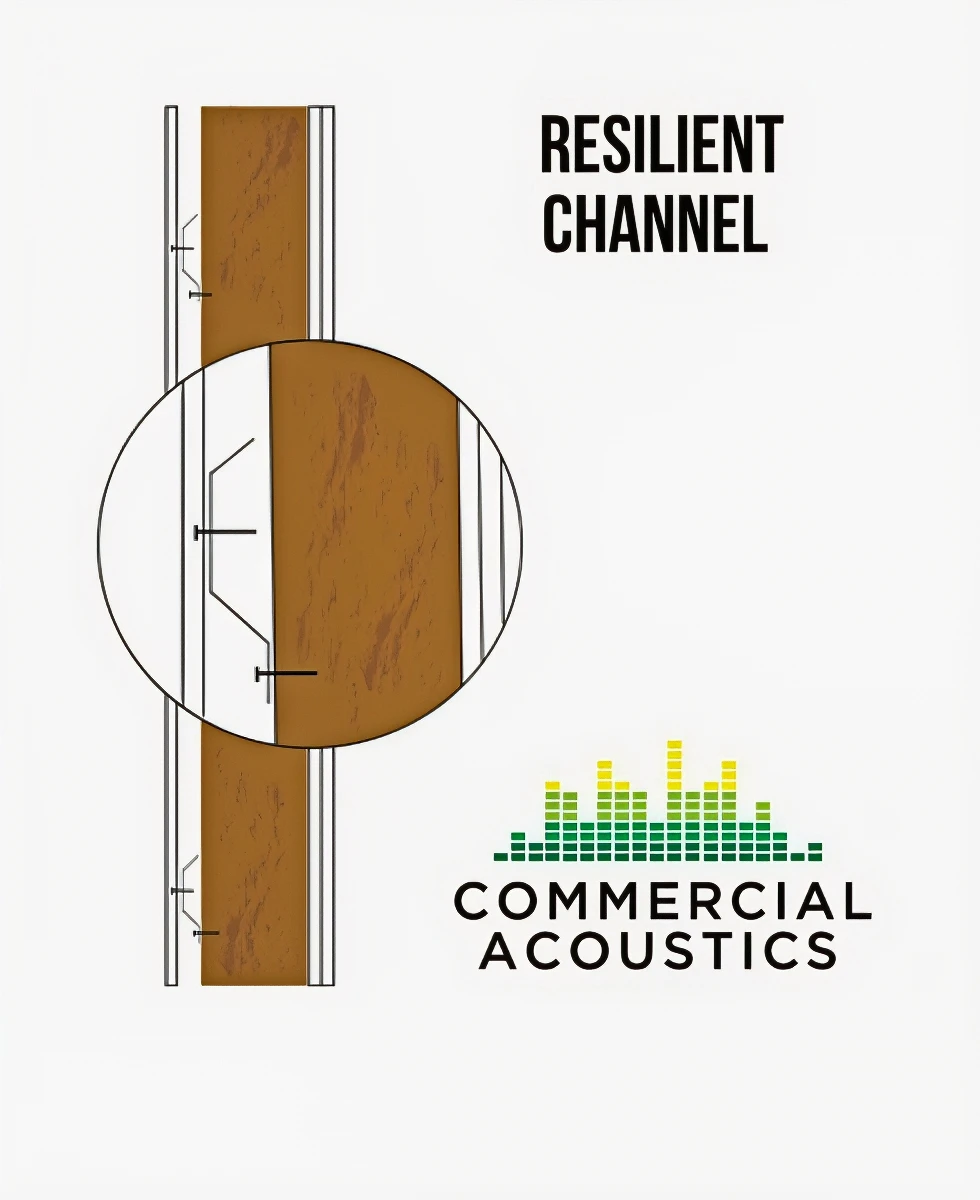
Resilient channel (or “Z channel”) isolates drywall from framing, allowing vibration to dissipate before reaching the next surface. It’s simple, affordable, and powerful — but only if installed right. Done wrong, it might as well not be there.
Common Resilient Chanel Installation Mistakes:
- Mounting TVs, cabinets, or millwork directly onto RC walls kills isolation.
- Using blocking behind the channel crushes the decoupling system.
- Overdriven screws can make rigid contact with studs and short-circuit performance.
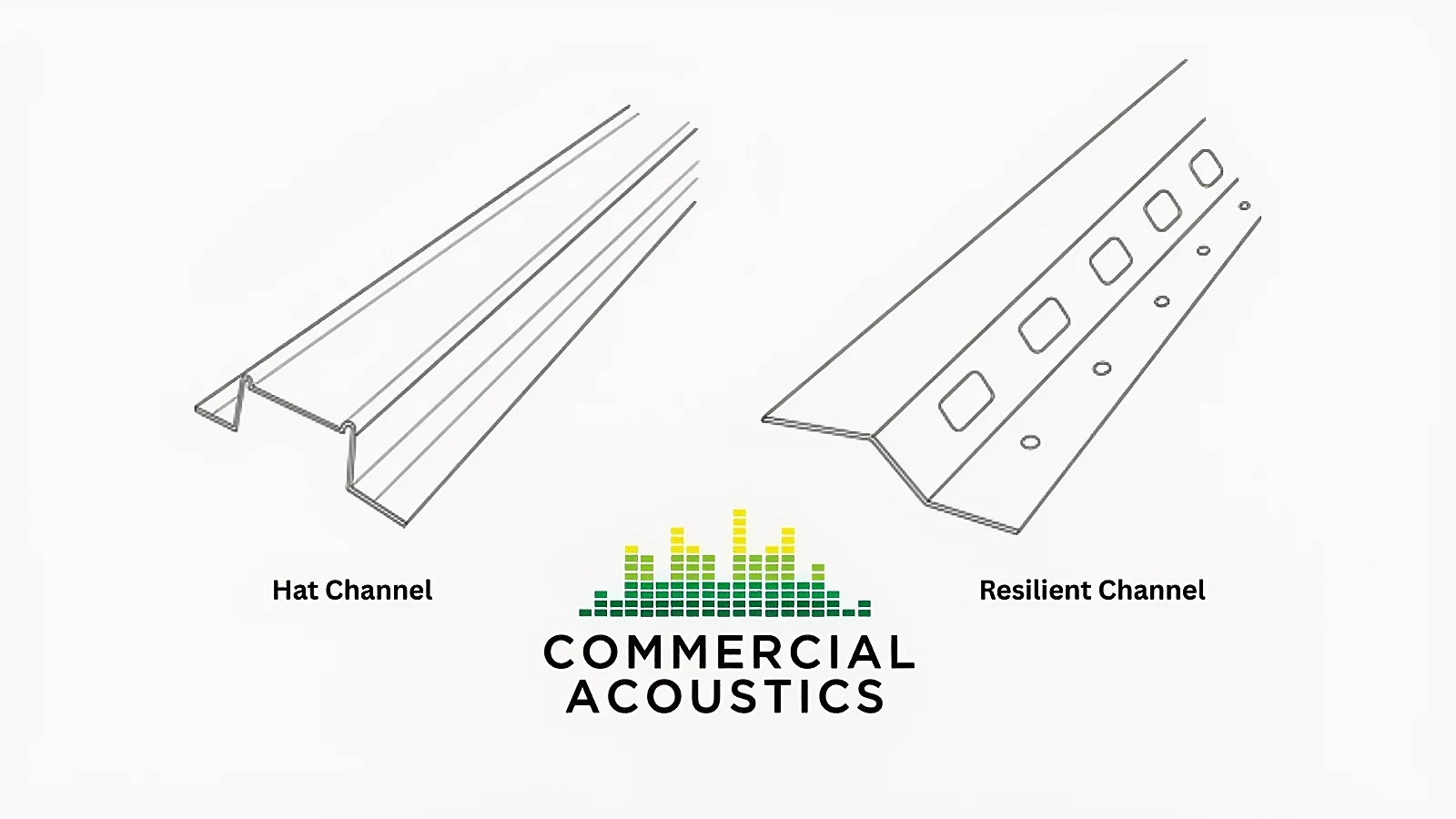
Hat Channel vs. Resilient Channel: Hat channel connects at two flanges and transmits vibration unless paired with isolation clips. Resilient channel connects at a single flange, decoupling the drywall. Use hat channel only when structure or load requires it — never as a substitute for acoustic isolation.
Real-World Example: In a university dorm renovation, designers specified RC walls between sleeping areas. After completion, sound transmission still exceeded acceptable levels. The post-audit showed students had installed shelves directly into the wall studs — compressing the resilient channel. The lesson: education doesn’t stop at design; it extends to the user.
Why Flanking & Workmanship Define Real-World Results
In laboratory tests, walls and floors perform under perfect conditions: sealed joints, precise installation, and no outside interference. But the field isn’t a lab. Sound travels wherever physics allows — and real construction rarely matches ideal drawings. That’s why flanking and workmanship determine whether your design hits its STC target or fails by 10 points.
When flanking paths are left open or workmanship slips, the result is predictable: noise complaints, change orders, and warranty calls. But when architects and contractors collaborate early, inspect key acoustic details, and maintain field discipline, performance becomes consistent.
According to the white paper “Building Acoustics — Sound Insulation” by Knauf, verifying acoustic performance in the field typically falls “up to 5 dB points lower and can be as high as 8 dB points lower” than the laboratory ratings due to workmanship, flanking and structural leakage. This underscores how critical early collaboration on detailing, sealing and field discipline really is.
Real-World Example: A mixed-use project in Miami specified STC 55 demising walls. During inspection, HVAC returns were left open between tenant spaces — an easy miss that dropped performance to STC 40. After isolating ductwork and re-sealing ceiling junctions, post-testing confirmed compliance without rework.
Controlling flanking and workmanship isn’t extra work — it’s risk management. Done right, it saves time, money, and reputation.
Conclusion: The Quiet Difference Is in the Details
Soundproofing doesn’t fail because of materials — it fails because of execution. When flanking paths are identified early and workmanship is held to a higher standard, projects consistently meet acoustic goals.
At Commercial Acoustics, we bridge design and construction to make that happen. Our team supports architects, GCs, and owners from early detailing through field verification, ensuring the finished space performs exactly as intended. Because in acoustics, silence isn’t luck — it’s built.
FAQs: Flanking & Workmanship in Soundproofing
What causes walls with high STC ratings to underperform?
Poor workmanship is the main reason. Even small gaps, missing sealant, or overdriven screws can create openings where sound escapes, lowering real-world performance compared to lab results.
What is flanking in acoustics?
Flanking occurs when sound travels around a barrier through ceilings, ducts, framing, or other hidden paths. It’s often the reason projects fail sound tests despite having properly rated assemblies.
Why is resilient channel installation so critical?
If installed incorrectly or grounded to studs, resilient channel loses its isolation function. Proper spacing, orientation, and fastener length are essential to prevent vibration from short-circuiting through the wall.
How can flanking be reduced during construction?
Extend partitions to the deck, seal every penetration with acoustical caulk, and isolate HVAC connections. Managing flanking paths during framing and finish stages preserves intended acoustic performance.
How does Commercial Acoustics help ensure field success?
Commercial Acoustics works with architects and contractors to refine details, inspect installations, and eliminate flanking and workmanship issues before they cause costly rework. Our goal is consistent, verified soundproofing results in every project.
