

Table of Contents
Why Outdoor Noise Control Matters
- Outdoor noise control is crucial for mitigating highway, industrial, and construction noise.
- Poor planning can result in long-term complaints and costly post-construction fixes.
- Proactive acoustic design helps maintain property value, comfort, and compliance.
While interior acoustics get the most attention, outdoor soundproofing plays an equally critical role. Continuous traffic, HVAC units, and nearby construction all contribute to elevated background noise levels that affect both comfort and productivity. In the U.S., acoustic planning is often reactive—addressed only after noise complaints—unlike Europe, where pre-development sound studies are standard. Early investment in outdoor noise control ensures quieter environments and prevents costly litigation or retrofitting later.
Common Sources of Outdoor Noise
- Highways and major roads: steady low-frequency noise
- Construction or demolition: impulsive or mechanical sounds
- Industrial operations: constant hums, compressors, or fans
- Outdoor venues and loading docks: variable crowd or impact noise
Understanding the type of sound source—whether linear like a freeway or point-based like a generator—determines the right mitigation approach. Linear sources demand long, continuous barriers, while point sources often need targeted sound-blocking solutions or modular acoustic panels.
1. Outdoor Sound Barriers: The First Line of Defense
- Height: Taller barriers block more direct sound energy.
- Proximity: Place barriers as close to the source or receiver as possible.
- Mass: Minimum 2 lb/ft² surface density for true sound-blocking performance.
- Continuity: Avoid gaps—sound flanks through even small openings.
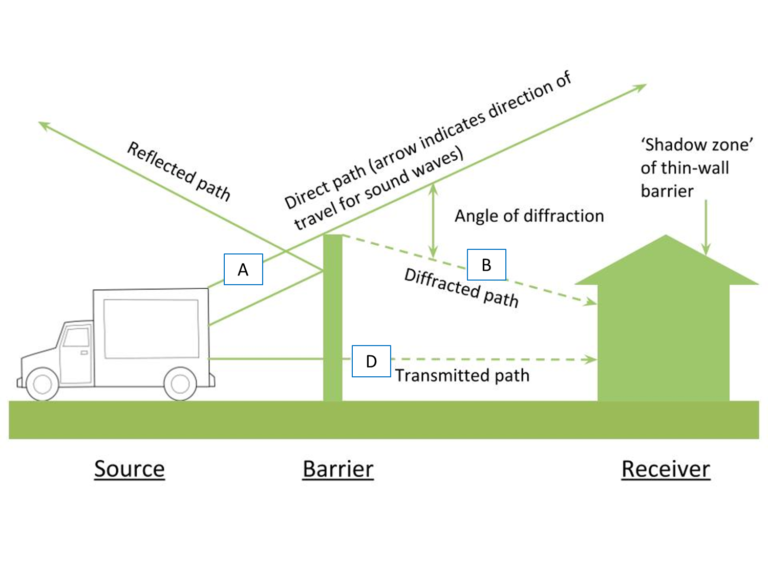
Outdoor sound barriers remain the most effective way to stop airborne noise before it reaches sensitive areas. Precast concrete walls and composite steel panels are common for highways, but flexible options like Fence Blokker are ideal for residential or commercial perimeters where aesthetics and adaptability matter. Fence Blokker panels are lightweight, weatherproof, and capable of reducing up to 75% of direct sound energy, making them a preferred alternative to traditional masonry walls.
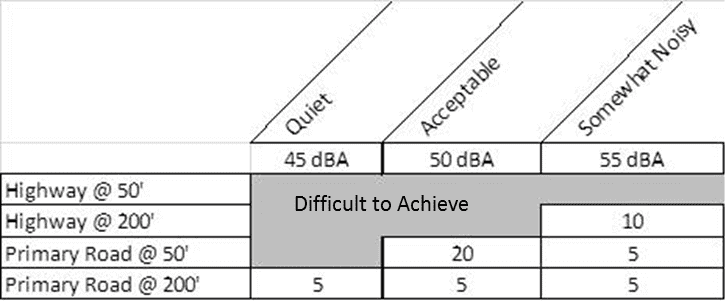
When designed properly, an outdoor sound barrier can reduce noise by 10–20 dB, transforming a disruptive environment into a tolerable one without compromising airflow or visibility.
2. The Role of Distance in Outdoor Noise Control
- Sound power drops by 6 dB with each doubling of distance.
- Heavy vegetation can add up to 10 dB of additional noise reduction.
- Smooth surfaces like concrete or water reflect sound; textured terrain diffuses it.
Distance is one of the simplest—and most cost-effective—tools for outdoor soundproofing. For example, noise measuring 100 dB at 25 ft drops to 82 dB at 200 ft purely through propagation loss. However, environments like parking lots or water bodies reflect rather than absorb sound, often requiring supplemental barriers or landscaping buffers.
Dense trees and shrubs can enhance attenuation, particularly when paired with a physical barrier such as Fence Blokker, which provides predictable results regardless of season or foliage density.
3. Understanding Noise Source Characteristics
- Low-frequency: Engines, subwoofers, HVAC equipment.
- Mid-frequency: Speech, general machinery.
- High-frequency: Whistles, alarms, or high-pitched tools.
Low-frequency sound travels farther and penetrates most materials easily, so barriers must balance mass and flexibility. Materials like mass loaded vinyl (MLV) and polymer composites offer better broadband attenuation than gypsum or plywood, especially below 125 Hz. Pairing flexible membranes with rigid barriers prevents resonance buildup and creates a more balanced attenuation curve across all frequencies.
4. Building Facades and Composite STC
- Even high-STC walls can fail due to weak links like windows or vents.
- Composite STC defines total façade performance.
- Upgrading weak components yields the biggest acoustic gains.
The total noise isolation of a building depends not just on wall assemblies but on the Composite STC, a weighted average of every façade component. For example, a brick wall (STC 55) paired with single-pane windows (STC 25) can drop the overall rating to STC 27.
Improving exterior soundproofing means focusing on the weakest points: upgrading to laminated glass, sealing joint lines, and reinforcing door gaskets. Use the STC Calculator to model and optimize your façade’s sound isolation before final design approval.
5. Real-World Outdoor Noise Control Solutions
| Noise Source | Recommended Barrier | Material Example | Estimated Reduction |
|---|---|---|---|
| Highway Traffic | Rigid precast wall | Concrete or masonry | 10–20 dB |
| Construction Sites | Flexible temporary barrier | MLV curtain or Fence Blokker | 8–15 dB |
| Industrial Equipment | Hybrid enclosure + barrier | Steel or composite panels | 15–25 dB |
| Outdoor Stage or Venue | Absorptive sound barrier | Fabric-faced acoustical panels | 10–18 dB |
Projects that combine physical barriers with smart material selection routinely achieve 10–25 dB reductions, which can cut perceived loudness in half or more. A mixed-use development near a major interstate, for instance, used Fence Blokker panels atop a 6-ft concrete base and achieved a verified 12 dB drop across occupied spaces.
Achieving Long-Term Outdoor Soundproofing Success
- Combine barrier height and mass for maximum attenuation.
- Use flexible membranes for low-frequency performance.
- Address flanking paths—sound finds the smallest openings.
- Model barrier placement with acoustic prediction tools.
Effective outdoor noise control isn’t about eliminating sound—it’s about intelligently managing it. By understanding how sound diffracts, reflects, and transmits through various materials, designers can create quieter, more livable environments. Whether it’s a permanent precast barrier or a lightweight Fence Blokker system for quick deployment, success depends on precise design and consistent installation quality.
Conclusion: Smarter Soundproofing for a Quieter Outdoors
Outdoor soundproofing is about strategic design—balancing acoustical science with construction practicality. The best results come from a combination of barrier height, mass, distance, and flexibility. Too often, projects rely on heavy materials alone, overlooking the importance of decoupling and broadband performance that low-frequency noise demands.
At Commercial Acoustics, we help engineers, developers, and architects design outdoor noise control systems that achieve measurable reductions without excessive cost or complexity. From Fence Blokker installations for residential or commercial perimeters to large-scale highway barriers, our team provides modeling, design, and installation support across the U.S. The result is a quieter, more sustainable built environment that enhances livability and compliance while adding measurable long-term value.
FAQs: Outdoor Noise Control & Soundproofing
What’s the most effective way to block outdoor noise?
Dense, continuous barriers made of concrete, steel, or MLV-based materials like Fence Blokker are most effective.
Can landscaping reduce outdoor noise?
Yes. Dense, full-height vegetation can reduce sound by 5–10 dB when used with solid barriers.
How tall should a sound barrier be?
Most exterior noise barriers range from 8–16 ft, depending on source height and proximity.
Are temporary outdoor noise barriers effective?
Yes. Flexible systems like Fence Blokker provide strong sound attenuation and can be reconfigured or moved as needed.
Does Commercial Acoustics design outdoor noise control systems?
Yes. We provide acoustic modeling, material selection, and full turnkey installation services across the U.S.
