
Table of Contents
The Challenge of Mechanical Noise Control
Mechanical noise shows up in every type of building — hospitals, manufacturing plants, offices, schools, and mixed-use developments. The challenge is that this noise typically comes from vibration, airflow turbulence, or panel resonance, and those problems travel easily through slabs, ductwork, and steel structures.
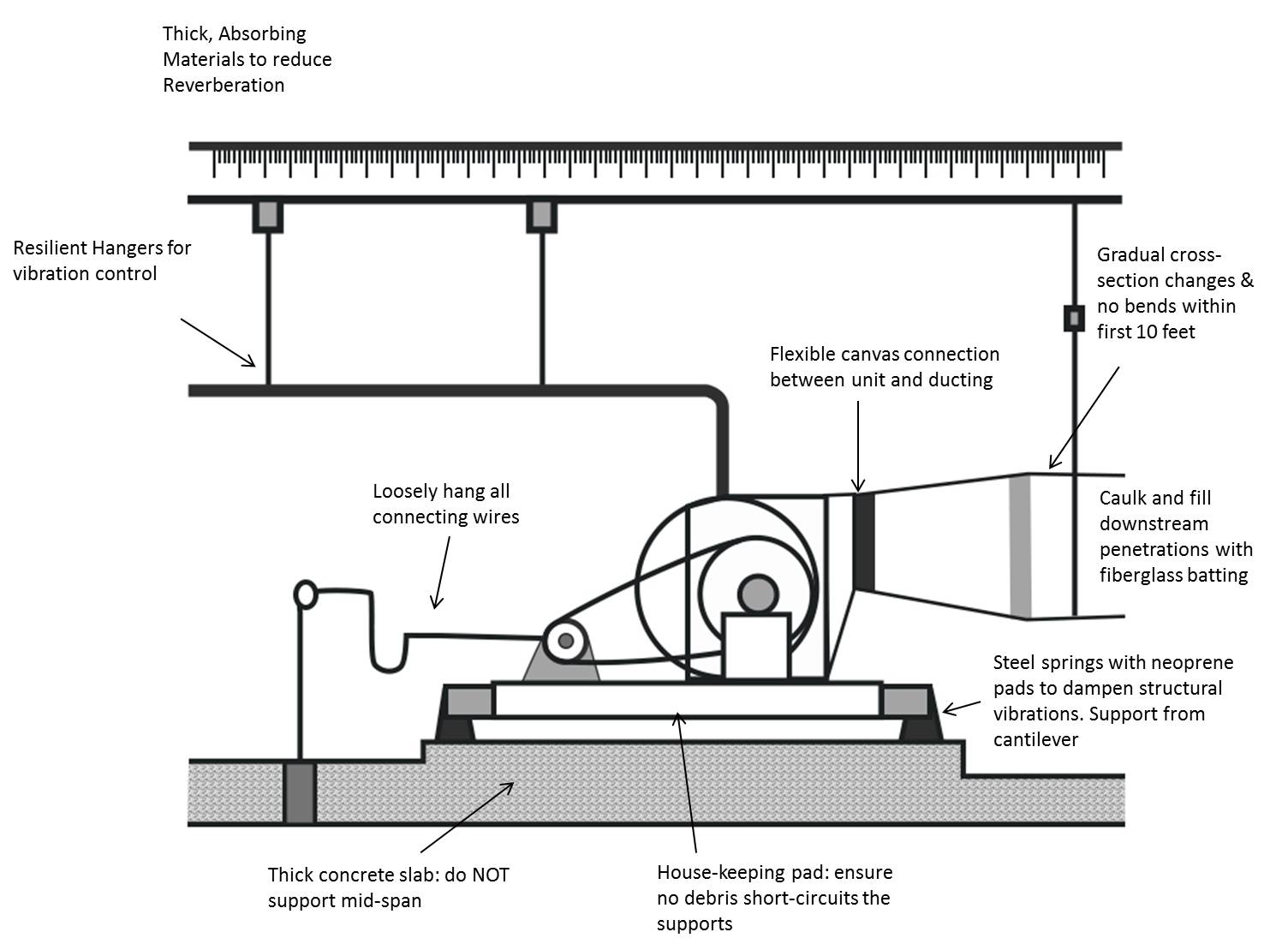
The solution is almost always an engineering one. Once you identify the source and the path, most mechanical noise issues can be reduced quickly with predictable, repeatable methods. Below are the 10 techniques we use most often when solving mechanical noise problems for architects, facility managers, and contractors across the U.S.
1. Vibration Isolation Pads (HVAC, Motors, Pumps, Compressors)
Used When: Equipment sends vibration into floors, walls, or steel framing.
Typical Reduction: 5–12 dB depending on mass and mounting.
- Neoprene or Rubber-Cork Pads: Absorb mid-frequency vibration and prevent machinery from coupling into the structure.
- Isolation Washers on Bolts: Stop bolts from bypassing the isolator — the most common cause of failed installations.
- Steel Bearing Plates: Spread equipment weight so isolators compress evenly and effectively.
- Correct Static Deflection: Ensures isolators match equipment load for maximum vibration absorption.
- Double-Isolation on Light Structures: Prevents mezzanines and thin floors from amplifying mechanical vibration.
Most mechanical noise begins as vibration, not airborne sound. Once vibration enters concrete or steel, it spreads throughout the building. Proper isolation pads stop that transfer at the source. When bolts, deflection, and load distribution are handled correctly, the low-frequency hum drops immediately — often outperforming expensive enclosures.
2. Constrained-Layer Damping (Chillers, Panels, Guards, RTUs)
Used When: Thin metal panels “ring” or radiate noise.
Typical Reduction: 3–15 dB depending on surface area.
- Laminated Metal Panels: Built-in damping eliminates casing resonance on rooftop units and chillers.
- Self-Adhesive Damping Sheets: Add mass and viscoelastic loss to noisy panels.
- Damping Tiles for Retrofits: Target the worst vibrating areas without replacing entire panels.
- Replace Weak OEM Guards: Thin guards behave like speaker cones; damped metal stops that behavior.
- Reinforce Wide Flat Surfaces: Large flat metal sheets radiate the most noise and benefit most from damping.
Metal panels vibrate like loudspeakers when airflow, motors, or compressors excite them. Constrained-layer damping drains energy inside the panel rather than allowing it to radiate outward. It’s extremely effective for chillers, AHUs, RTUs, and sheet-metal guards — any application where casing resonance drives overall noise.
3. Correct Fan & Duct Geometry
Used When: Turbulence, not vibration, drives noise.
Typical Reduction: 3–12 dB depending on severity.
- Straight Duct Before Inlet: Stabilizes airflow to reduce blade-pass noise.
- Move Dampers Away from Fan: High-velocity turbulence near the fan multiplies noise.
- Bell-Mouth Intakes: Smooth airflow entry reduces tonal peaks.
- Gradual Transitions: Avoids sudden velocity spikes that increase noise.
- Avoid Elbows Near Inlets: Elbows at the inlet create chaotic airflow and loud operation.
Fans get significantly louder when fed unstable airflow. Correcting duct geometry improves efficiency and noise performance simultaneously. Even small layout corrections can dramatically reduce blade-pass tones and broadband turbulence noise.
4. Duct & Pipe Lagging (Breakout Noise Control)
Used When: Ducts or hydronic lines radiate noise into occupied spaces.
Typical Reduction: 5–20 dB.
- MLV + Fiberglass Lagging: Adds mass and damping to stop noise from escaping duct walls.
- Internal Liners & Turning Vanes: Reduce turbulence that causes rumble and hiss.
- Increase Wall Mass: Heavier ducts radiate far less noise.
- Seal Penetrations: Prevents noise leaks around piping or duct passes.
- Resilient Hangers: Isolate duct vibration from structural slabs.
Breakout noise appears when thin metal ducts act like speakers. Lagging increases mass while internal liners calm the airflow, dramatically reducing noise. This upgrade is especially important for return plenums, mechanical rooms, and undersized ducts.
5. Resilient Hangers & Flexible Connectors
Used When: Noise transfers through ceilings or steel framing.
Typical Reduction: 6–15 dB.
- Resilient Duct Hangers: Prevent vibration from entering ceiling grids or joists.
- Flexible Connectors: Break rigid vibration paths at the equipment itself.
- Soft Pipe Supports: Keep pipes from rattling against steel framing.
- Floating Mount Clips: Reduce metal-to-metal contact.
- Sealed Penetrations: Block airborne spillover into adjacent rooms.
Rigid mounting can transmit vibration dozens of feet through a building. Resilient hangers and flex connectors interrupt those paths, eliminating drum-like resonance and low-frequency vibration in nearby rooms.
6. Cross-Talk & Return Air Noise
Used When: Rooms share a return plenum or open duct path.
Typical Reduction: 8–20 dB.
- Acoustic Baffles: Force sound to reflect multiple times, reducing speech clarity.
- Sound Maze / Sound Lock: Creates a long internal path that dissipates noise energy.
- Lined Transfer Ducts: Excellent for eliminating office-to-office noise transfer.
- Above-Ceiling Barriers: Blocks sound flanking over walls.
- Sealed Grid & Tile Gaps: Prevents noise bypassing duct paths entirely.
Cross-talk is a major privacy issue in offices. The duct path is almost always the leak. Lined transfer ducts and baffles break that path, delivering immediate improvements in speech privacy and overall acoustic comfort.
7. Mufflers & Silencers for Fans
Used When: Fans produce tonal peaks or broadband noise.
Typical Reduction: 10–25 dB.
- Inline Dissipative Silencers: Absorb broadband noise from turbulent airflow.
- Reactive Silencers: Target specific tonal frequencies like blade-pass tones.
- Large Cross-Section Silencers: Lower pressure drop while improving performance.
- Downstream Installation: Silencers work best after the fan, not before.
- Frequency-Matched Design: Incorrect silencers deliver poor results.
Fan noise often includes strong tonal peaks. Properly selected silencers cut these tones dramatically while preserving airflow performance. It’s one of the fastest ways to reduce mechanical room noise.
8. Flexible Piping & Vibration Breaks
Used When: Pumps or compressors send vibration through rigid piping.
Typical Reduction: 6–18 dB.
- Flexible Hose Sections: Interrupt vibration before it enters walls or floors.
- Isolated Couplings: Break rigid transmission paths along piping networks.
- Soft Pump Connectors: Prevent pump vibration from entering the piping system.
- Cushioned Pipe Clamps: Stop rattling against structural steel.
- Sealed Penetrations: Prevent airborne noise from leaking through wall openings.
Piping is an excellent vibration conductor. A compressor far away can still be heard clearly if the pipe is rigid. Flexible breaks eliminate that path and significantly reduce rumble and low-frequency vibration in adjacent spaces.
9. Room-Within-a-Room Enclosures (Extreme Noise Sources)
Used When: Equipment exceeds OSHA limits or causes persistent complaints.
Typical Reduction: 15–35 dB.
- Isolated Wall Framing: Completely decouples noise from the building structure.
- Mineral Wool Absorption: Reduces reverberation inside the enclosure.
- Floating Floor Panels: Stop vibration from re-entering the slab.
- Independent Ceiling Grid: Avoids coupling to the main structure
- Fully Sealed Penetrations: Ensures the enclosure actually performs.
RWAR enclosures deliver complete acoustic separation when simpler fixes are not enough. They eliminate vibration, airborne noise, and casing resonance altogether, making them ideal for the loudest mechanical systems.
10. Converting Guards into Acoustic Guards
Used When: Mesh or perforated guards leak airborne noise.
Typical Reduction: 5–15 dB.
- Reduce Gaps & Openings: Even small gaps leak significant noise.
- Polycarbonate or Metal Panels: Seal perforations while maintaining visibility.
- Internal Absorption Panels: Reduce reverberation trapped inside the guard.
- Damped Guard Panels: Prevent the guard itself from vibrating.
- Tight Perimeter Seals: Block flanking paths around the guard edges.
Closing openings and adding internal absorption dramatically reduces direct radiation and internal buildup. It’s a fast, low-cost way to improve airborne noise performance on many machines.
Real-World Mechanical Noise Reductions
- Vibration Isolation Pads → 6–12 dB
- Duct Lagging → 8–15 dB
- Aerodynamic Fan Upgrades → 10–20 dB
- Air Handler Isolation → 15–25 dB
- Panel Damping → 3–15 dB
These numbers come from actual projects, not lab tests. When you apply the right fix to the right noise path, the results are highly predictable — and far more effective than relying on enclosure-only solutions.
Conclusion: The Most Effective Way to Solve Mechanical Noise
Mechanical noise disappears when you identify the source, find the transmission path, and apply the correct engineering fix. Vibration isolation, duct lagging, airflow corrections, damping, and decoupling nearly always provide immediate improvement. These methods not only reduce noise but also improve system efficiency, reduce equipment wear, and extend service life.
If you need help diagnosing mechanical noise or want a targeted, cost-effective plan, Commercial Acoustics can evaluate the issue and recommend the most efficient path forward.
FAQs: Mechanical Noise Control
What causes most mechanical noise?
Mechanical noise typically comes from vibration, turbulent airflow, or resonant metal panels. Identifying which path is dominant determines the correct fix.
Can vibration isolation pads fix HVAC noise?
Yes—when installed correctly with isolation washers and proper static deflection. Incorrect mounting is the main reason pads “don’t work.”
Do duct silencers actually reduce noise?
Absolutely. When sized correctly, silencers can eliminate blade-pass tones and reduce overall fan noise by 10–25 dB.
What’s the cheapest way to reduce mechanical noise?
Vibration isolation pads and flexible connectors are the lowest-cost, highest-impact upgrades for most equipment.
Can Commercial Acoustics help diagnose mechanical noise?
Yes. We provide on-site testing, vibration analysis, and turnkey mechanical noise solutions for facilities across the U.S.