Table of Contents
What IBC §1206 Says
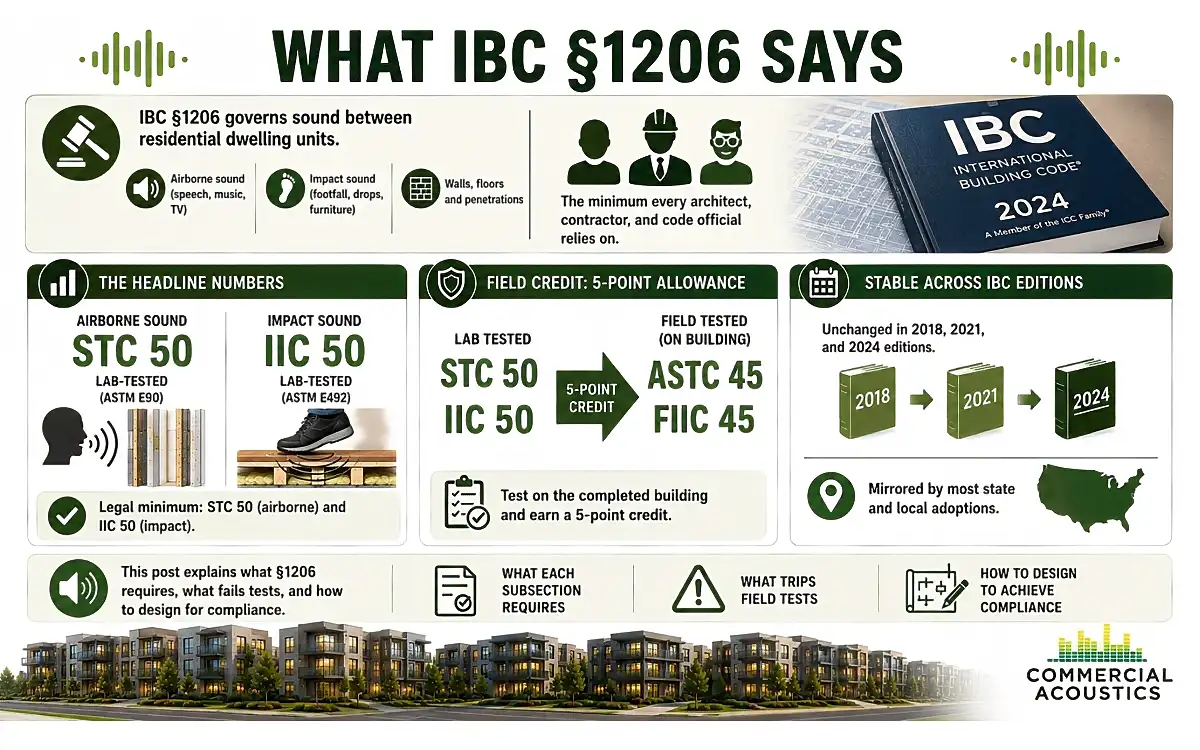
IBC Section 1206 is the part of the International Building Code that governs sound transmission between residential dwelling units. It defines the minimum acoustic performance for walls, floor-ceiling assemblies, and the penetrations through them — both for airborne sound (speech, music, TV) and impact sound (footfall, dropped items, dragged furniture). It is the section every architect, contractor, and code official defaults to when a multifamily, hotel, or hospitality project asks “what is the legal minimum?”
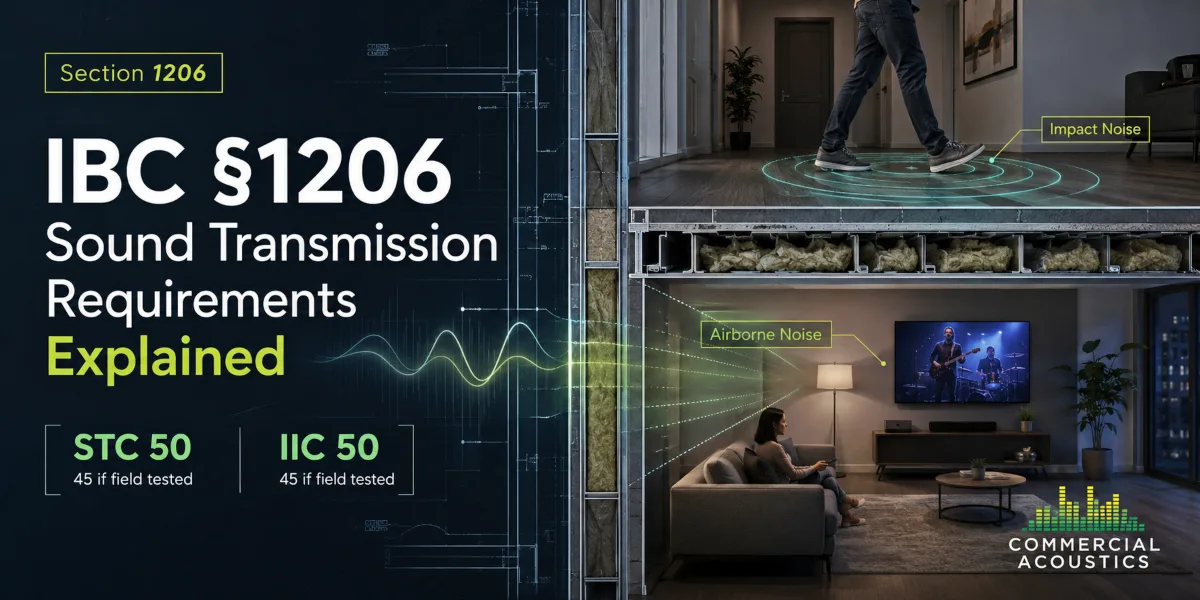
The headline numbers are STC 50 for airborne sound and IIC 50 for impact sound, both lab-tested, with a 5-point field credit if you instead measure performance on the completed building. Those numbers have been stable across the 2018, 2021, and 2024 editions of the IBC, and have been mirrored by most state and local adoptions. This post breaks down what each subsection requires, what trips field tests, and how to design to land in compliance after the field penalty is paid.
If you need a primer on what STC and IIC mean before the code language, start with our STC overview and IIC chart.
Scope: Which Assemblies Are Covered
§1206 applies to walls, partitions, and floor-ceiling assemblies that separate:
- One dwelling unit from another dwelling unit
- One sleeping unit (e.g., hotel guest room) from another sleeping unit
- Any dwelling or sleeping unit from a public service area — corridor, stairwell, mechanical room, laundry room, elevator shaft, trash room
It does not govern exterior walls or windows (those fall under separate energy and structural sections), interior partitions inside the same unit, or assemblies separating commercial spaces. It is a residential-occupancy code — Group R in IBC classification — though the same numerical targets are routinely adopted as design standards for healthcare, hospitality, and educational projects through other regulatory frameworks.
- Lab tested per ASTM E90 / E413
- Field tested per ASTM E336
- Applies to walls, floors, ceilings
- Between dwelling units and from public areas
- Fix: speech, music, TV transmission
- Lab tested per ASTM E492 / E989
- Field tested per ASTM E1007 (AIIC)
- Applies to floor-ceiling assemblies only
- Above-unit impact transmission to the unit below
- Fix: footfall, dropped items, structure-borne
§1206.2 — Airborne Sound: STC 50 (Lab) or NNIC 45 (Field)
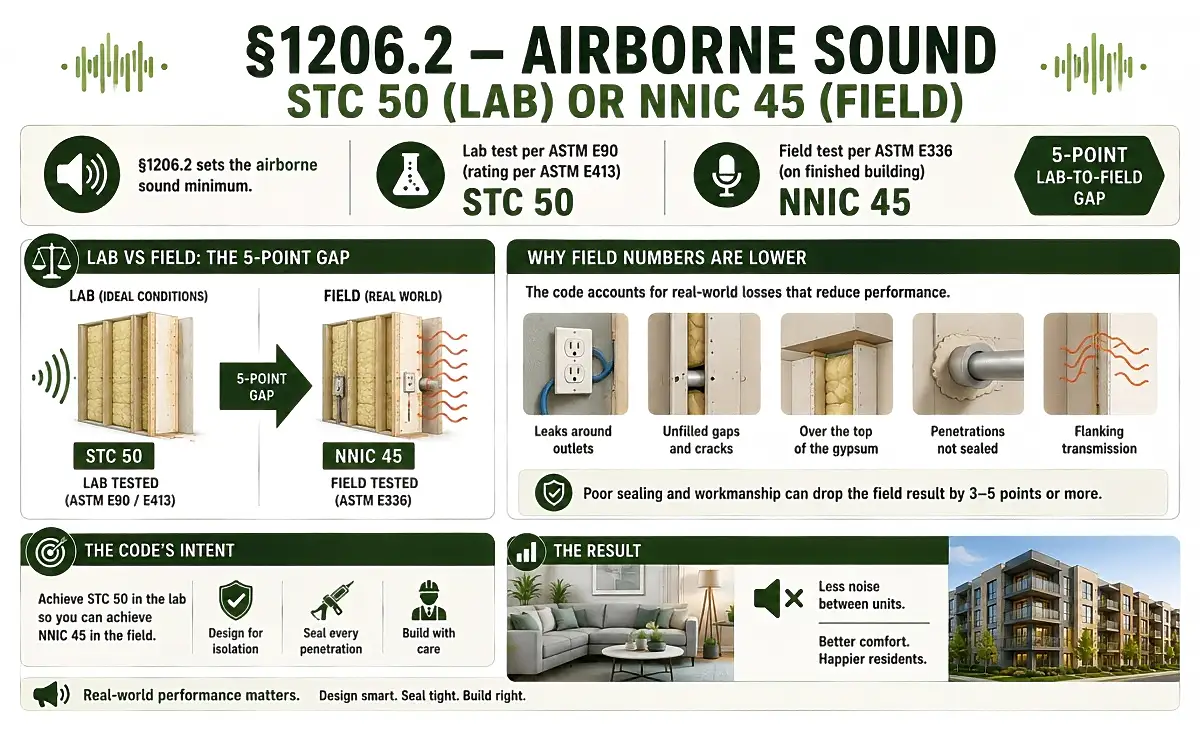
§1206.2 sets the airborne sound minimum at STC 50 when tested in the lab per ASTM E90 (with the rating calculated per ASTM E413). The alternative compliance path measures performance on the finished building per ASTM E336 and requires a Normalized Noise Isolation Class (NNIC) of 45.
The 5-point gap between the lab and field thresholds is not arbitrary: it is the code’s acknowledgment of flanking transmission, construction tolerances, and workmanship loss. Real walls leak around outlets, through unfilled gaps, over the top of the gypsum, and through every penetration the design did not catch. A wall that tests at STC 50 in the lab routinely measures 3–5 points lower at the property — sometimes more if penetration sealing was sloppy. The code lets the field result trail the lab number by exactly that margin.
For typical wall assemblies and the 12 variables that move the STC number, see our wall STC reference.
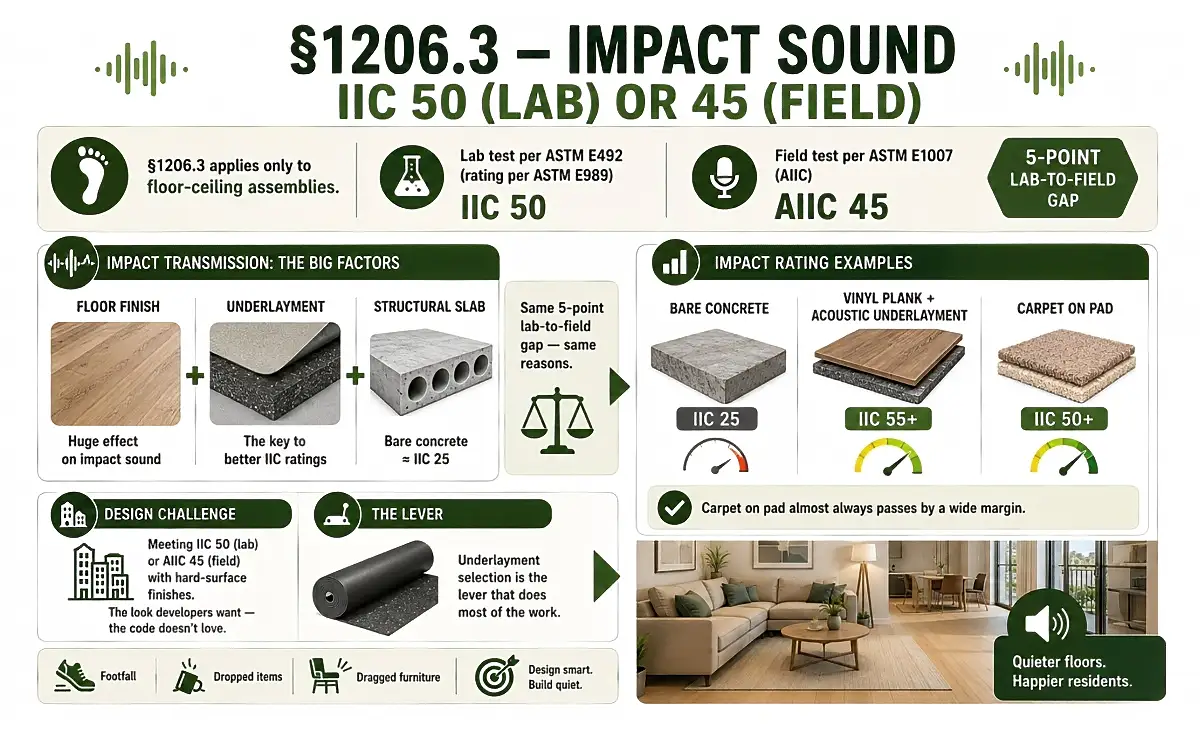
§1206.3 — Impact Sound: IIC 50 (Lab) or 45 (Field)
§1206.3 applies only to floor-ceiling assemblies and sets the impact sound minimum at IIC 50 when tested in the lab per ASTM E492 (rating per ASTM E989). The field alternative measures Apparent Impact Insulation Class (AIIC) per ASTM E1007 and requires AIIC 45.
The same 5-point lab-to-field gap applies, and for the same reasons. Impact transmission is dominated by the floor finish and the underlayment beneath it; bare concrete is around IIC 25, vinyl plank over an acoustic underlayment can reach IIC 55+, and carpet on pad almost always passes by a wide margin. The challenge in modern multifamily design is hitting the spec with hard-surface finishes — the look most developers want and the geometry the code does not love.
Underlayment selection is the lever that does most of the work. See our Delta IIC chart for how different underlayments contribute to the final IIC of a finished floor.
§1206.4 — Penetrations and Common Pitfalls
§1206.4 is the subsection most field tests fail on. The code requires every penetration that compromises a rated assembly — piping, electrical, recessed cabinets, bathtubs, soffits, HVAC ducts — to be sealed, lined, insulated, or otherwise treated to maintain the required sound transmission rating.
The common failures we see at field testing:
- Back-to-back electrical outlets across a demising wall — an acoustic short circuit that drops the rating 2–5 points. Offset by at least one stud bay and wrap each box with an acoustic putty pad.
- Unsealed perimeter joints — the bottom plate, top of wall at the ceiling, and any framing penetrations need acoustic sealant. A 1/8-inch gap can cost 5 dB.
- Unrated doors flanking a rated wall — an STC 50 wall with an STC 20 hollow-core door is, acoustically, an STC 27 wall. See our writeup on door flanking.
- HVAC duct penetrations that share supply between units — the duct itself becomes a flanking path. Inline silencers or dedicated unit ducts solve it.
- Recessed lighting or speakers that breach the ceiling membrane — rated enclosures or back-boxes are required.
Penetrations are where well-designed assemblies fail on testing day. A field tester walks the unit before measuring; if the outlets are back-to-back and the perimeter has visible gaps, the result is decided before the meter is set up. The official IBC code text and current editions of §1206 are available through the UpCodes IBC reference, which architects use as a daily working copy.
Two compliance paths under IBC §1206
Both paths satisfy IBC §1206. The lab path is the standard route for new construction; the field path is the fallback when a project deviates from a tested assembly. The 5-point field credit reflects the flanking and workmanship loss that real construction always introduces.
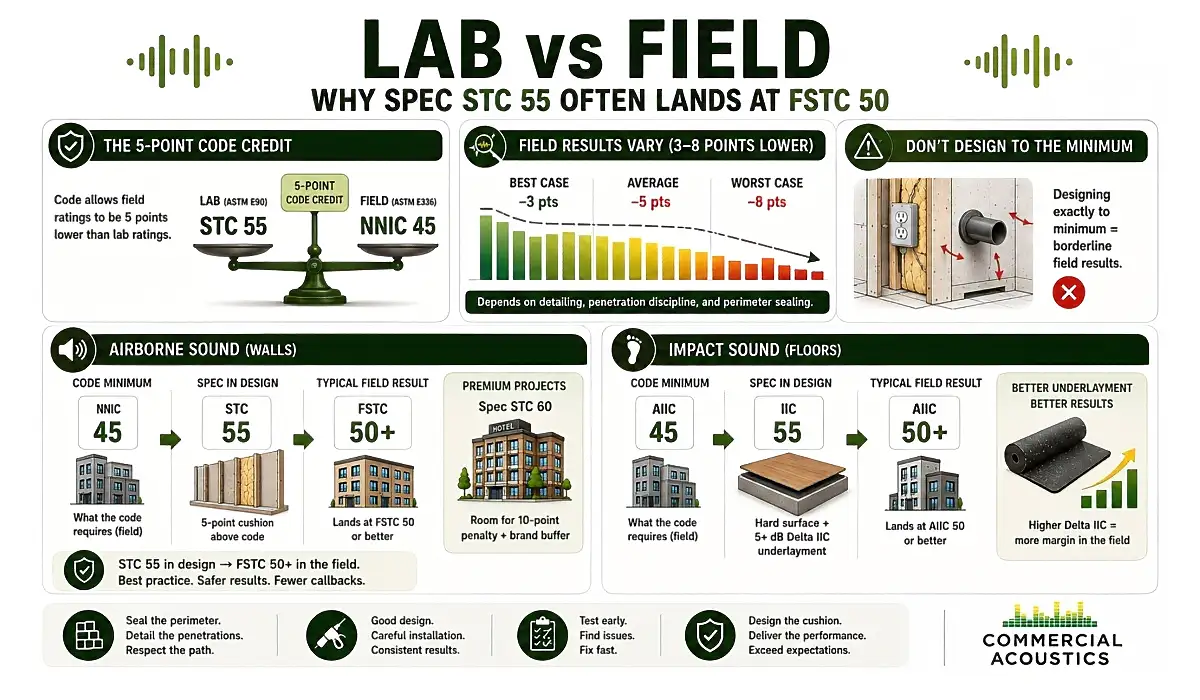
Lab vs Field: Why Spec STC 55 Often Lands at FSTC 50
The 5-point code credit for field testing covers the average flanking and workmanship loss — but it is an average. Field results range from 3 to 8 points below the lab number, depending on detailing, penetration discipline, and how cleanly the perimeter was sealed. Designing exactly to the code minimum is a recipe for borderline field results.
The standard professional hedge is to specify STC 55 in design — a 5-point cushion above the code minimum — and let the field penalty land the as-built at FSTC 50 or better. Premium projects (hotels, condos, hospitals) commonly specify STC 60 to leave room for a 10-point field penalty plus a brand-standard buffer above code. Our guide to reaching STC 50 in modular construction walks through the practical implications of this design discipline.
The same 5-point hedge applies on the impact side: specifying IIC 55 in design (typically a hard-surface floor over a 5+ dB Delta IIC underlayment) lands at AIIC 50 even after the field penalty.
Real-World Compliance
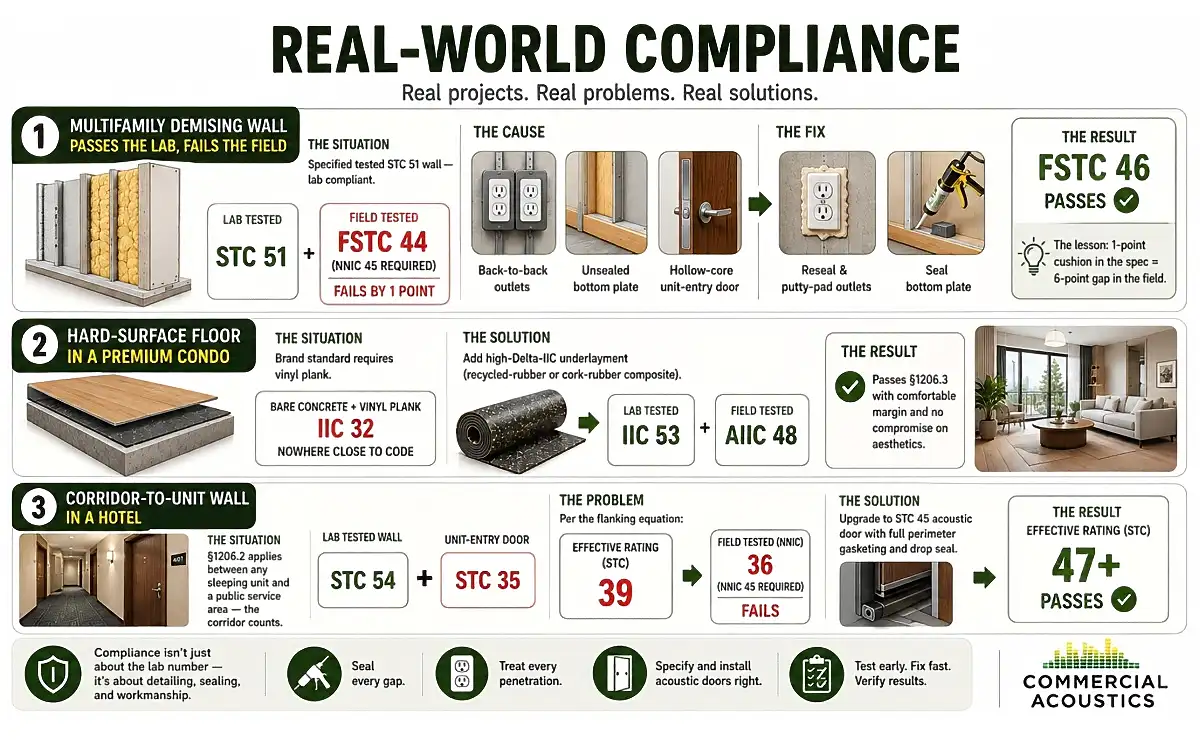
Multifamily Demising Wall Passes the Lab, Fails the Field
A developer specifies a tested STC 51 wall assembly from a manufacturer’s catalog — technically compliant. Field testing on a finished unit measures FSTC 44. The code requires NNIC 45; this fails by one point. The cause traces to back-to-back outlets, unsealed bottom plate, and a hollow-core unit-entry door that flanks the wall. Resealing and putty-padding the outlets pushes the rating to FSTC 46. The lesson: a 1-point cushion in the spec is a 6-point gap in the field.
Hard-Surface Floor in a Premium Condo
A condo brand standard requires vinyl plank in every unit. Bare concrete with the plank tests at IIC 32 — nowhere close to code. Adding a high-Delta-IIC underlayment (typically a recycled-rubber or cork-rubber composite) raises the assembly to IIC 53 in the lab and AIIC 48 in the field. The project passes §1206.3 with a comfortable margin and the brand standard with no compromise on aesthetics.
Corridor-to-Unit Wall in a Hotel
§1206.2 applies between any sleeping unit and a public service area — the corridor counts. The demising wall tests STC 54 in the lab. The unit-entry door is rated STC 35. Per the flanking equation, the effective wall-plus-door rating drops to STC 39. Field NNIC measures 36 — a clear failure. The corridor wall is fine; the door is the problem. Upgrading to an STC 45 acoustic door with full perimeter gasketing and a drop seal raises the effective rating above the code minimum.
Conclusion: Build to the Field, Not the Spec
IBC §1206 sets a numerical floor. Hitting that floor in design is not the same as hitting it on the finished building — flanking, penetrations, doors, and workmanship all conspire to drag the as-built below the lab number. The professionals who pass on test day all design the same way: spec a 5-point cushion above code, detail penetrations as if every one will be inspected, and treat doors as part of the wall rating they flank.
The code is straightforward. The execution is where projects pass or fail.
For expert consulting, spec review, ASTM E336 or E1007 field testing, or help building a §1206-compliant assembly, contact Commercial Acoustics to connect with our engineering team.
FAQs: IBC §1206 Sound Transmission
What does IBC Section 1206 require?
IBC §1206 requires walls, floors, and ceilings separating dwelling units or sleeping units from each other or from public service areas to achieve a minimum STC 50 (lab) or NNIC 45 (field) for airborne sound, plus IIC 50 (lab) or AIIC 45 (field) for impact sound on floor-ceiling assemblies. Penetrations must be sealed or treated to maintain the rated assembly’s performance.
Does IBC §1206 apply to my project?
Yes if the project is Group R residential occupancy — apartments, condos, hotels, motels, dormitories, assisted living — and contains walls, partitions, or floor-ceiling assemblies that separate one dwelling or sleeping unit from another, or from a public service area like a corridor, stairwell, or mechanical room. It does not govern interior partitions inside the same unit or exterior walls.
What is the difference between STC 50 (lab) and NNIC 45 (field)?
STC 50 is measured in a certified acoustic laboratory under ASTM E90, where flanking paths are eliminated. NNIC 45 is measured on the finished building under ASTM E336, which captures real-world flanking and workmanship loss. The 5-point difference between the two thresholds is the code’s allowance for typical field penalty — but the actual penalty varies from 3 to 8 points depending on detailing quality.
Does IBC §1206 cover exterior walls or windows?
No. §1206 only governs interior assemblies that separate dwelling or sleeping units from each other or from public service areas. Exterior wall sound transmission is governed by other parts of the IBC and by specific occupancies — for example, schools near highways or airports often fall under HUD or FAA noise standards, not §1206.
What happens to penetrations under IBC §1206?
§1206.4 requires every penetration through a rated assembly — pipes, electrical outlets, ducts, recessed cabinets, soffits — to be sealed, lined, insulated, or otherwise treated to maintain the assembly’s required sound rating. In practice this means offset outlets, acoustic putty pads on boxes, acoustic sealant at perimeters, rated enclosures for recessed lighting, and inline silencers or dedicated ducts where HVAC crosses unit boundaries.

Walker Peek|Founder & CEO, Commercial Acoustics
Walker founded Commercial Acoustics in 2013 to bring aerospace-grade engineering discipline to soundproofing, and runs the firm as CEO from its 12,000 sq ft Tampa production facility. The company designs custom acoustic panels, sound membranes, and masking systems for multi-family, hospitality, healthcare, and commercial projects across the US — built around Walker’s invention, Wall Blokker, an EVA-based sound barrier that hits STC 50-plus at roughly $1 per square foot installed.
A Jacksonville native, Walker spent five years at Kennedy Space Center with Craig Technologies before founding Commercial Acoustics — certifying aerospace manufacturing to the AS9100 standard and leading Six Sigma Black Belt process-improvement teams on NASA programs. He is a certified Industrial Noise Control Engineer and the author of Architectural Acoustics: A Practical Handbook.
