
Table of Contents
Understanding Structure-Borne Noise and Its Impact on Design
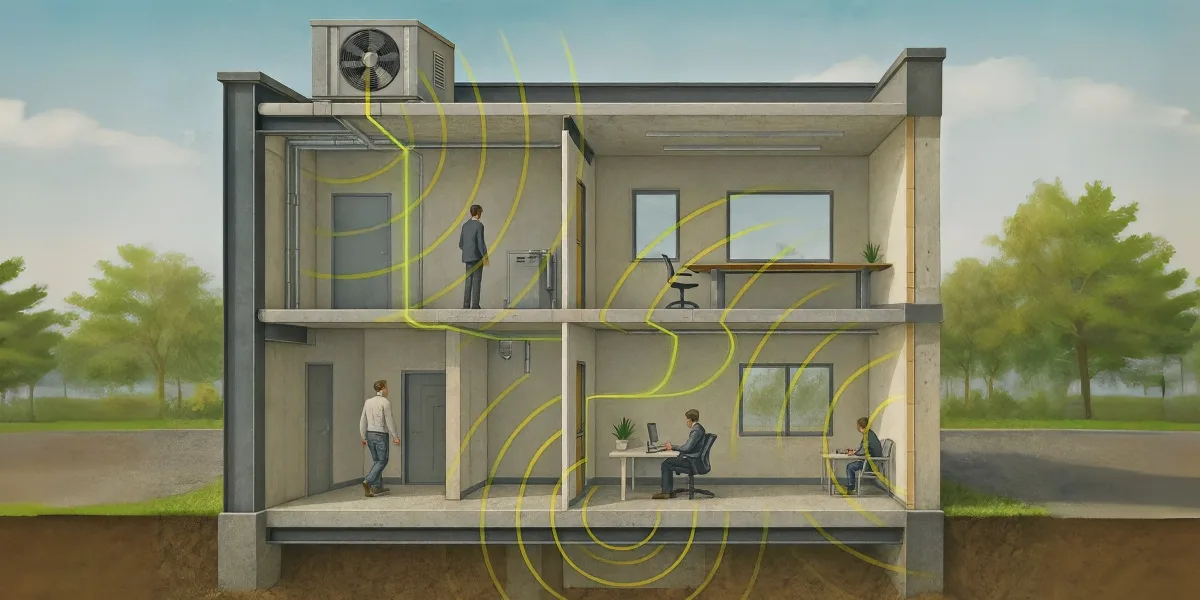
Sound waves aren’t the only things that move through a building. Vibration—the physical motion of energy through solid materials—can travel surprisingly far, creating audible noise, rattling surfaces, and structural fatigue.
Unlike airborne sound that moves through open air, vibration passes directly through walls, floors, beams, and columns. Once that energy enters the structure, it can spread quickly, reappearing as noise in distant rooms. Understanding this movement is essential for architects and contractors aiming to design quiet, high-performing buildings.
What Causes Vibration in Buildings
Vibration begins anywhere mechanical energy meets a solid surface. Common sources include:
- HVAC equipment: Compressors, fans, and pumps mounted directly on slabs or framing.
- Footfall impacts: Running, dancing, or gym activity on upper floors.
- Mechanical rooms: Generators, chillers, or elevators transferring energy through columns.
- Transportation: Heavy trucks, nearby rail lines, or subways exciting the foundation.
Each of these activities introduces impact energy that becomes structure-borne vibration, traveling through the frame and radiating back into occupied spaces as low-frequency noise. Without proper isolation, a single vibration source can impact multiple floors or tenants.
How Vibration Travels
Once vibration enters the structure, it seeks the stiffest and most direct path—just like current flowing through a conductor.
- Direct Transmission: Energy moves through continuous structural components such as beams, slabs, or columns.
- Flanking Paths: Vibrations bypass isolated areas by traveling through ceilings, walls, or piping.
- Cavity Coupling: Vibration jumps between adjacent assemblies, often through studs or ceiling grids.
Each connection creates a bridge that carries vibration farther than expected. Even in well-built facilities, one poorly isolated mechanical mount or rigid connection can transmit energy across multiple spaces. For a detailed reference on how vibration waves propagate through foundations and building structures, see the FTA’s Transit Noise & Vibration Impact Assessment Manual.
Speed of Vibration Through Common Building Materials
The denser a material, the faster vibration moves through it—explaining why structure-borne noise is so persistent in commercial construction.
| Material | Approx. Speed of Vibration (m/s) | Notes |
|---|---|---|
| Air | ~343 | Slowest; loses energy quickly |
| Wood | 3,300–4,000 | Moderate; depends on grain direction |
| Concrete | 3,200–4,000 | Dense and efficient at transmitting low frequencies |
| Steel | 5,000–6,000 | Extremely rigid; carries energy with minimal loss |
Because steel and concrete conduct vibration so efficiently, designers must include resilient components early—otherwise impacts or machine noise can travel throughout the structure.
Structure-Borne vs. Airborne Noise
Vibration and airborne sound are related, but not interchangeable. Each behaves differently and requires unique control strategies.
| Type | Transmission Path | Common Examples | Best Control Methods |
|---|---|---|---|
| Airborne Noise | Through open air | Speech, music, HVAC air noise | Add mass, seal air gaps, use absorptive materials |
| Structure-Borne Noise | Through rigid materials | Footfall, mechanical vibration, impacts | Use isolation mounts, decoupled framing, damping layers |
Airborne noise can be absorbed or blocked; structure-borne noise must be isolated at the source. Once vibration reaches the structure, it cannot be “absorbed away” with insulation alone.
Controlling Vibration Transmission
Reducing vibration starts by interrupting the path and absorbing energy before it spreads. Proven methods include:
- Resilient Mounts: Rubber or spring isolators on equipment prevent energy transfer into framing.
- Floating Floors: Isolation pads or underlayments absorb impact energy from gyms and studios.
- Decoupled Walls & Ceilings: Independent framing eliminates direct vibration bridges.
- Pipe & Duct Isolation: Flexible hangers and connectors stop vibration from traveling through MEP systems.
- Damping Materials: Viscoelastic membranes or compounds convert vibration into heat, minimizing resonance.
When integrated during design, these systems protect acoustic comfort and prevent costly post-construction corrections.
Why Architects and Contractors Should Care
Vibration impacts more than sound—it affects occupant comfort, equipment performance, and long-term durability. Persistent low-frequency vibration can crack finishes, loosen fasteners, and shorten the lifespan of building systems.
By understanding vibration behavior, architects can specify proper isolation, while contractors ensure it’s installed correctly. Early collaboration between trades, MEP engineers, and acoustic consultants keeps these problems off the punch list and out of warranty claims.
Conclusion: The Hidden Force in Every Structure
Vibration is the quiet traveler that shapes how buildings feel and function. It’s invisible, fast-moving, and often overlooked—until it becomes a costly issue.
By accounting for structure-borne transmission early in design, teams can prevent complaints, improve occupant satisfaction, and extend building life. Whether it’s a mixed-use tower, a hospital, or a gym build-out, understanding how vibration travels through buildings is the key to controlling it.
For consultation, field testing, or isolation material recommendations, contact Commercial Acoustics to speak with our engineering team.
FAQs: Understanding Vibration in Buildings
Can vibrations go through walls?
Yes. Vibrations travel through solid materials like drywall, concrete, and steel, often re-emerging as audible noise or subtle movement in other areas of the structure.
What causes vibrations in buildings?
Common sources include HVAC equipment, elevators, pumps, mechanical rooms, and nearby transportation. Each introduces mechanical energy that, without isolation, travels through framing and foundations.
How does sound travel through a building?
Sound moves either through the air as pressure waves or through solids as vibration. In most buildings, the two interact—airborne sound becomes structure-borne upon impact with walls or floors, and vice versa.
Can vibrations travel through space?
No. Space lacks air or matter for vibration to move through. Vibration requires a medium—solid, liquid, or gas—to propagate.
What can vibrations travel through?
Vibrations move through solids, liquids, and gases, but travel fastest through dense materials like steel or concrete where atoms are closely packed.
