Table of Contents
Quick Overview
- Speakers go in the plenum above the ceiling, out of sight. Direct-field speakers exist for exposed-deck environments.
- Standard spacing: 15 ft on center, 7 ft from walls, ~225 sq ft per speaker. Adjust for room geometry.
- Tune to 43 dBA in closed offices, 45–47 dBA in open offices, measured 4.5 ft AFF with a calibrated SLM.
- Pink vs white noise depends on CAC. High-CAC tile means play white noise; exposed deck or low-CAC tile means play pink.
- Wiring is low-voltage 24V. 12-2 and 12-5 plenum-rated for power, CAT5E for networked control. Use a low-voltage certified installer.
Where Sound Masking Speakers Are Installed
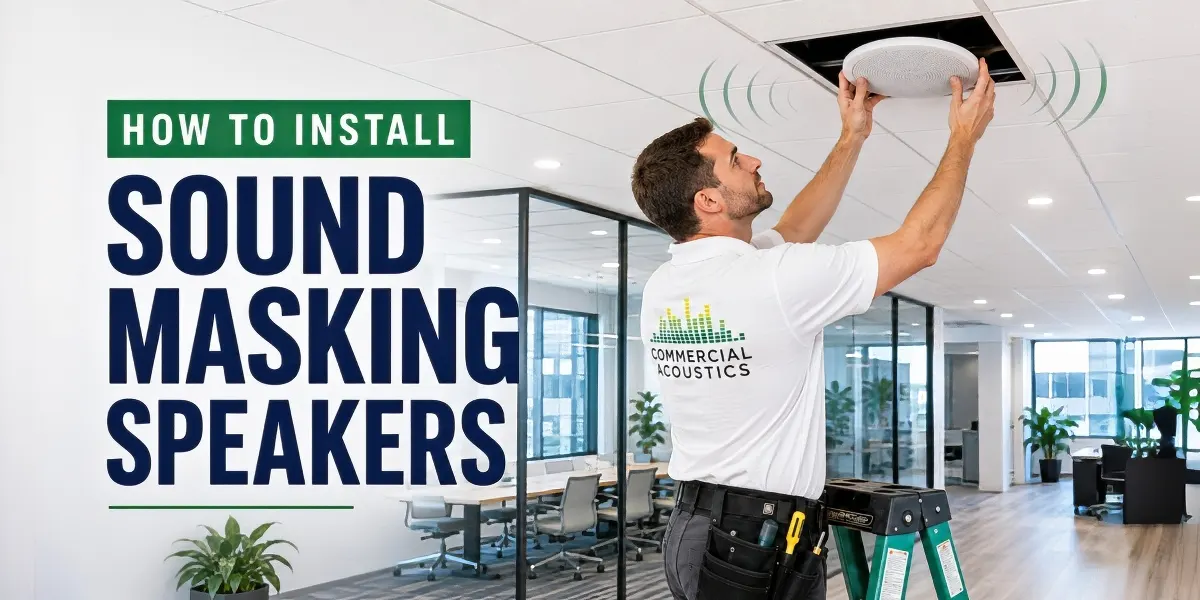
- Drop-ceiling installs: Speakers face up into the plenum. Sound diffuses down through the tile.
- Exposed-deck installs: Direct-field speakers hang from the structure pointing down at the occupied space.
- Hybrid spaces: Mixed ceiling conditions (open offices with drop ceilings adjacent to exposed-deck collaboration zones) need different speaker types in each zone.
Sound masking works best when occupants do not know it is running. The classic deployment uses plenum-mounted speakers above a drop ceiling, so the masking sound diffuses through the tile and arrives at desk height as a soft, broadband hiss. There is no visible hardware in the occupied space.
The right product depends on the ceiling. A Classic Sound Masking system handles standard offices, bullpens, call centers, and libraries with drop ceilings. Exposed-deck environments need direct-field speakers and a different spacing approach.
Speaker Spacing and Layout
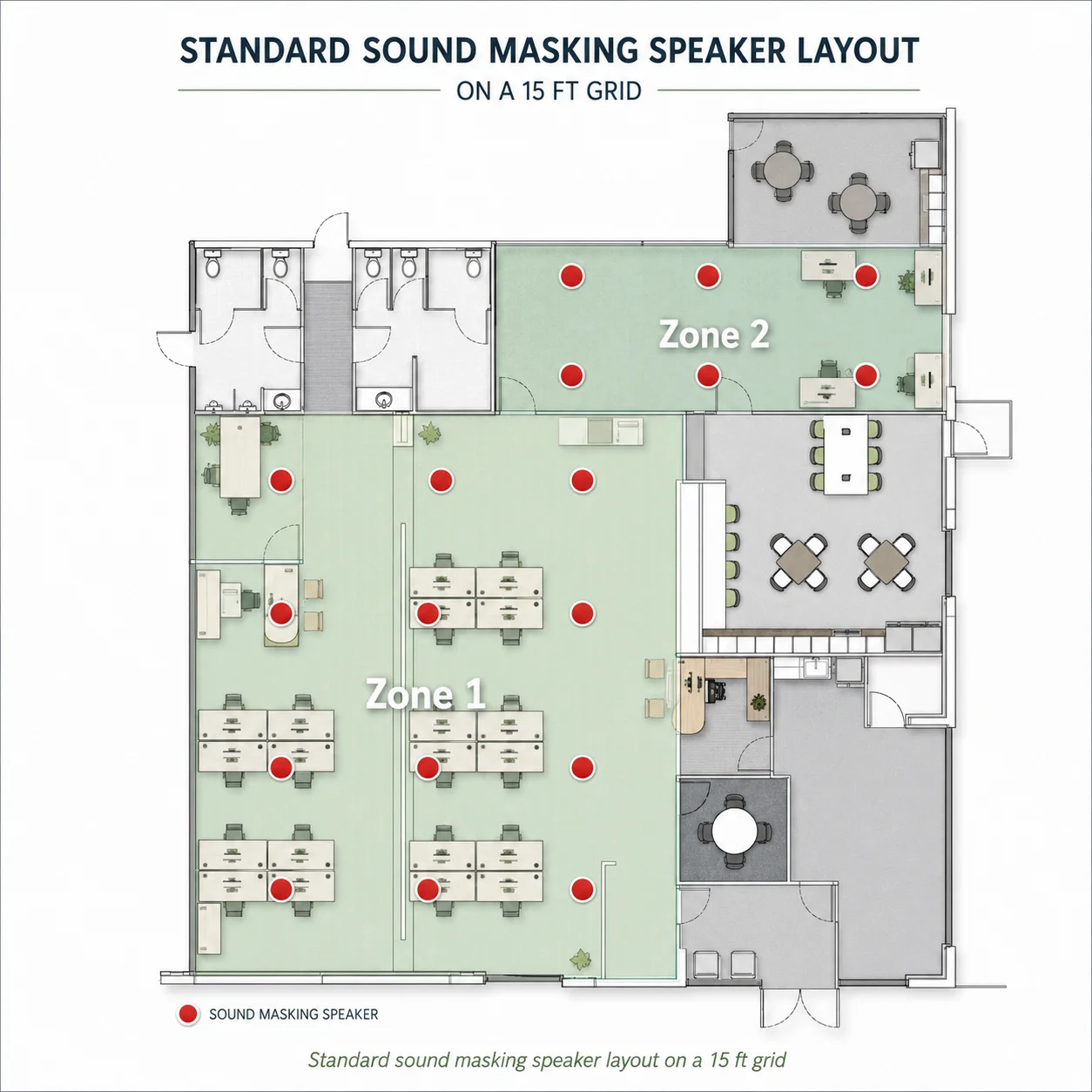
- Standard grid: 15 ft on center, ~225 sq ft per speaker
- Wall offset: 7 ft from the nearest wall, adjusted for geometry
- Plenum height affects spacing: Shallower plenums need tighter speaker spacing to maintain even coverage
- Irregular layouts: Jut-outs, columns, and partial-height walls all push speaker placement off the standard grid
The 15 ft grid is a starting point, not a spec. Final spacing depends on plenum height, ceiling tile thickness, room geometry, and the target dBA level. The sound masking calculator sizes speaker count from floor area and ceiling type before quoting.
Spacing is not just a count problem. Hot spots and cold spots show up at desk level when the grid is off. After install, a certified tech walks the space with a calibrated SLM at 4.5 ft AFF and adjusts individual speaker output until the field is within ~2 dBA across the occupied area.
Pink Noise vs White Noise: Choosing by CAC
- Exposed deck or low-CAC tile (under ~30): Play pink noise. What is generated is what occupants hear.
- High-CAC tile (35+): Play white noise. The tile filters the high-frequency content out, and what reaches occupants is pink.
- Goal at the listener: A pink-shaped spectrum that masks speech without sounding harsh or hissy.
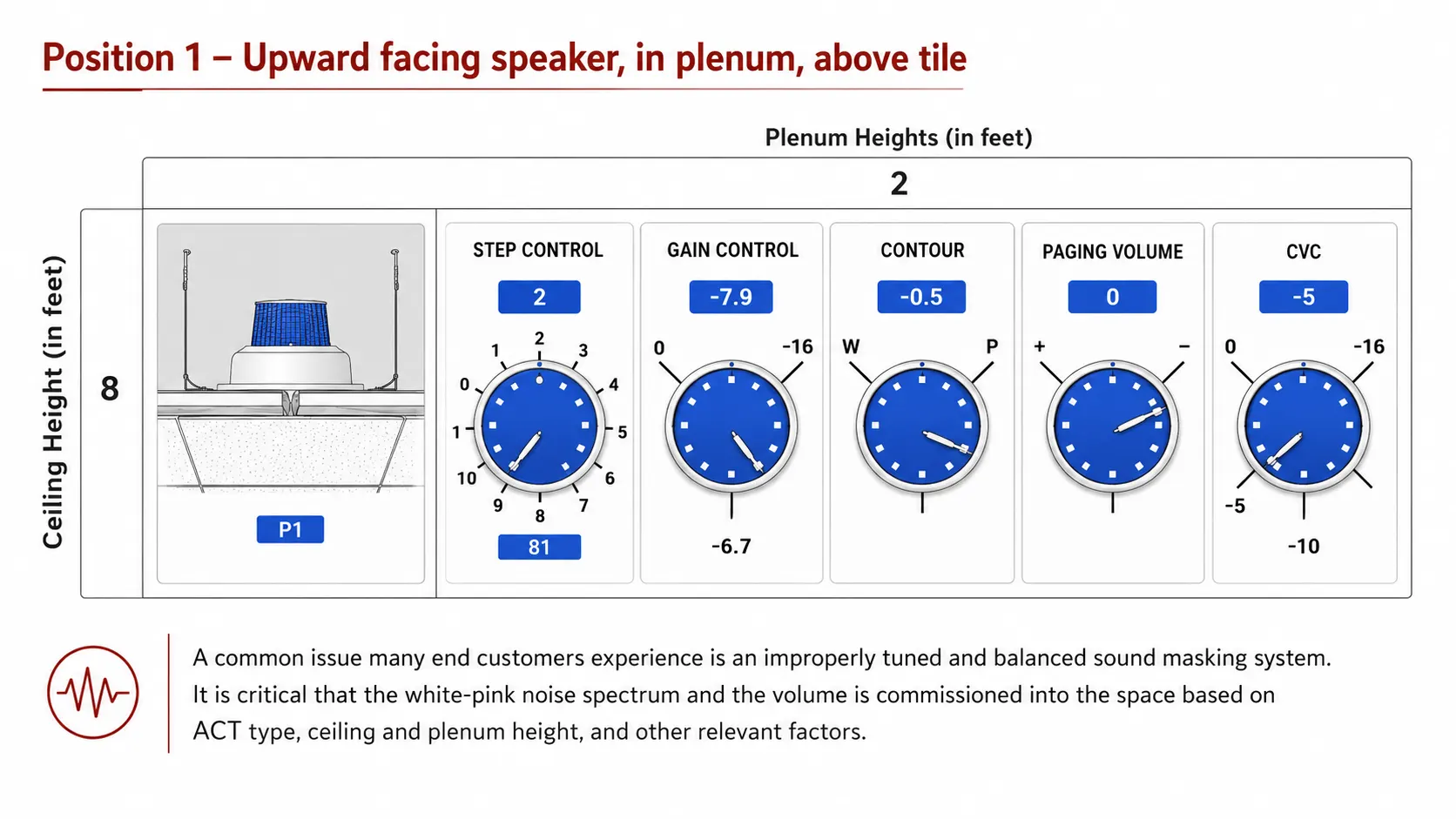
The pink-vs-white decision is not a preference call. It is dictated by the ceiling. Thick, high-CAC acoustic tile blocks the upper frequencies of white noise, so the spectrum that lands at the desk is pink-shaped after the tile filters it. Skip that filter (exposed deck or low-CAC tile) and white noise arrives at the desk still hissy and harsh.
For background on the two spectra, the pink noise vs white noise primer explains why pink wins for masking. Pink noise has equal energy per octave, which matches how the ear weights frequency. That is what makes it disappear into the room rather than calling attention to itself.
Target dBA Levels and Tuning in the Field
- Closed offices: 43 dBA at 4.5 ft AFF
- Open offices: 45–47 dBA at 4.5 ft AFF
- Field uniformity target: ±2 dBA across the occupied floor
- Calibration tool: Type 1 or Type 2 sound level meter, A-weighted, slow response
Closed offices run quieter because the walls already provide some isolation. Open offices need a higher masking level because there is no built-in privacy. Push past 48 dBA and occupants start to notice the masking sound. That is when the system stops doing its job.
An experienced sound masking technician walks the space after install with a calibrated SLM, identifies hot and cold spots, and trims individual speaker output to flatten the field. An out-of-the-box install almost never lands in spec without this commissioning step.
Wiring, Power, and Network Control
- Power wiring: 12-2 and 12-5 plenum-rated cable for 24V speaker bus
- Control wiring: CAT5E for networked systems with central or zoned control
- Code compliance: Plenum-rated jackets are required for any cable in a return-air plenum
- Installer requirement: Low-voltage certified technician (state-specific license)
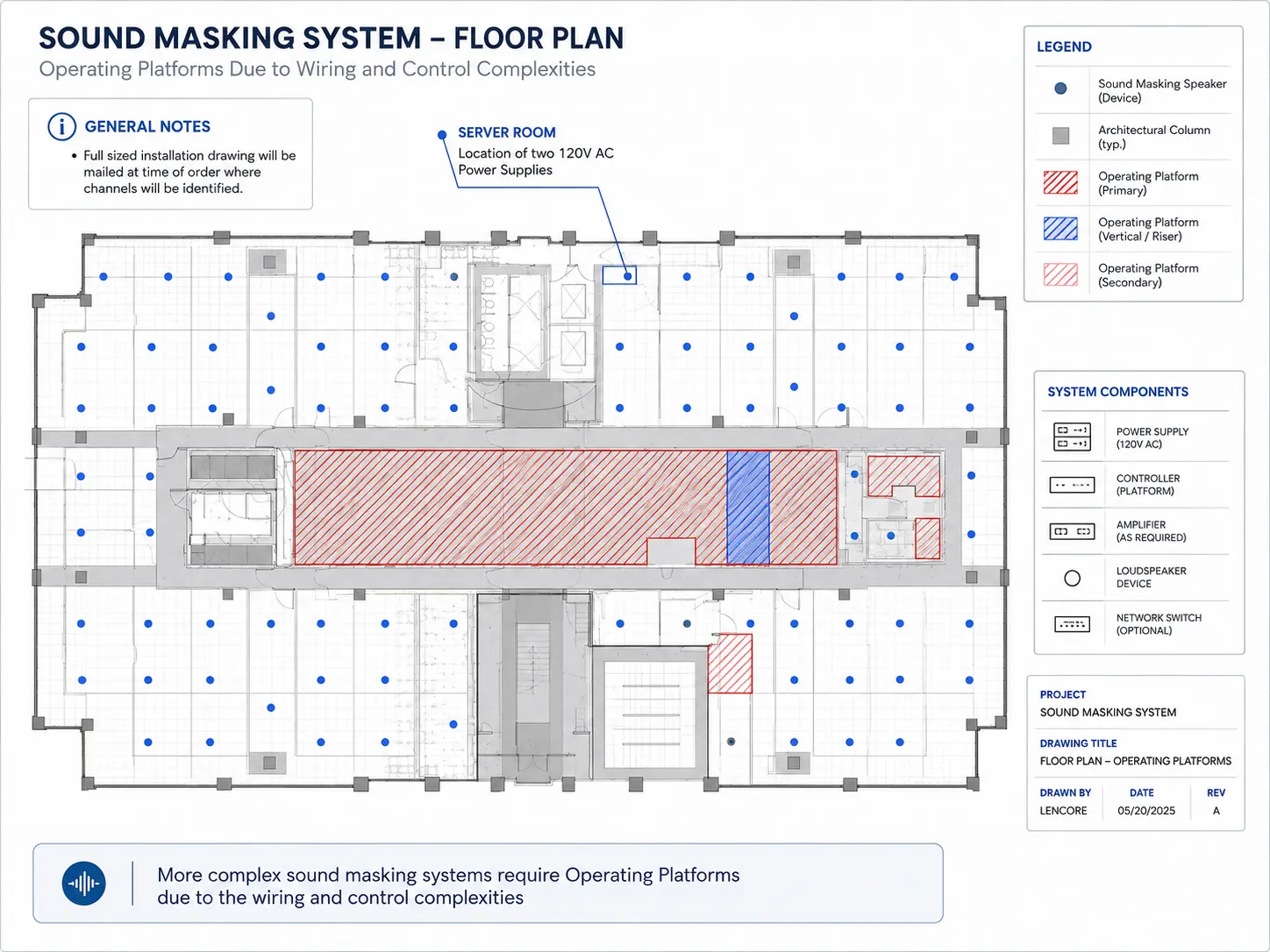
Sound masking is a 24V low-voltage system. Standard installs run 12-2 (two-conductor) and 12-5 (five-conductor) plenum-rated cable from a central amplifier or controller out to each speaker zone. Wire runs follow the same plenum-rating and bend-radius rules as any other low-voltage system in the ceiling.
For systems that need central control, multi-zone tuning, or future reconfiguration without rewiring, CAT5E carries the control signal. That is where a networked sound masking system earns its premium over a passive analog install.
Large buildings with mass notification requirements add redundant wiring, self-healing network topologies, and battery backup so masking and paging stay online during a power or network event.
Common Installation Mistakes
- No field commissioning: Powered up the system, never tuned the field. Hot and cold spots stay forever.
- Wrong noise type for the ceiling: White noise played through low-CAC tile arrives harsh and gets turned down until it does nothing.
- Speakers too tight or too far apart: Tight spacing wastes hardware. Loose spacing leaves dead zones where masking fails.
- System tuned too loud: Past ~48 dBA, occupants notice the masking and complain.
- Non-plenum cable in a return-air plenum: Code violation that surfaces at the worst possible time, usually during a commissioning inspection.
Most sound masking complaints trace back to one of these five issues. The fix is almost never more speakers. It is recommissioning the existing system with the right noise spectrum, the right dBA target, and a proper field walk.
When to Use a Networked System
- Multi-zone offices where different departments need different masking levels
- Frequent reconfiguration (workstation moves, meeting room expansion, tenant changes)
- Mass notification or paging integration on the same speaker network
- Centralized facility management across multiple floors or buildings
A passive analog system is the right call for a single open office that does not need zone control. A networked system earns its premium when the building has multiple use zones, ongoing reconfiguration, or a single facility manager who needs central control over the masking field.
For more on the design decisions behind a sound masking spec, the sound masking system design post walks through the trade-offs between speaker type, layout density, and control architecture.
Pulling It Together
A sound masking install is half hardware, half commissioning. Get the speaker count and spacing roughly right on the drawing, then trust the field tuning to finalize the dBA targets and the noise spectrum against the actual ceiling.
The cheapest sound masking project is the one that gets the noise spectrum right the first time. Pink vs white is dictated by the ceiling, not by preference. Get that decision wrong and no amount of dBA adjustment will fix the harshness occupants feel.
Need a Designed Sound Masking System?
Sound masking design lives or dies on the commissioning, not the speaker count. Send us a floor plan and ceiling type, and we will return a speaker layout, dBA targets by zone, and a wiring plan that a low-voltage installer can build from.
Learn more about the team behind this work and the projects we have commissioned across offices, law firms, and healthcare facilities.
FAQs: Sound Masking Speaker Installation
How far apart should sound masking speakers be?
Standard layout is 15 ft on center, about 225 sq ft per speaker, with 7 ft from the nearest wall. Plenum height and ceiling tile thickness shift the final spacing.
What dBA level should a sound masking system be tuned to?
43 dBA in closed offices, 45–47 dBA in open offices, measured 4.5 ft AFF with a calibrated A-weighted SLM. Push past 48 and occupants notice the masking.
Should I play pink noise or white noise?
Depends on the ceiling. Exposed deck or low-CAC tile means play pink. Thick high-CAC tile means play white — the tile filters it to pink before it reaches the desk.
What wiring does a sound masking system need?
12-2 and 12-5 plenum-rated cable for the 24V speaker bus. CAT5E for networked control. All cable in a return-air plenum must carry a plenum rating.
Can I install sound masking myself?
No. Sound masking is a low-voltage system that needs a certified low-voltage installer and field commissioning by an experienced tech. DIY installs almost always end with hot spots and complaints.

Walker Peek|Founder & CEO, Commercial Acoustics
Walker founded Commercial Acoustics in 2013 to bring aerospace-grade engineering discipline to soundproofing, and runs the firm as CEO from its 12,000 sq ft Tampa production facility. The company designs custom acoustic panels, sound membranes, and masking systems for multi-family, hospitality, healthcare, and commercial projects across the US — built around Walker’s invention, Wall Blokker, an EVA-based sound barrier that hits STC 50-plus at roughly $1 per square foot installed.
A Jacksonville native, Walker spent five years at Kennedy Space Center with Craig Technologies before founding Commercial Acoustics — certifying aerospace manufacturing to the AS9100 standard and leading Six Sigma Black Belt process-improvement teams on NASA programs. He is a certified Industrial Noise Control Engineer and the author of Architectural Acoustics: A Practical Handbook.
