
Table of Contents
What Are Fabric Wall Track Profiles?
Fabric wall track profiles are the framework that makes stretched fabric wall systems possible. While fiberglass cores and acoustical fabrics provide the absorption, it’s the track that defines the edges, secures the fabric, and allows installations to span entire walls or even full rooms. This flexibility makes fabric walls a practical alternative to prefabricated acoustic panels, which are limited by size and difficult to install around obstructions.
For architects and contractors, understanding fabric wall track profiles is essential. The choice of profile impacts both the visual finish and the acoustic performance of a space. From corporate offices to auditoriums and studios, these details determine how well the system integrates with penetrations, corners, and overall design intent — ensuring the final installation meets both performance and aesthetic goals.
Types of Fabric Wall Track Profiles
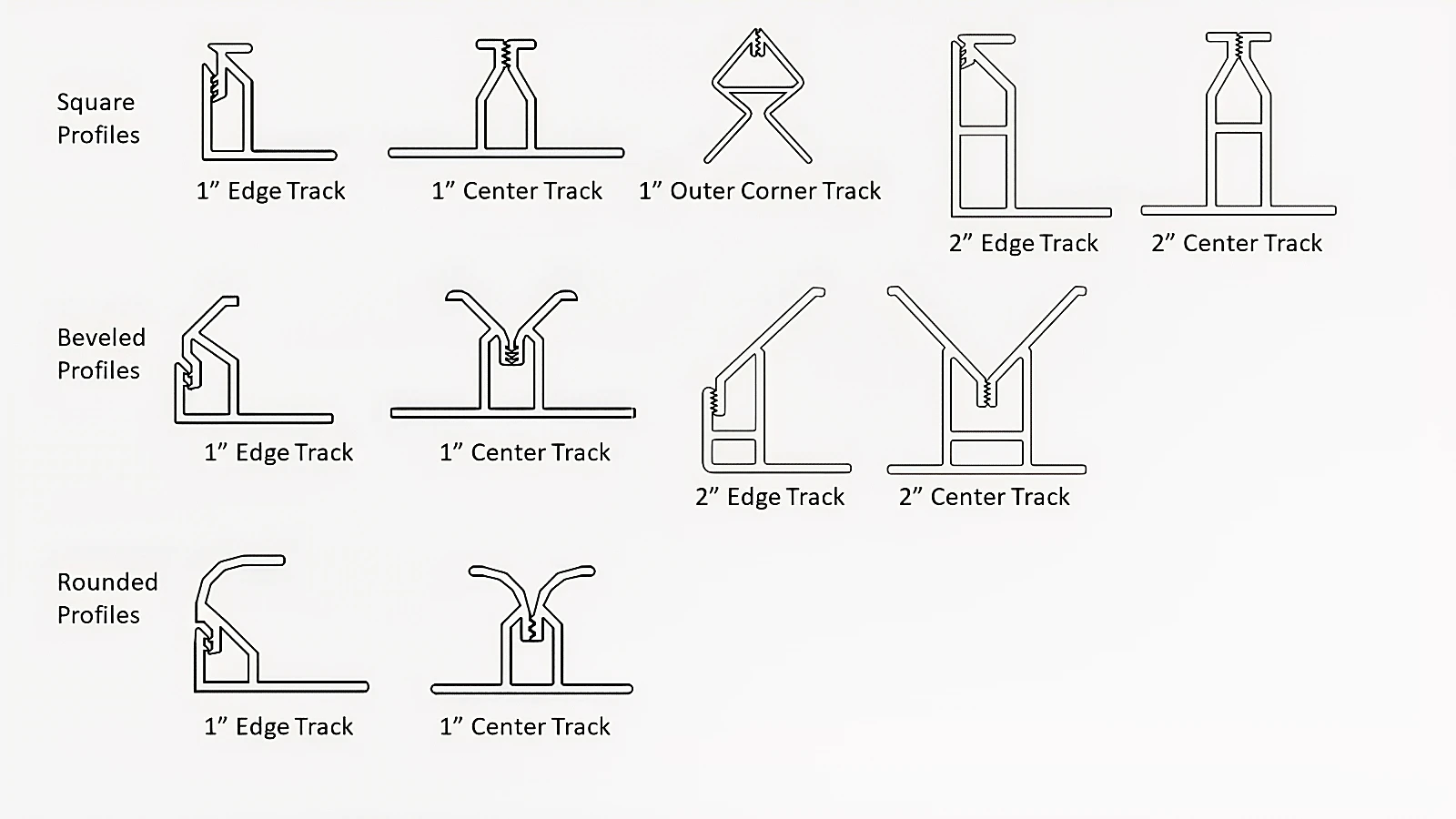
- Square profile: Clean, modern edge finish.
- Radius profile: Rounded edge for softer transitions.
- Beveled profile: Angled edge for sharp visual lines.
Fabric wall tracks come in multiple edge conditions, giving designers the freedom to align acoustics with visual intent. For perimeter runs, top-load tracks are common, with center tracks spaced every 4–5 feet to match fabric roll widths (usually 50″–66″). Specialty systems allow wider spans up to 10 feet without seams, but most installations require visible center track seams placed at even intervals.
Similar to acoustic wall panels there are multiple edge profiles available for stretched fabric wall including square, bevel and rounded. However, while the fiberglass would be cut to shape the edge of an acoustic panel, the track creates the edge profile for a stretched fabric wall.
Handling Penetrations in Fabric Wall Systems
- Outlets & switches: Fabric cut into fiberglass; cover plates conceal cuts.
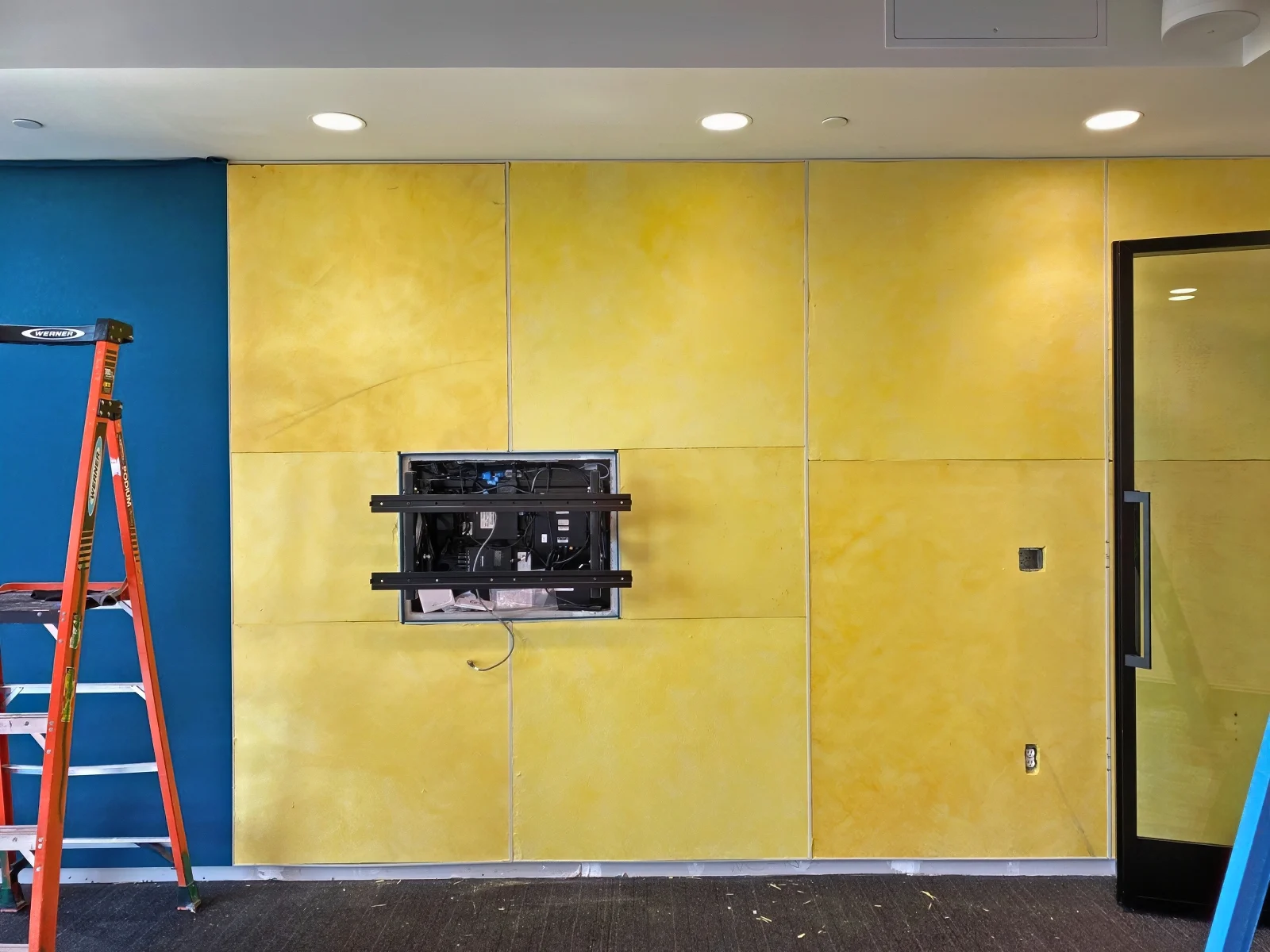
- Larger penetrations: Track can be built around TVs, signage, or speakers.
- Seamless finish: Fabric holds tight around obstructions without gaps.
Unlike prefabricated acoustic panels, fabric wall systems are easy to field-cut around penetrations. Outlets, thermostats, sprinklers, strobe lights, and signage can all be integrated without sacrificing appearance. For smaller penetrations, the fiberglass is cut to fit and the cover plate holds the fabric cleanly in place. Larger penetrations use track to frame the cutout, ensuring the system remains stable and visually consistent.
Corner & Edge Conditions
- Outer corners: Specialty “fish track” provides a seamless wrap.
- Inner corners: Two fabric sheets can tuck into a single top-load track.
- Furred conditions: Track can be offset to accommodate thicker cores.
Corner details are critical for a clean finish. Outer corners often use a 1″ specialty track that lets fabric bend smoothly around the edge, while inner corners can be built with two separate tracks or a single top-load track tucked from both sides. Furring or blocking may also be added when substrates like CMU prevent direct fastening. These options ensure that every edge condition — whether visible or hidden — maintains the desired aesthetic and acoustic performance.
The inner corner condition is much more common in fabric wall designs, especially when treating all 4 walls in a single room. This was a common occurrence at the new iHeart Media Offices, where our team recently furnished and installed full fabric wall in each recording studio.

Fabric Wall Track Profiles in Design
- Custom depth: Track maxes at 2″, but fiberglass cores can reach 4″.
- Flexibility: Works around penetrations, corners, and complex layouts.
- Applications: Used in offices, classrooms, auditoriums, and studios.
By combining the right track profile with core selection, fabric choice, and proper spacing, architects can achieve both high NRC values and a clean, durable finish. Fabric wall track profiles are what make stretched fabric systems practical for large, complex designs where traditional panels fall short.
Stretched Fabric Systems vs Prefabricated Panels
- Scalability: Fabric walls can cover full rooms without size limits.
- Adaptability: Tracks allow easy integration with outlets & penetrations.
- Design control: Multiple edge profiles suit different aesthetics.
Prefabricated acoustic panels have limitations — they can’t span large walls and don’t adapt well to penetrations. Stretched fabric systems solve those challenges by using track profiles that can run continuously across walls, integrate with existing features, and deliver seamless acoustic performance. For architects working on auditoriums, studios, or Class A office projects, this flexibility is often the deciding factor.
Fabric Wall Track Profiles: Key Takeaways
- Profile options matter: Square, radius, and beveled tracks change the look.
- Seams are unavoidable: Center tracks keep fabric tight and aligned.
- Performance scales: NRC values improve with thicker fiberglass cores.
Track profiles are more than just a detail — they’re the backbone of a stretched fabric wall system. Knowing the options helps architects balance aesthetics with acoustic performance, whether the project calls for seamless inner corners, wrapped outer edges, or full wall-to-wall coverage.
Fabric Wall Projects Across Industries & States
- Georgia Factory Soundproofing: Managing equipment noise & echo in active production spaces.
- Virginia Multi-Family Soundproofing: Improving sound isolation & privacy between adjoining units.
- Tennessee Dog Kennel Soundproofing: Reducing barking noise & creating calmer acoustic environments.
Fabric wall systems enhance performance across a variety of projects. From controlling mechanical noise in Georgia factories, to improving residential comfort in Virginia multi-family buildings, and creating calmer kennel environments in Tennessee—these applications show how fabric wall track systems combine precision, durability, and acoustic performance. They help architects & contractors integrate sound control seamlessly into functional, visually cohesive designs.
Partnering With Experts in Fabric Wall Systems
Commercial Acoustics specializes in designing and installing stretched fabric walls that meet both acoustic and aesthetic goals. Our team has delivered systems across offices, classrooms, studios, and performance spaces, with expertise in handling penetrations, corner details, and large-scale applications.
If your project requires precision in both design and sound performance, partner with experts who understand fabric wall track profiles inside and out. Contact Commercial Acoustics to discuss specifications and installation details.
FAQs: Fabric Wall Track Profiles & Acoustic Wall Systems
What is a fabric wall track profile?
A fabric wall track profile is the framework that holds stretched fabric in place. It defines the edges, secures the fabric, and allows installations to span entire walls or rooms while maintaining a clean finish.
What types of fabric wall track profiles are available?
Common options include square, radius, and beveled profiles. Each creates a different edge detail, giving architects flexibility in visual style and acoustic performance.
How are penetrations like outlets or TVs handled in fabric wall systems?
Tracks and fiberglass can be field-cut to fit around outlets, signage, or speakers. Smaller penetrations are trimmed cleanly, while larger ones are framed with track for stability and precision.
Can fabric wall track profiles be used on corners?
Yes. Outer corners use specialty “fish track” for a wrapped finish, and inner corners can share a single top-load track for a seamless joint, even across multiple walls.
Why choose fabric wall systems over prefabricated acoustic panels?
Fabric wall systems offer scalability, design flexibility, and higher acoustic performance. They can cover entire rooms, handle penetrations, and maintain tight seams where panels cannot.
