
Table of Contents
Understanding Noise Criteria (NC)
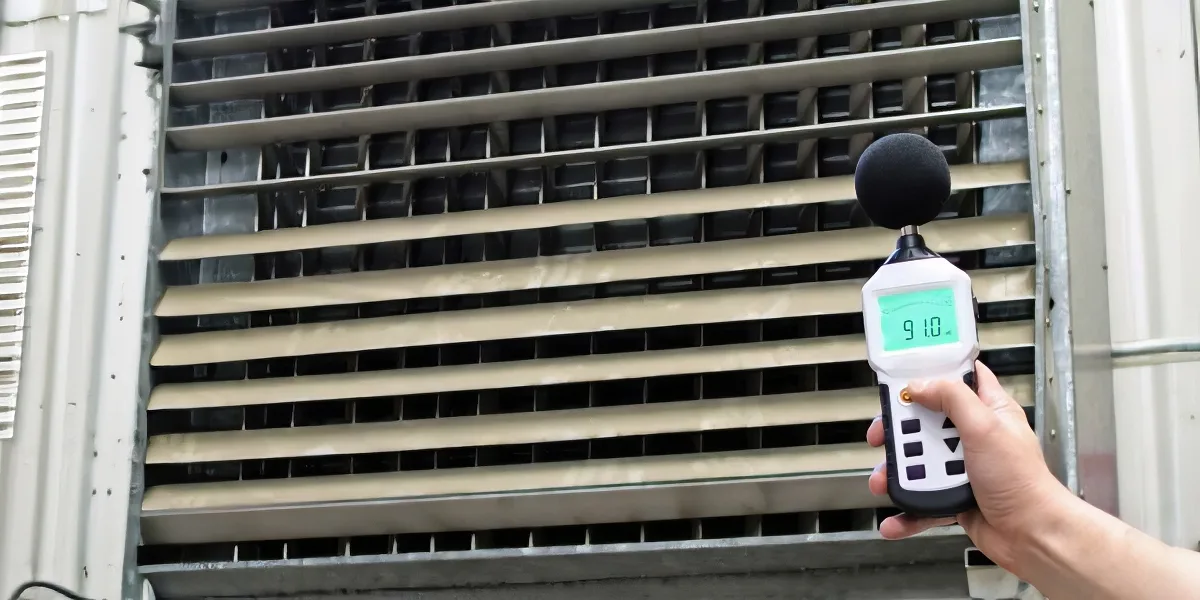
Noise Criteria, or NC, refers to the background noise level caused by HVAC systems, air movement, and other mechanical sources within a space. These levels are a key part of acoustic design — too high, and speech clarity or listening comfort suffers; too low, and spaces can feel unnaturally quiet, revealing even minor disturbances.
In critical listening environments such as theaters, classrooms, and healthcare facilities, designers use NC ratings to define acceptable noise limits. For instance, a concert hall might target NC-15, while an office may be acceptable at NC-35. Achieving these values requires coordination between mechanical engineers, architects, and acoustic consultants to control how sound travels through ducts, vents, and walls.
Common Sources of Elevated NC Levels
- Air movement: High air velocity through ducts & diffusers raises background noise.
- Equipment vibration: Fans, compressors, & pumps transfer vibration through structure.
- Poor isolation: Uninsulated ducts or direct paths between rooms increase sound transfer.
Mechanical systems are often the hidden culprit behind distracting background noise. Even with high-performance walls and ceilings, uncontrolled air speeds or poorly mounted equipment can push noise criteria levels above design targets. Air rushing through diffusers, for example, may produce turbulent noise that dominates the acoustic character of a space.
By addressing noise at its source — using flexible duct connectors, vibration isolators, and acoustically lined plenums — designers can reduce the mechanical “hum” that would otherwise overwhelm an interior environment and maintain the desired noise criteria for occupant comfort.
Designing for Target NC Levels
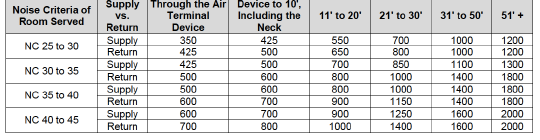
- Air velocity: Lower speeds reduce turbulence & mechanical noise at diffusers.
- Equipment selection: Quieter fans, dampers, & motors improve baseline performance.
- Distance & layout: Separating air handlers from sensitive areas minimizes transfer.
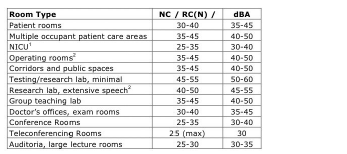
Every project type has its own recommended NC range. For example, hospitals and patient rooms typically aim for NC-25 or lower, while classrooms and conference rooms hover around NC-30 to NC-35. Spaces like theaters or recording studios may require NC-15–20 for optimal clarity.
To achieve these values, designers must balance performance and practicality. Reducing airspeed lowers noise but requires larger ducts. Relocating mechanical equipment increases distance but consumes more floor area. The art of acoustic design lies in finding equilibrium between these tradeoffs while maintaining comfort and efficiency.
Calculating Composite Noise & Sound Transmission
- Mixed materials: Walls with glass & masonry vary widely in sound isolation.
- Sound paths: Noise follows the weakest link — often glazing or ceiling plenum gaps.
- Composite performance: Weighted averages skew toward lower-STC components.
Composite Noise Calculations help engineers estimate how materials combine to block or transmit sound. For example, a wall that’s half glass (STC 20) and half brick (STC 40) won’t perform like a balanced average. Because sound takes the path of least resistance, the effective STC will lean toward the lower-performing element — around STC 23 in this case.
This principle reinforces why designers must treat the weakest element first. Upgrading glass assemblies or sealing ceiling plenum leaks often yields a more dramatic acoustic improvement than overbuilding already-quiet wall partitions.
Similar to 1% rule, sound follows the path of least resistance. This results in the majority of sound transfer passing through the glass. The composite STC may be calculated as follows:
Equation: Composite TL = 10log (SumS/Sum[tS])
This explains why exterior windows should always be improved prior to investing any STC improvement in exterior walls.
Managing Exterior Noise Propagation
- Barrier height: Taller walls block line-of-sight noise paths more effectively.
- Frequency control: Low-frequency sounds require larger or denser barriers.
- Distance: Doubling distance typically reduces sound by 6 dB, improving comfort.
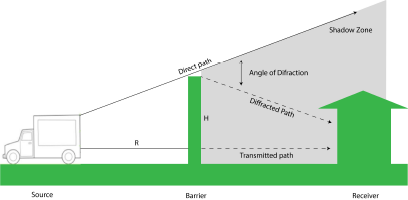
When addressing outdoor noise — such as traffic, HVAC condensers, or delivery docks — the challenge shifts to geometry and material mass. Exterior barriers must break the direct sound path between source and receiver.
Example: A truck backs up to loading docks for delivery at 6 AM every morning, near a hotel. The hotel owner is making noise complaints due to the early deliveries and upset guests. In order to meet the guests’ expectations, it is agreed upon that a 7 dB drop at the 500 Hz truck beeper frequency range will be acceptable.
The barrier is to be installed 10’ from the loading dock. How tall does it need to be?
Equation: TL = 10log(H2/R) + 10logf ‐ 17
7 = 10log(H/102) + 10log(500) – 17
H=3.2’ (Above the Line of Sight)
Controlling Vibration & Structure-Borne Noise
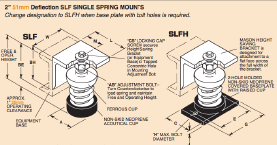
- Isolation mounts: Springs & pads decouple mechanical units from structure.
- Slab separation: Saw cuts or floating floors reduce vibration transfer.
- Testing tools: Accelerometers measure vibration in multiple directions.
Unlike airborne sound, vibration moves through solid materials like steel and concrete. When heavy equipment runs on a shared slab, it can cause walls and ceilings in nearby rooms to hum or rattle, often raising background levels that affect overall noise criteria ratings.
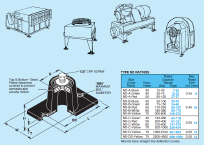
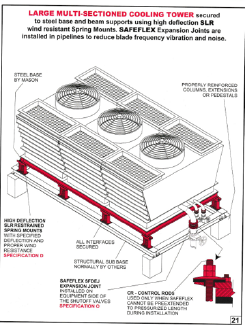
Proper isolation starts with design. Using neoprene or spring isolators under cooling towers and rooftop units prevents vibration from entering the structure. In some cases, isolation slabs or inertia bases are needed to separate mass and stiffness. Acoustic consultants use tri-axial accelerometers to measure vibration and verify that isolation efforts maintain the target noise criteria level.
Products & Methods for Mechanical Noise Control
- Duct liners: Absorb turbulent noise within air distribution systems.
- Flexible connectors: Prevent vibration from traveling through ductwork.
- Acoustic louvers & silencers: Reduce fan noise at intakes & exhausts.
Mechanical noise control products are specialized, but their impact on occupant comfort is significant. By attenuating fan noise and isolating vibration paths, these treatments help maintain design NC levels throughout a facility.
For large mechanical rooms or rooftop units, combining duct silencers with vibration isolators provides comprehensive control. This not only meets acoustic standards but also extends equipment life by reducing mechanical stress and resonance.
Conclusion: Designing for Comfort, Clarity, & Compliance
Noise Criteria (NC) is more than an abstract measurement — it’s a benchmark for comfort, communication, and acoustic quality. Whether in a hospital, school, or office, maintaining the right NC levels ensures that mechanical systems serve their purpose quietly, without becoming a distraction.
Architects and contractors who account for NC early in design deliver spaces that feel calm, perform efficiently, and meet stringent guidelines such as ASHRAE and FGI standards. From duct velocity adjustments to vibration isolation and composite STC design, every decision contributes to the acoustic integrity of a building.
Commercial Acoustics partners with architects and engineers nationwide to model, test, and achieve target NC levels through precision design and product selection. Contact our team to discuss your project and create spaces that sound as good as they look.
FAQs: Noise Criteria (NC) & Mechanical Noise Control
What is Noise Criteria (NC)?
Noise Criteria (NC) is a standardized way to rate the background noise in a space, primarily from HVAC and mechanical systems. It helps define acceptable levels for comfort and speech intelligibility.
What are acceptable NC levels for different spaces?
Hospitals target NC-25 or lower; classrooms and offices often aim for NC-30 to NC-35; and theaters or recording spaces may require NC-15–20. Each range balances quietness and practicality.
How can I reduce NC levels in my building?
Lower air velocity, use acoustically lined ducts, add vibration isolation mounts, and select quiet mechanical equipment. Consulting an acoustic specialist during design yields the best results.
How does vibration isolation help?
Isolators, pads, and springs decouple machinery from structural elements, preventing vibration from turning into audible noise in adjacent rooms.
Can Noise Criteria (NC) improvements be retrofitted after construction?
Yes. Many solutions — such as duct silencers, diffusers, and vibration isolators — can be added post-construction to meet acoustic standards without major disruption.
