Table of Contents
Understanding the True Cost of Acoustic Design Decisions
Every design decision carries a cost — and in acoustics, timing is everything. Sound isolation and control aren’t just technical specifications; they’re design elements that directly affect comfort, privacy, and usability. The earlier acoustics are addressed in a project, the more predictable and affordable the outcome. Wait too long, and even the best designs can become costly retrofits.
In commercial buildings, multifamily housing, or institutional environments, acoustic mitigation strategies fall into three categories — acoustic treatment, sound masking, and soundproofing. Each one behaves differently over the construction lifecycle, and understanding that difference can help architects and engineers make smart design trade-offs before the drywall goes up.
What Must Be Fixed Now vs. What Can Be Fixed Later
Because acoustic performance is difficult to visualize, it’s tempting to postpone those decisions until after occupancy. But while some systems can be added later, others must be designed into the structure itself.
Acoustic treatment — the use of panels, ceiling clouds, or fabric-wrapped absorptive materials — offers flexibility. These elements are surface-mounted and non-invasive, making them ideal for post-occupancy tuning. For example, if a lobby or dining area feels too “live,” designers can add wall or ceiling panels to balance the reverberation time (RT60). On the flip side, “over-treating” can make a space sound overly dead, so tuning after opening can sometimes yield the best result.
Soundproofing, however, is a completely different story. It’s about containment, not absorption. Once the walls and floors are sealed, the physics are locked in — and improving those ratings after the fact can require complete demolition. Increasing a wall’s STC (Sound Transmission Class) or a floor’s IIC (Impact Insulation Class) rating is easy to do during framing but nearly impossible after finishes are installed. In many cases, a $2,000 oversight during design can balloon into a $40,000 rebuild after move-in.
Architect’s Note: Before drywall is hung, perform a quick field test. Play music in one room while someone listens next door, or walk in hard shoes across an upper floor. It’s the simplest way to confirm whether your acoustic targets are actually being met before it’s too late.
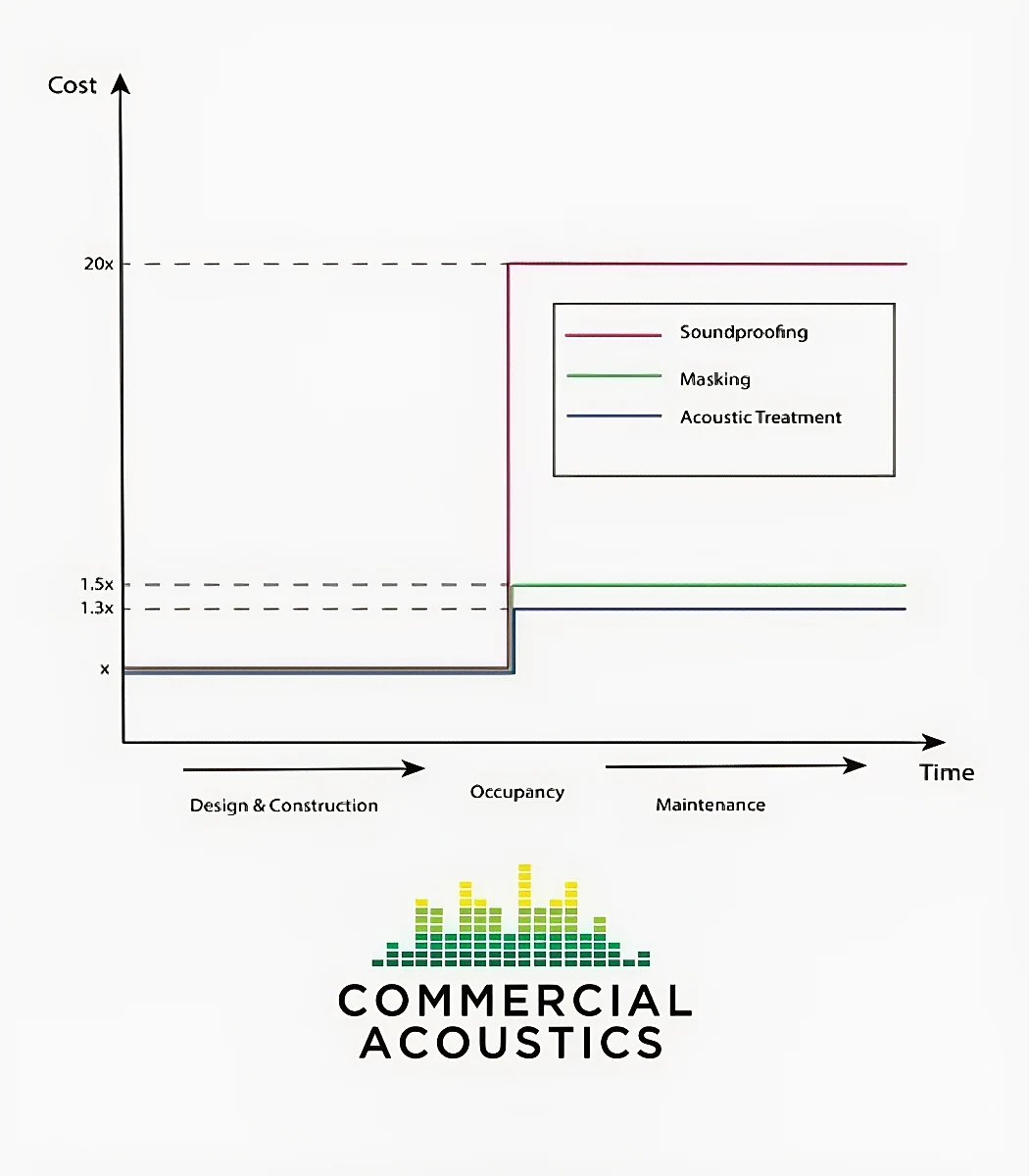
Cost of Acoustic Mitigation Options Across The Construction Timeline
The cost of acoustic solutions depends not only on the product but also on the project phase. Some interventions can be made anytime, while others are exponentially more expensive once the ceiling grid or walls are complete.
Acoustic Treatment (Absorption)
- Timing Flexibility: Panels, baffles, and stretched fabrics can be installed at nearly any stage, including post-occupancy.
- Cost Impact Later: Only 30–50% higher once finishes are complete, mostly due to working in occupied spaces or limited installation access.
- Architectural Insight: Treatments can also double as design features, blending acoustic control with aesthetic goals through color, texture, and geometry.
Real-World Example: A mid-range restaurant in Jacksonville waited until after opening to test its acoustics. When customers complained about excessive echo, the architect specified additional wall panels in the dining area. Installation took two nights — zero downtime, and an immediate improvement in clarity and comfort.
Sound Masking (Electronic Privacy)
- Timing Flexibility: Best installed after the ceiling grid but before ACT tiles. Still feasible after occupancy, though access to the plenum adds labor.
- Cost Impact Later: Moderate — typically 20–30% higher due to ceiling access and after-hours installation.
- Architectural Insight: For open-plan offices and healthcare environments, sound masking provides predictable speech privacy without altering the physical space.
Real-World Example: A corporate law firm in Orlando added sound masking two months post-occupancy to improve confidentiality between glass-fronted offices. The system was installed overnight, with zero construction required and immediate improvement in speech privacy.
Soundproofing (Blocking)
- Timing Flexibility: Must be addressed before drywall and finishes. Once walls and ceilings are sealed, upgrades require demolition.
- Cost Impact Later: Can exceed 2,000% once framing is complete.
- Architectural Insight: True sound isolation depends on mass, decoupling, and airtightness — all of which must be designed in from day one. Once construction reaches paint stage, it’s too late to add isolation layers or change assembly geometry.
Real-World Example: A multifamily developer in Miami discovered post-construction that unit-to-unit sound transmission exceeded code. The demising walls stopped at the ceiling grid instead of extending to deck. Fixing the issue required full demolition and rebuild of 14 walls — a six-figure rework that could’ve been solved with $3,000 of framing adjustments during construction.
The Hidden Cost Of Waiting
There’s a misconception that acoustic performance can always be adjusted later. While that’s true for reverberation and masking, it’s false for structural sound isolation. Once walls, floors, or ceilings are sealed, sound takes the path of least resistance — and you’ve lost your chance to redirect it.
There are no shortcuts. “Soundproofing paint,” “acoustic wallpaper,” and other quick fixes don’t increase STC or IIC in any measurable way. Real acoustic isolation relies on physics — not marketing.
When reviewing design trade-offs, remember this hierarchy:
- Acoustic Treatments: Adjustable after occupancy.
- Sound Masking: Install anytime for privacy tuning.
- Soundproofing: Design-critical; mistakes multiply exponentially after construction.
Retrofitting sound absorption might cost 30–50% more post-construction. Retrofitting soundproofing might cost 2,000% more, not counting delays, re-inspection fees, and tenant impact.
As noted in the white paper “Sound Matters: How to Achieve Acoustic Comfort in the Contemporary Office” (General Services Administration), acoustic mitigation becomes much more expensive and difficult to retrofit after build-out. This underscores the logic behind prioritizing proper isolation in the initial design phase, rather than relying on “soundproofing” fixes later.
Conclusion: Design Once, Build Quiet Forever
In the built environment, acoustics are one of the few systems you can’t easily patch. Walls and floors set the stage for every sound interaction in a building — and the difference between an acceptable and exceptional space often comes down to when you address it.
By planning acoustic strategies early, architects and engineers can deliver both performance and value. It’s far easier to design for quiet than to buy it later.
At Commercial Acoustics, we help design teams evaluate the cost of acoustic mitigation at every phase — from concept design to field verification. Because in construction, good acoustics aren’t an afterthought — they’re an investment in comfort, code compliance, and long-term client satisfaction.
FAQs: Cost & Strategy of Acoustic Mitigation
What is acoustic mitigation, and why address it early?
Acoustic mitigation reduces sound transfer and improves comfort. Tackling it early avoids costly fixes once walls or ceilings are sealed.
Which systems can be added later?
Acoustic treatments and sound masking can be installed after construction. Soundproofing, however, must be built in during framing.
How expensive is late-stage acoustic mitigation?
Adding treatments later costs about 30–50% more, while missed soundproofing can exceed 2,000% in rework costs.
What’s the difference between soundproofing, treatment & masking?
Soundproofing blocks sound, treatment absorbs it, and masking adds background noise. Each plays a role in full acoustic mitigation.
How does Commercial Acoustics support projects?
We help plan and price acoustic mitigation early, guiding teams to meet performance targets without costly retrofits.
