
STC Rules of Thumb: The Guide to Better Wall Soundproofing
Table of Contents
Understanding STC & Why It Matters in Wall Design
Sound Transmission Class (STC) ratings determine how much speech, music, and mechanical noise a wall will block. Bigger gains usually come from smarter framing and detailing—not just piling on more drywall. Use the quick rules below to design higher-performing, cost-efficient partitions for multi-family, hospitality, education, office, and healthcare projects.
How Sound Travels Through a Wall
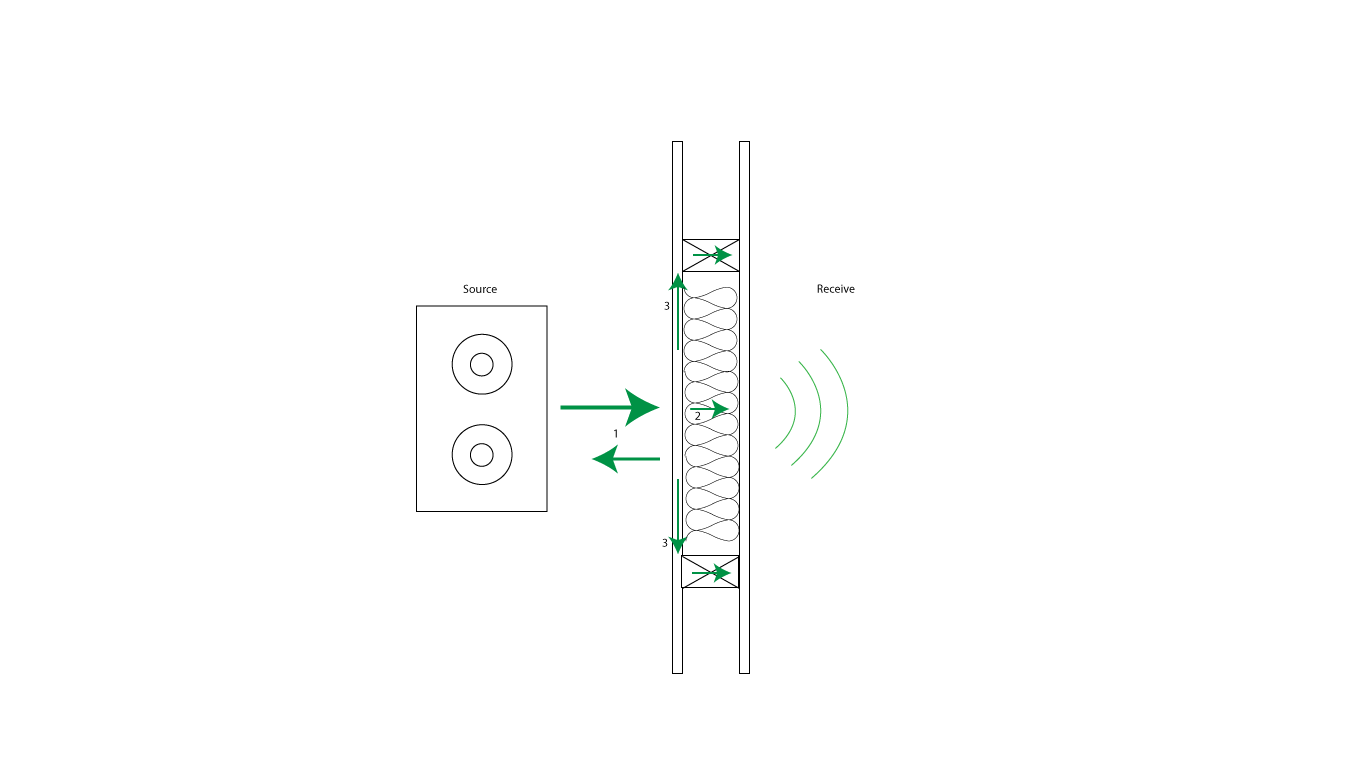
- Airborne path: Sound passes through drywall into the cavity.
- Structure-borne path: Vibration moves through studs & connections.
- Mixed path: Real projects combine both airborne & structure-borne transfer.
When sound hits drywall, some reflects back, some is absorbed, and some transmits through. Airborne energy that enters the cavity can be absorbed by insulation before striking the far layer. Structure-borne energy bypasses insulation and travels along studs, tracks, and fasteners. Understanding these paths explains why flexible, decoupled walls consistently outperform rigid, overbuilt ones.
Key STC Rules of Thumb
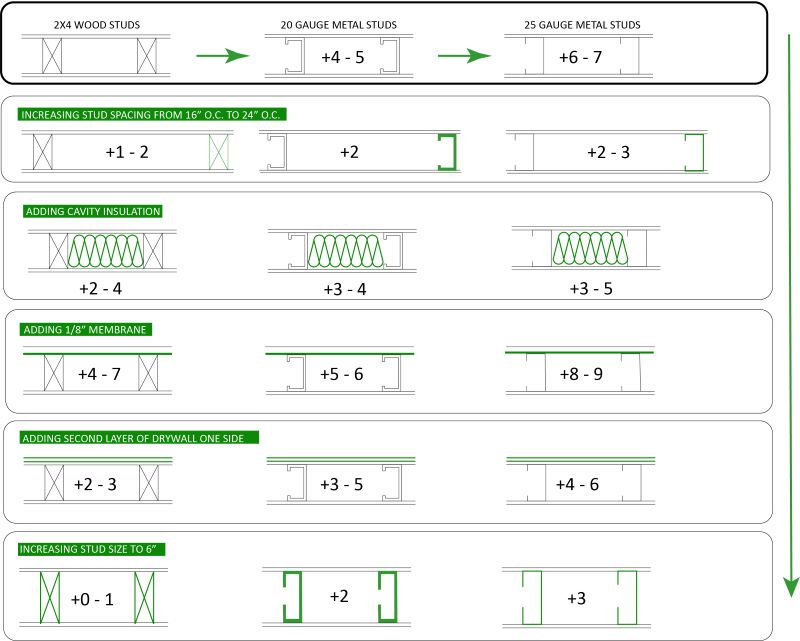
- Stud gauge: 25-gauge steel studs outperform heavier gauges for STC.
- Stud spacing: 24″ o.c. reduces structure-borne bridging vs. 16″ o.c.
- Flex over stiffness: More flexible walls block more sound.
Moving from 20-gauge studs at 16″ on center to 25-gauge studs at 24″ on center typically increases STC by about 7 points while lowering material cost. This swap is one of the highest value moves for demising walls in apartments, hotels, and offices.
Effective Ways to Increase STC
- Add cavity insulation: Reduces airborne energy and damps panel vibration.
- Use soundproofing membrane: Adds mass and a resilient break at the stud line.
- Decouple the faces: Staggered studs, double studs, or resilient channel.
Combining light-gauge studs at wider spacing with batt insulation and a membrane behind the source-side drywall can deliver large gains without increasing wall thickness. For sensitive adjacencies such as sleeping rooms, exam rooms, and music spaces, add decoupling to stop structure-borne transfer.
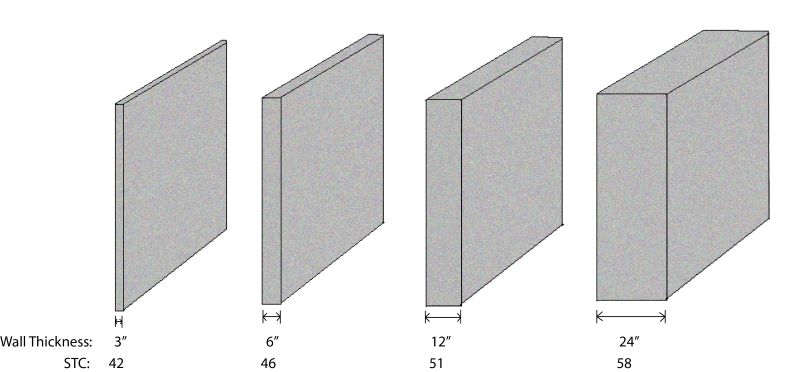
Mass Law & Diminishing Returns
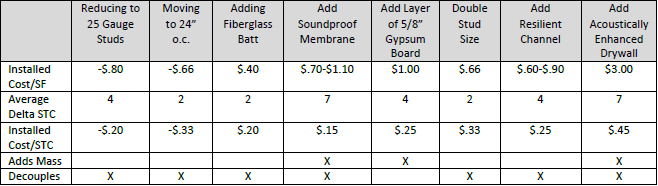
- Double mass ≈ +5 STC: Only when mass is continuous across the whole wall.
- Partial mass adds little: Extra studs or localized thickening don’t help much.
- Best with decoupling: Mass + flexibility beats mass alone.
Extra drywall layers help, but returns flatten quickly. Pair modest mass increases with a resilient connection (e.g., resilient channel with correct screws and spacing) to outperform “more gypsum” at a lower total cost.
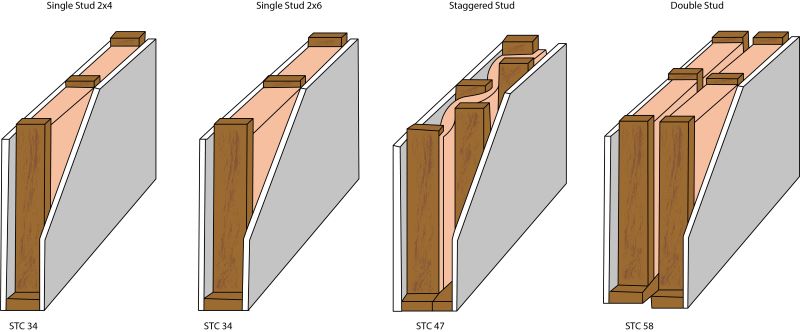
Wood Stud Walls: Why Decoupling Matters
- Bigger cross-section: Wood gives sound a wider structural bridge.
- Higher stiffness: Wood transmits vibration more readily than 25-ga steel.
- Use separation: Staggered or double studs, or resilient channel, are key.
Because wood is thick and stiff, structure-borne transfer dominates. To reach high targets in classrooms, studios, or residential theaters, plan for decoupling early and detail penetrations carefully.
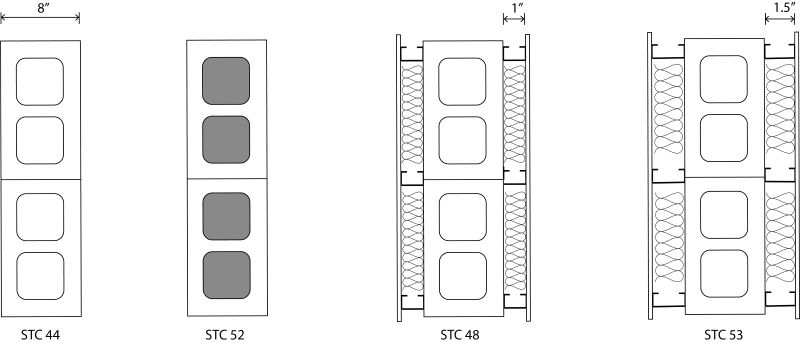
CMU Walls: What Actually Improves STC
- Fill every cavity: Use sand or grout for uniform mass distribution.
- Add light-gauge furring: 25-ga studs create a decoupled face for drywall.
- Skip partial fills: Every-fourth-cell grout/rebar doesn’t add useful STC.
CMU is heavy but rigid. Full-cell fills raise effectiveness, but the biggest gains come from adding a shallow, decoupled stud layer and finishing with gypsum—far better than stacking multiple gypsum layers directly on the block.
Common Soundproofing Mistakes
- Short-circuited resilient channel: Screws into studs or hard backing defeat it.
- Leaky penetrations: Unsealed boxes, gaps, and flanking paths erase lab STC.
- Overbuilt framing: Heavier studs and tighter spacing often lower STC.
Field performance often trails lab numbers due to detailing errors. Coordinate acoustic details and QC: back boxes, putty pads, sealed seams, continuous membrane, and isolated fixtures. Protect the resilient path and verify with inspections before close-up.
Takeaway STC Rule
If you remember only one principle, let it be this: Stronger, stiffer walls do NOT block more sound — more flexible walls do. Once you’ve chosen your wall assembly, make sure the acoustic details are executed correctly in the field. Even a perfectly designed lab-tested wall can fail to deliver if there are installation gaps, penetrations, or short-circuited resilient channels.
For help improving your wall’s STC rating while reducing cost and thickness, contact Commercial Acoustics for expert guidance.
FAQs: For STC Rules of Thumb
What’s the most cost‑effective first step to raise STC?
Switch to 25‑gauge steel studs at 24″ o.c. and add cavity insulation. If more isolation is needed, add a soundproofing membrane on the source side; decouple (resilient channel or staggered/double studs) for the next jump in performance.
Does adding more drywall always improve STC?
Only to a point. Doubling continuous mass yields roughly +5 STC, but returns flatten fast. Pair modest mass increases with decoupling to outperform multiple extra layers—especially where structure‑borne paths dominate.
Why do wood stud walls need decoupling?
Wood has a larger cross‑section and higher stiffness than light‑gauge steel, so it carries vibration efficiently. Use staggered or double studs, or resilient channel, and detail penetrations (boxes, seams, back‑to‑back outlets) to prevent short‑circuits.