
How to Soundproof a Wall
Table of Contents
Understanding the Basics of Wall Soundproofing
Walls set the tone for how a space feels — private, calm, or painfully loud. Whether it’s traffic noise outside or your neighbor’s late-night TV habitFs, unwanted sound usually finds its way through interior partitions that weren’t built for silence.
While no wall is ever perfectly “soundproof,” you can dramatically improve noise control with smart design and the right materials. The key lies in balancing mass, isolation, and airtightness — three fundamentals that determine your final Sound Transmission Class (STC) rating. At Commercial Acoustics, we’ve refined these methods across apartments, offices, and hotels nationwide to deliver measurable results that keep clients happy (and noise complaints low).
Step 1: Assess the Existing Wall
- Check the framing: Identify whether it’s wood, steel, or aluminum channel, and note stud spacing — 16″ or 24″ on center.
- Inspect the insulation: Determine the type and thickness of any batting or fill in the wall cavity.
- Locate weak points: Outlets, ducts, and unsealed joints often leak more noise than the drywall itself.
Before adding products or tearing anything out, start by understanding what you’ve got. A quick wall audit shows where sound actually travels. Wood studs transmit structure-borne vibration differently than steel, and empty cavities or loose junction boxes can undo great materials. Diagnose the real issue first—it’s the smartest way to soundproof a wall so every upgrade counts.
Step 2: Determine Your Target STC
- Offices & conference rooms: STC 35–40 is usually enough to muffle speech.
- Multifamily & residential: STC 50–55 limits traffic and neighbor noise.
- Studios & high-security areas: STC 60+ achieves full acoustic privacy.
Your STC target shapes your approach. If you only need moderate separation, you can often retrofit existing walls without rebuilding. But in hospitality, multifamily, and government spaces, going beyond minimum code ratings pays dividends — in tenant satisfaction, privacy, and long-term property value.
Step 3: Add Mass to the Wall
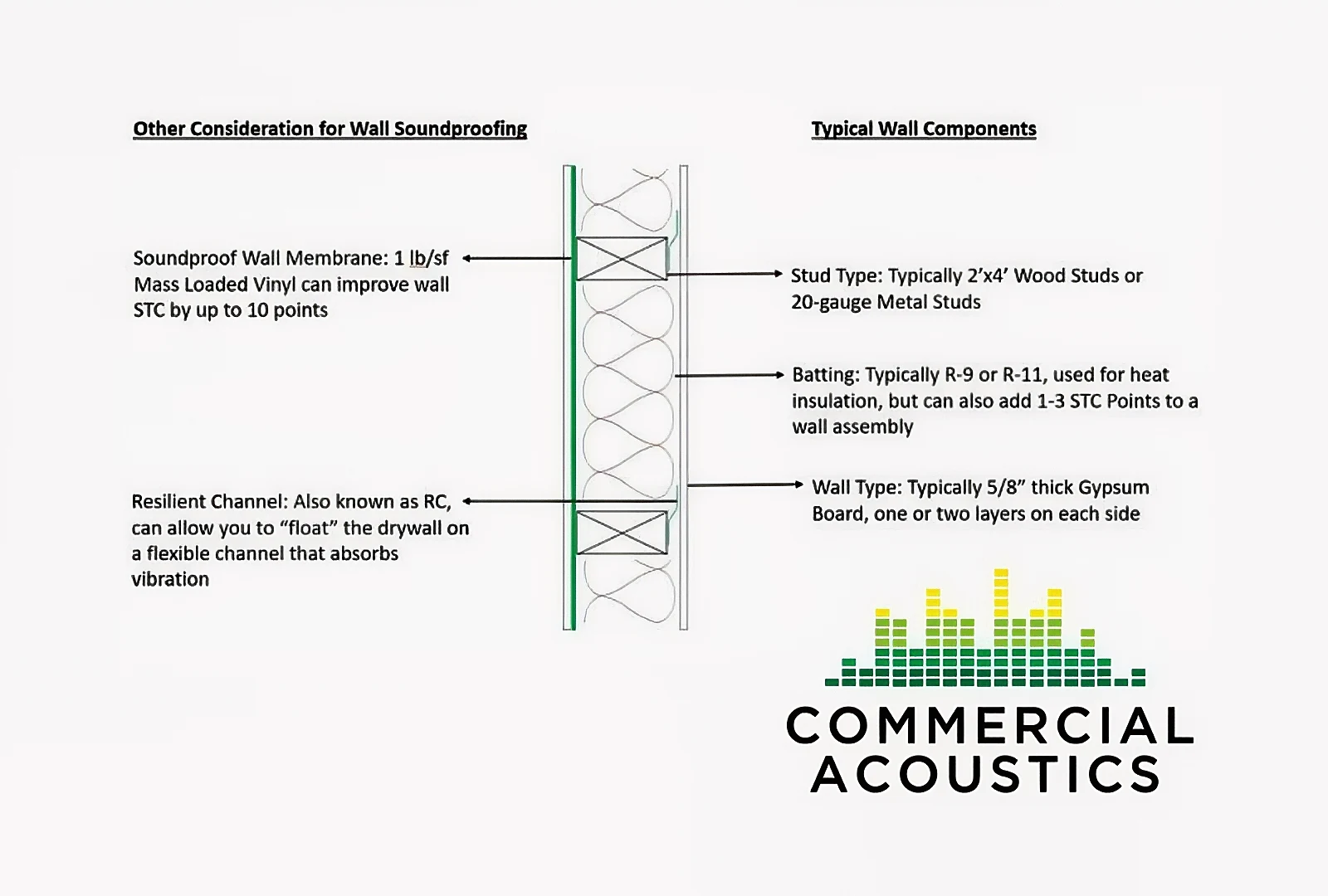
- Double the drywall: Adding a second ⅝-inch layer increases wall density and improves isolation by 4–6 STC points.
- Install sound membranes: Products like Wall Blokker or mass-loaded vinyl (MLV) add “limp mass” between drywall sheets for better low-frequency control.
- Fill the cavity: Fiberglass or mineral wool batting absorbs mid- to high-frequency sound energy.
Mass is your foundation. According to the Mass Law, doubling a wall’s weight can reduce sound transmission by roughly 6 dB. Drywall layers and acoustic membranes work best when they’re continuous and fully sealed. Even inexpensive insulation batting inside the wall cavity dramatically improves absorption and prevents sound from bouncing around internally.
Step 4: Decouple the Structure
- Use resilient channels or isolation clips: These “float” drywall off the studs to break vibration paths.
- Build staggered or double-stud framing: Separate structural connections on each side of the wall.
- Combine isolation with mass: The combination yields the best performance per dollar.
If adding mass quiets the wall, decoupling silences it. Think of it as installing suspension in your wall system — vibration energy hits the first layer but can’t jump to the next. This method is essential when low-frequency or mechanical noise dominates. It’s one of the most effective ways to soundproof a wall and move from simply passing code to creating true quiet.

Step 5: Seal & Finish Airtight
- Apply acoustic caulk: Run flexible sealant around perimeters, seams, and penetrations.
- Wrap electrical boxes: Use putty pads or airtight covers.
- Inspect again before finishing: Drywall taping and paint can hide small but costly leaks.
Even the best soundproofing system fails if air leaks remain. Acoustic caulk stays flexible, expanding and contracting with seasonal shifts to maintain a perfect seal. We see countless “quiet walls” ruined by a single unsealed outlet or joint. It’s not the fancy materials — it’s the details that define real acoustic performance.
Step 6: Verify the Results
- Use a sound meter app: Compare interior vs. exterior readings using C-weighting.
- Document your data: Record baseline and post-upgrade readings.
- Target a 10 dB reduction: Equivalent to roughly half the perceived loudness.
When you measure results, you turn theory into proof. Showing clients or ownership that you cut noise in half is powerful. It quantifies the value of learning how to soundproof a wall — and lets you replicate that success across other walls or buildings.
Common Mistakes when Soundproof a Wall
- Adding drywall only: More drywall adds mass, but without decoupling or sealing, vibration and flanking still pass through the studs.
- Ignoring penetrations: Electrical boxes, vents, and cracks can leak 10–20 dB — more than the rest of the wall combined.
- Using rigid foam: Excellent thermal insulation, but acoustically reflective; it amplifies noise rather than absorbing it.
These mistakes are surprisingly common, even on high-end projects. Real soundproofing is about understanding how sound energy moves, not just adding layers. Every small oversight can create an acoustic shortcut that undermines the entire assembly.
Conclusion: The Right Way to Build Silence
Soundproofing a wall isn’t about trial and error — it’s about using physics intelligently. By combining mass, decoupling, and airtight detailing, you can transform an ordinary wall into an acoustic barrier that performs far above code.
Well-designed walls don’t just pass inspections — they create peace, privacy, and measurable satisfaction. Every 3 dB of improvement adds real comfort that tenants and guests notice immediately. At Commercial Acoustics, we engineer wall systems that meet the highest performance demands while keeping costs realistic for builders and developers.
If you’re planning new construction or retrofitting an existing space, our team can help you design, test, and deliver a wall that truly works. Contact Commercial Acoustics to start your project.
FAQs: Soundproof a Wall
How can I soundproof an existing wall?
Add insulation to the wall cavity, seal every joint with acoustic caulk, and apply a dense soundproofing membrane like Wall Blokker behind new drywall. This approach adds significant STC performance without a full tear-out.
How do I soundproof a wall cheaply?
Focus on the fundamentals — seal leaks, replace outlets with putty pads, and add one extra layer of drywall or MLV. Even budget-friendly steps can cut noise by 8–10 dB when executed cleanly.
How to stop hearing neighbors through walls?
Increase wall mass, fill voids with insulation, and decouple one side using resilient channels. For multifamily units, addressing both airborne (speech) and structure-borne (vibration) paths makes the biggest difference.
How do I block noise on a shared wall?
A shared wall should be isolated using resilient clips or an added drywall layer with MLV. When you seal all perimeters and stop flanking paths, you soundproof a wall effectively enough to cut shared noise by half or more.
Can Commercial Acoustics help with soundproofing a wall?
Absolutely. We design and install tested wall systems that balance performance, cost, and code requirements for commercial, residential, and hospitality projects nationwide. Whether it’s STC 50 or STC 70, we help you hit your acoustic target — and prove it.