Table of Contents
Project Overview: Reverberation Control in a Federal Courthouse
- Project: Greenville Federal Courthouse
- Address: 305 Main Street, Greenville, MS 38701
- Client: U.S. General Services Administration (GSA)
- Facility Type: Federal Courthouse – New Construction
- Architect: Duvall Decker Architects // EskewDumezRipple
- General Contractor: Robins & Morton Construction
- Objective: Enhance speech clarity & reduce echo in courtrooms
- Scope: Ceiling baffles, column wraps, wall-mounted treatments
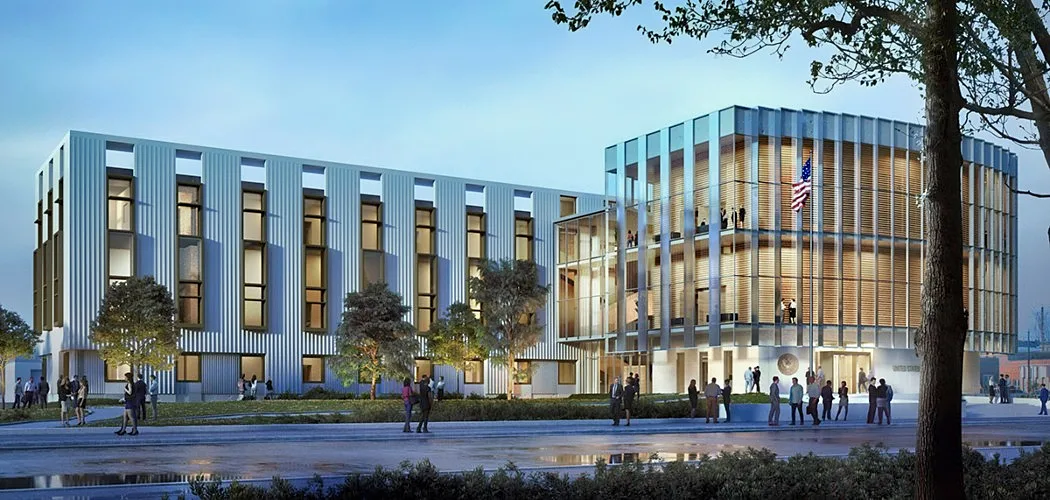
The Greenville U.S. Courthouse was commissioned to house the U.S. Courts and Department of Justice. With high ceilings, masonry finishes, and large open volumes, the design posed serious acoustic challenges. Commercial Acoustics was brought in by Robins & Morton to implement reverberation control strategies that aligned with the architectural vision and federal performance standards—without delaying construction.
Existing Conditions: Echo Problems in Civic Spaces
- Ceiling Height: 20+ ft in lobbies and corridors
- Finishes: Plaster, tile, glass, & stone
- Use Case: High-traffic public zones & speech-critical courtrooms
- Acoustic Risk: Long reverberation times & speech unintelligibility
Like many federal buildings, the Greenville Courthouse was built to be monumental—but hard surfaces and open volume meant voices echoed throughout the building. Without targeted noise reduction, speech in courtrooms, lobbies, and jury assembly rooms would be difficult to understand. This would impact everything from witness testimony to day-to-day operations. Our team addressed these issues early to avoid late-stage retrofit headaches.
Ceiling Baffle Installation for Echo Control
- Material: Polyester core, fabric-wrapped
- Baffle Size: 24″×48″, 2″ thick
- NRC Rating: 0.90
- Mounting: Suspended from ceiling structure & grid
- Application: Public corridors, courtroom entries, & galleries
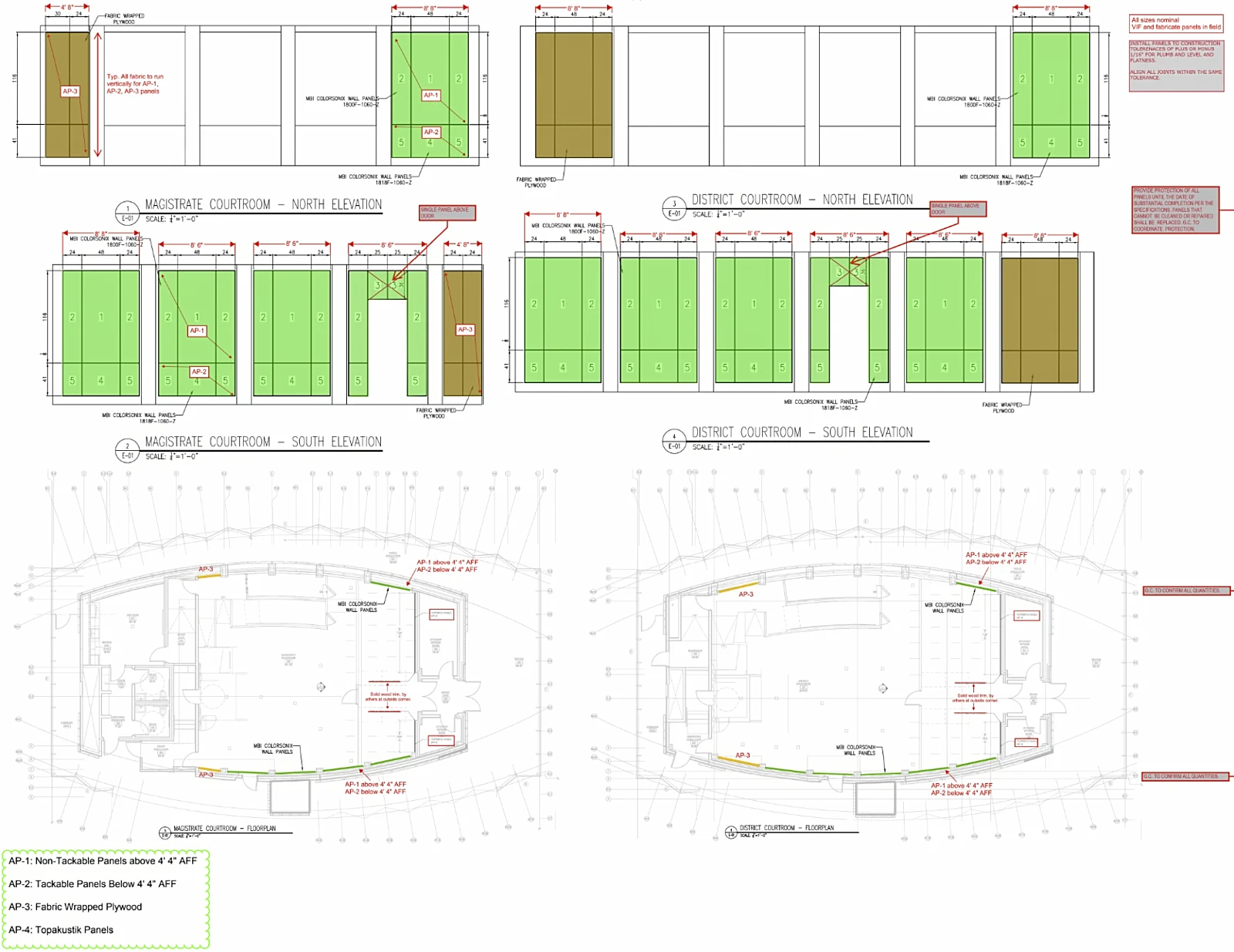
To reduce vertical sound reflection in tall spaces, we installed ceiling baffles above courtroom access areas and main circulation zones. These absorptive units intercept mid- and high-frequency reverberation while blending cleanly with lighting and sprinkler layouts. Their lightweight construction made them fast to install, and their high NRC rating ensured fewer units were needed—saving install time and keeping material costs down.
Column Wraps for Targeted Sound Control
- Material: 1″ absorptive core, fabric-wrapped
- Design: Color-matched to interior millwork
- Mounting: Custom-fit around exposed structural columns
- Function: Eliminate voice reflection at conversation height
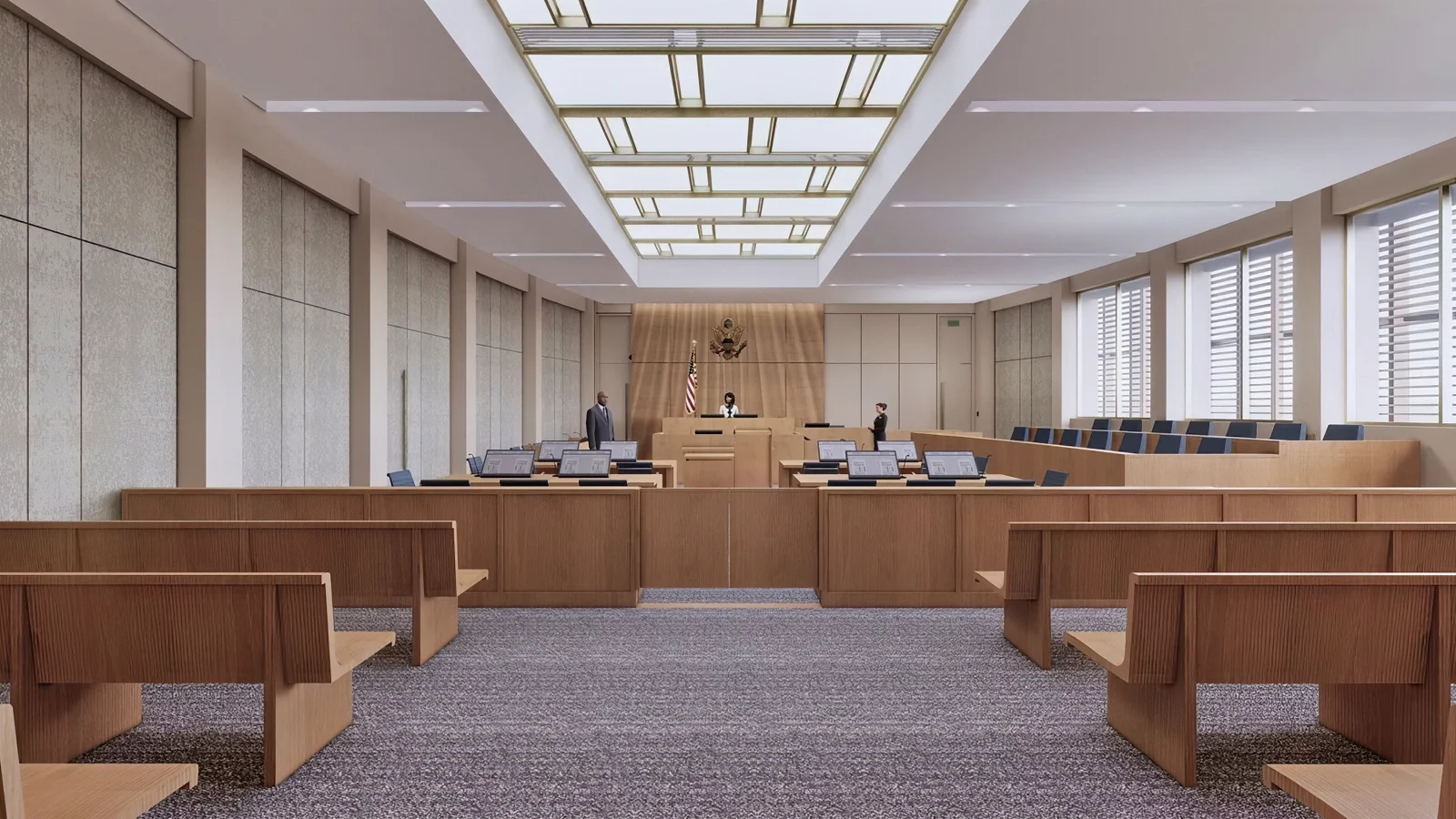
Exposed columns in jury assembly and admin spaces were treated with fabric-wrapped absorptive covers. These reduce echo around seating and discussion areas, improving clarity during interactions. Each wrap was custom-fabricated to integrate with the building’s finish palette, avoiding visual conflict while enhancing localized speech control. These small-footprint treatments deliver major performance benefits without taking up wall or ceiling real estate.
Wall-Mounted Panels for Jury and Administrative Areas
- Panel Thickness: 2″
- NRC Rating: 1.05
- Mounting: Mechanical Z-clips
- Finish: Fabric-wrapped, matching space palette
- Install Duration: 3 days across 2 phases
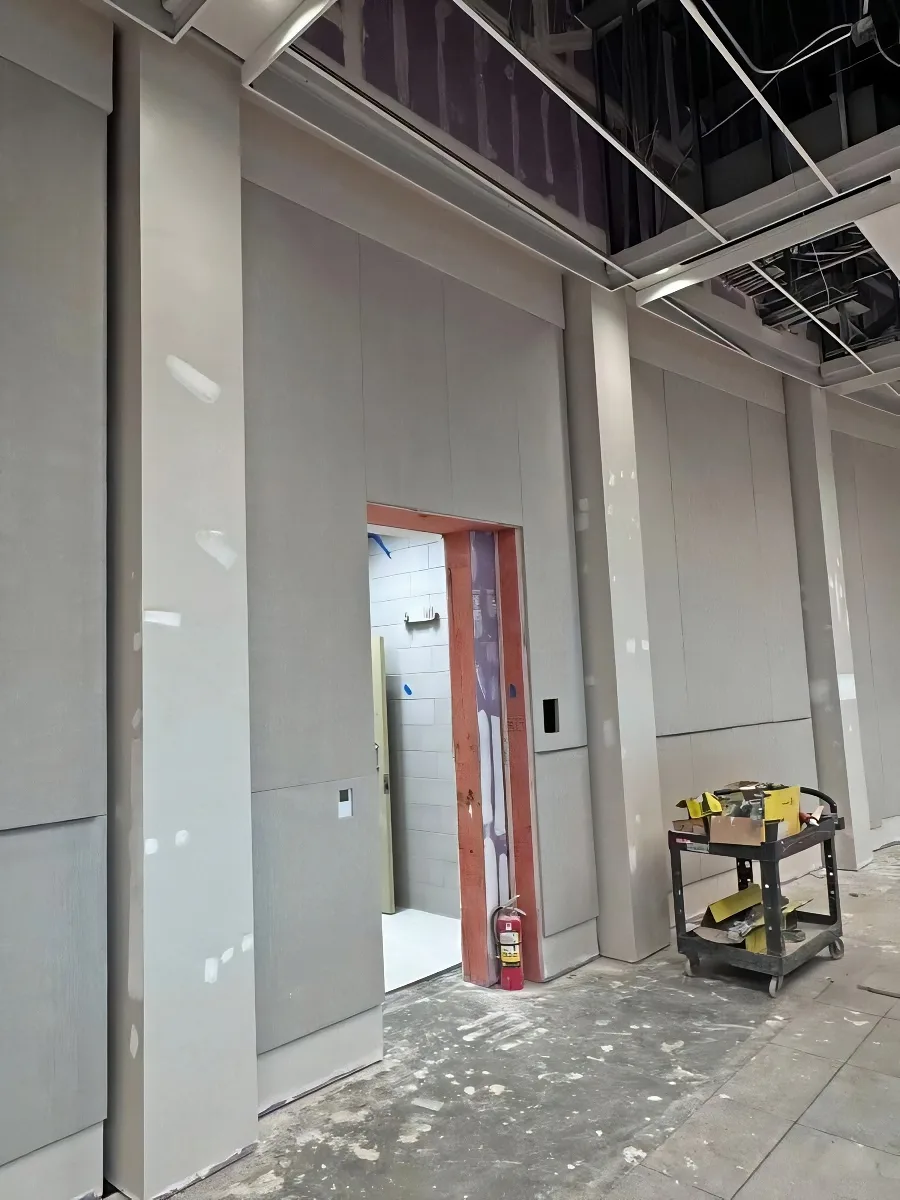
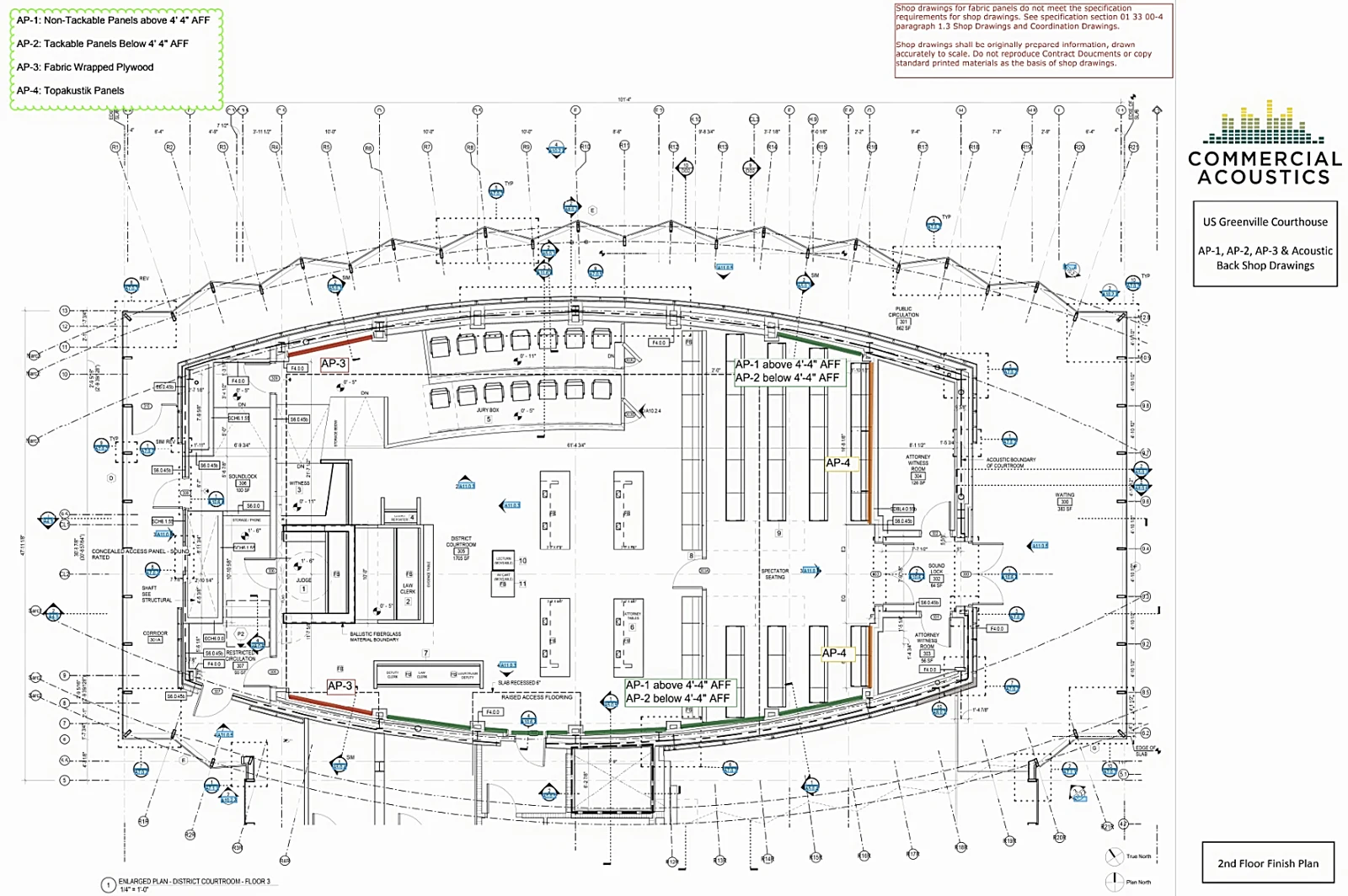
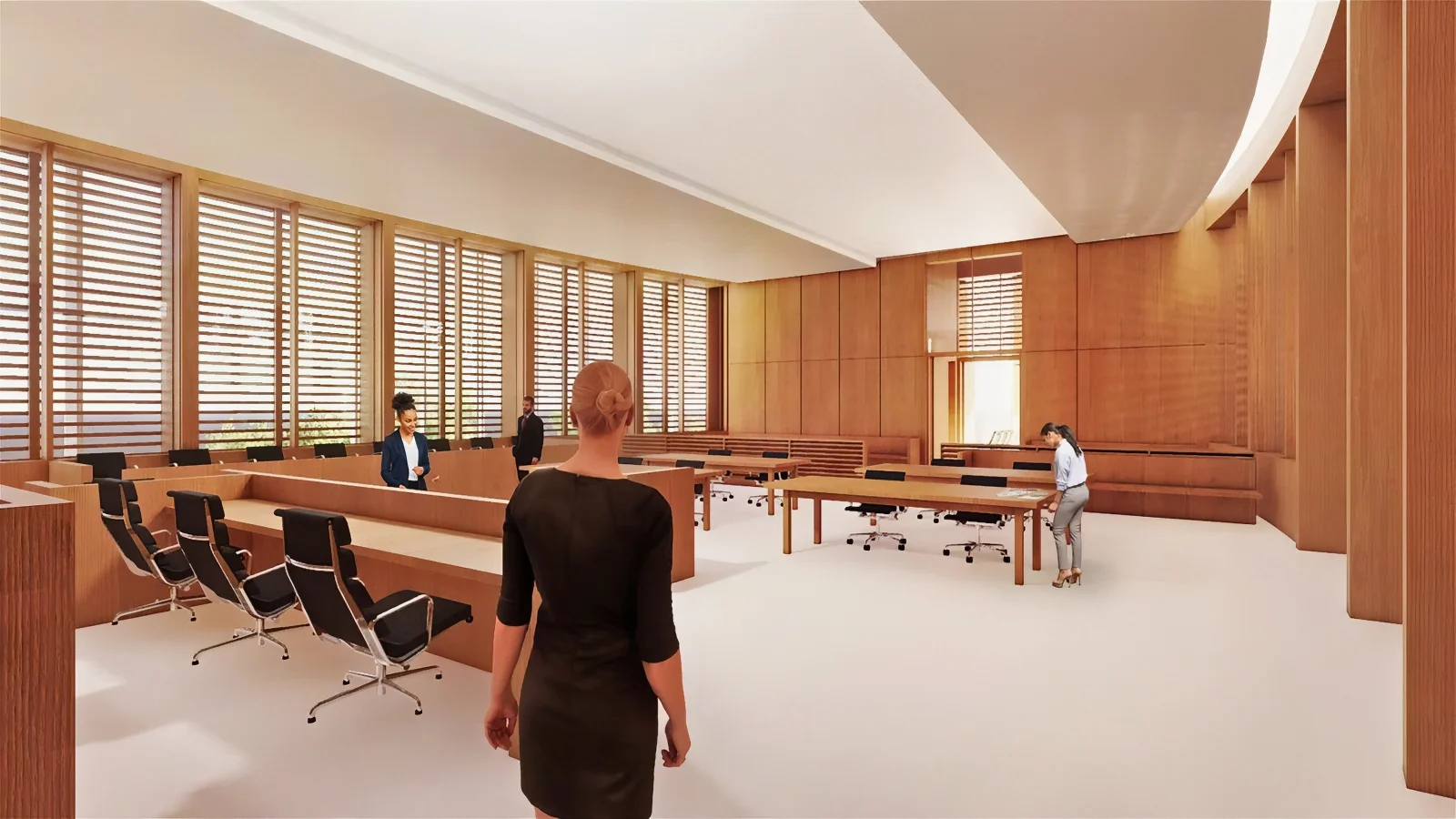
In offices, conference rooms, and jury lounges, wall-mounted Topakustik perforated wooden panels helped absorb horizontal echo. These panels were selected for their balance of performance and appearance—offering high absorption without clashing with the building’s minimalist interior design. Quick mounting hardware kept labor minimal and allowed seamless integration with millwork and signage.
Construction Coordination with Robins & Morton
- Scheduling: Installed off-hours and around MEP work
- Lead Time: 4 weeks
- Fire Rating: All treatments Class A & GSA-approved
- Integration: No delays to drywall, lighting, or inspections
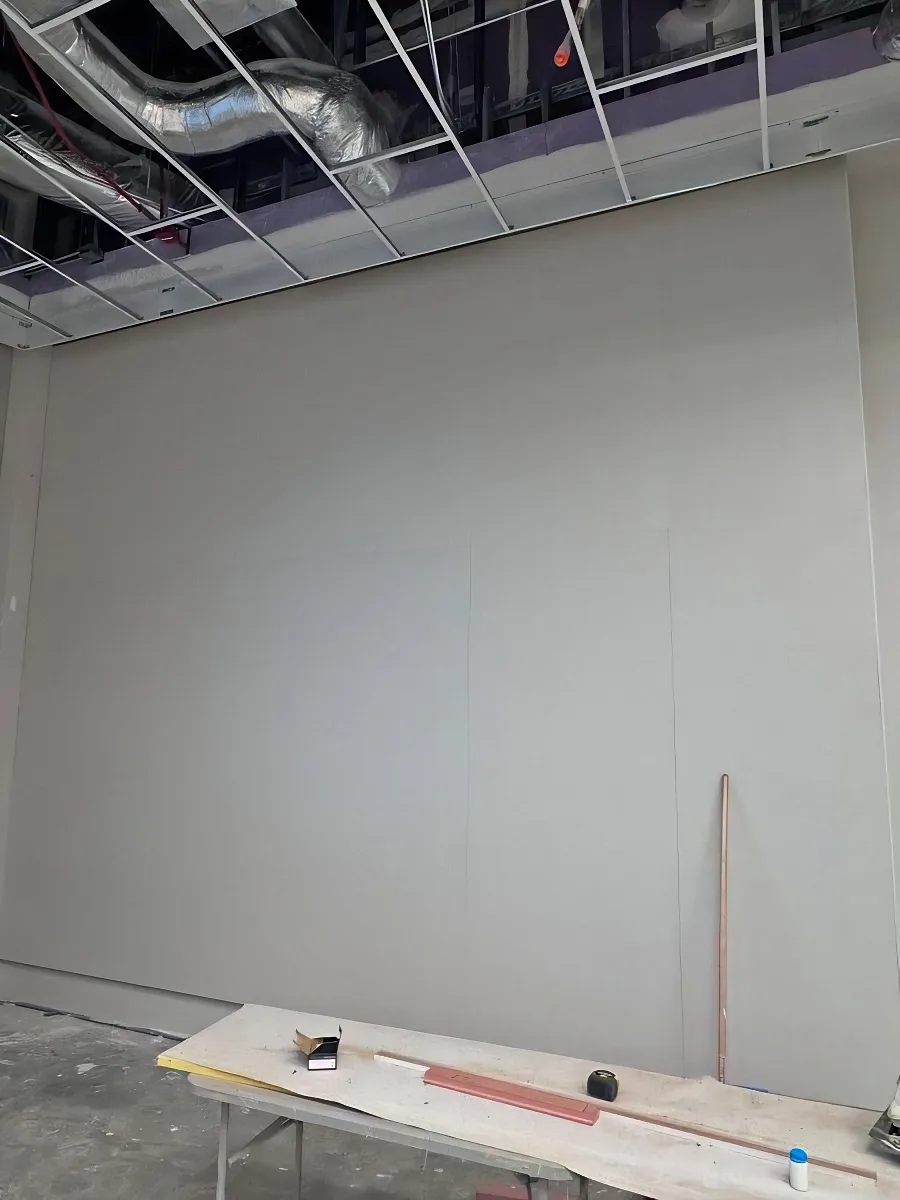
All acoustic treatments were planned to align with the general contractor’s schedule. Pre-cut materials were delivered just-in-time and installed in phases to avoid bottlenecks. Field coordination with lighting, HVAC, and fire suppression systems helped avoid rework. By planning ahead, we ensured echo control was delivered without creating change orders or delaying finish trades.
Outcome: Functional, Quiet Civic Space
- RT60 Reduction: From ~2.1 sec to ~1.0 sec
- Impact: Clearer speech, reduced echo, improved courtroom performance
- User Experience: Less listener fatigue & better communication
Post-installation acoustic modeling confirmed that reverberation time dropped by over 50%, bringing courtroom zones in line with GSA speech intelligibility standards. Occupants now experience cleaner, clearer speech across all areas—from galleries to judge’s chambers. Noise reduction was achieved without compromising the architecture—and without slowing construction.
Summary: Reverberation Control in Courthouse Projects
The Greenville U.S. Courthouse stands as a clear example of how early acoustic coordination can enhance both design integrity and construction efficiency. Reverberation control was achieved without compromising the architect’s vision or disrupting Robins & Morton’s schedule. All treatments—including ceiling baffles, wall panels, and column wraps—were selected for their clean integration with interior finishes and their proven performance in speech-critical environments.
By phasing installation alongside other trades and maintaining compliance with all GSA and life-safety standards, the project avoided costly rework and stayed on track. The final result is a civic facility that not only looks refined but functions with acoustic precision—supporting courtroom communication, reducing listener fatigue, and improving the overall user experience.
For architects and general contractors working on courthouse or government projects, this case reinforces the importance of addressing reverb control early in the design process. If you’re seeking help with product selection, lead time coordination, or turnkey acoustic solutions, contact the team at Commercial Acoustics.
FAQs: Reverb Control in a U.S. Courthouse
Why is reverberation control so important in a courthouse?
Clear speech is essential in courtrooms. Without reverberation control, sound reflections from hard surfaces and high ceilings make speech hard to understand—affecting proceedings and daily operations.
What was the targeted reverberation time in this project?
The goal was to reduce RT60 to around 1.0 second, meeting GSA standards. Untreated spaces were projected over 2.0 seconds, which would have impacted clarity in key areas.
How were acoustic treatments integrated without affecting the courthouse design?
Ceiling baffles, wall panels, and column wraps were matched to interior finishes and installed around MEP systems to preserve the building’s clean visual design.
Were installations coordinated to avoid construction delays?
Yes. Treatments were delivered with a 4-week lead time and installed off-hours in phases—coordinated with Robins & Morton’s schedule to avoid delays or trade conflicts.
