Table of Contents
Project Overview: Courtroom Acoustics Upgrade at 25th District Courthouse
- Project: Courtroom Acoustic Treatment & Reverberation Control
- Address: 20180 Plaquemine St, Plaquemine, LA 70764
- Facility Type: Courthouse
- Objective: Improve speech intelligibility & reduce excessive reverberation
- Scope: Install custom acoustic wall panels to meet design RT60 targets
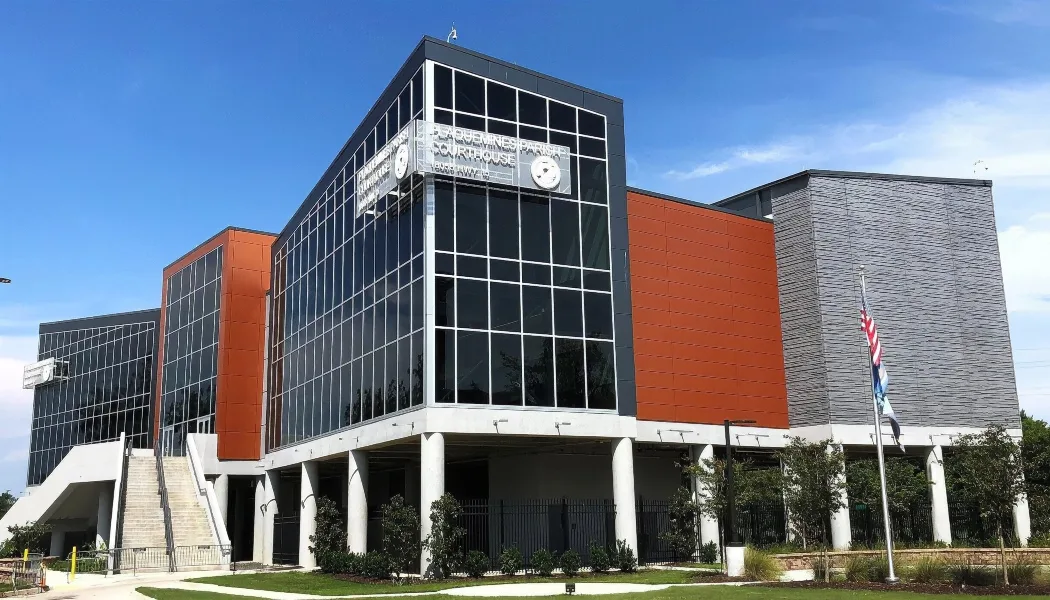
The 25th District Courthouse in Plaquemines Parish, Louisiana, faced a persistent challenge with courtroom acoustics. Judges, attorneys, and stenographers struggled to hear proceedings clearly due to excessive reverberation. This was more than an annoyance—it interfered with efficient hearings and accurate record keeping. Commercial Acoustics was engaged to design and implement a focused solution that would reduce reverberation time and restore clarity to spoken word.
Understanding the Courtroom’s Acoustic Challenges
- Reverberation Issues: Measured RT60 between 1.4s–1.7s prior to treatment
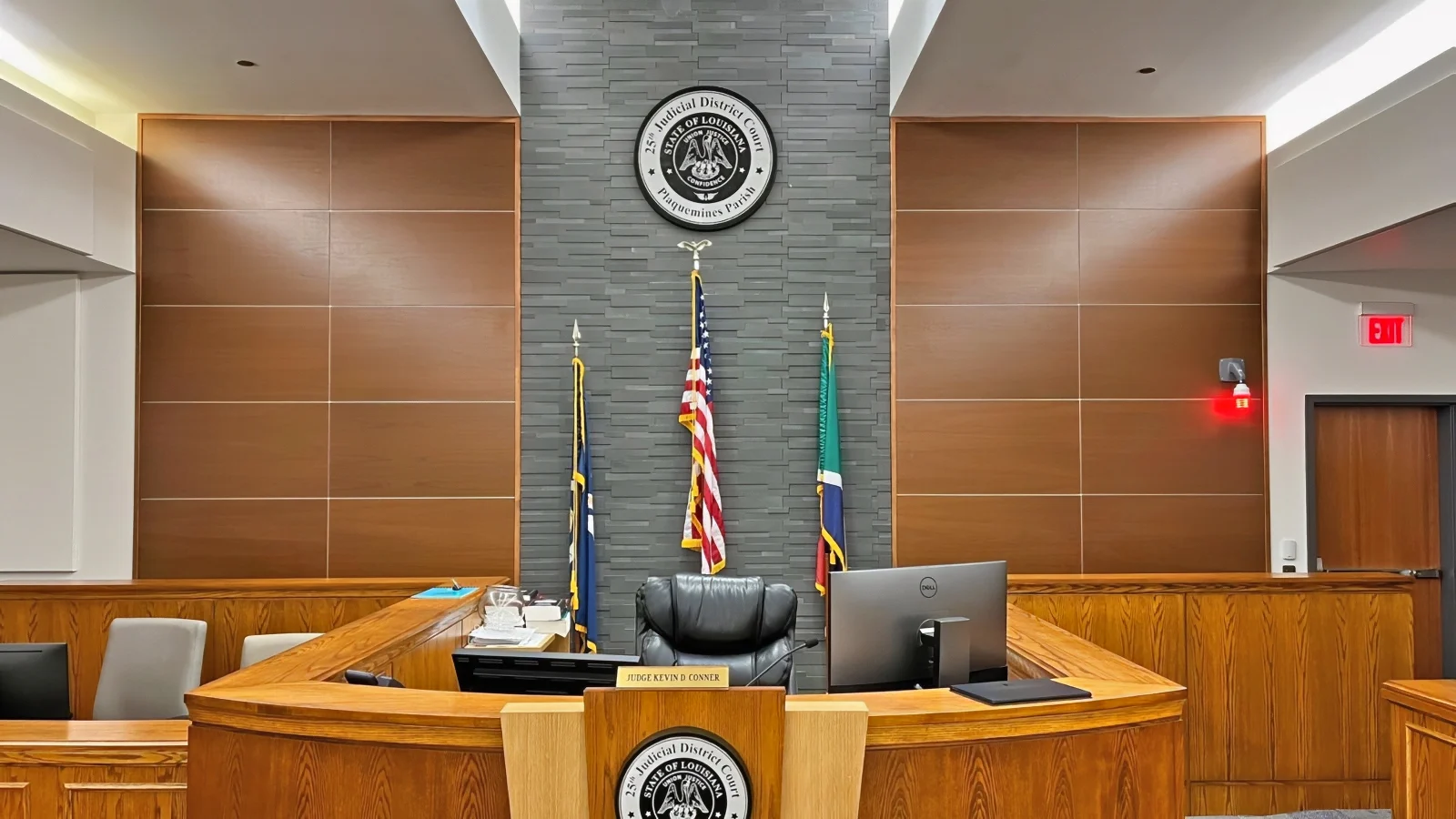
- Hard Surface Finishes: Drywall ceilings, wood paneling & low‑pile carpet
- Speech Intelligibility: Listeners reported muffled, overlapping dialogue
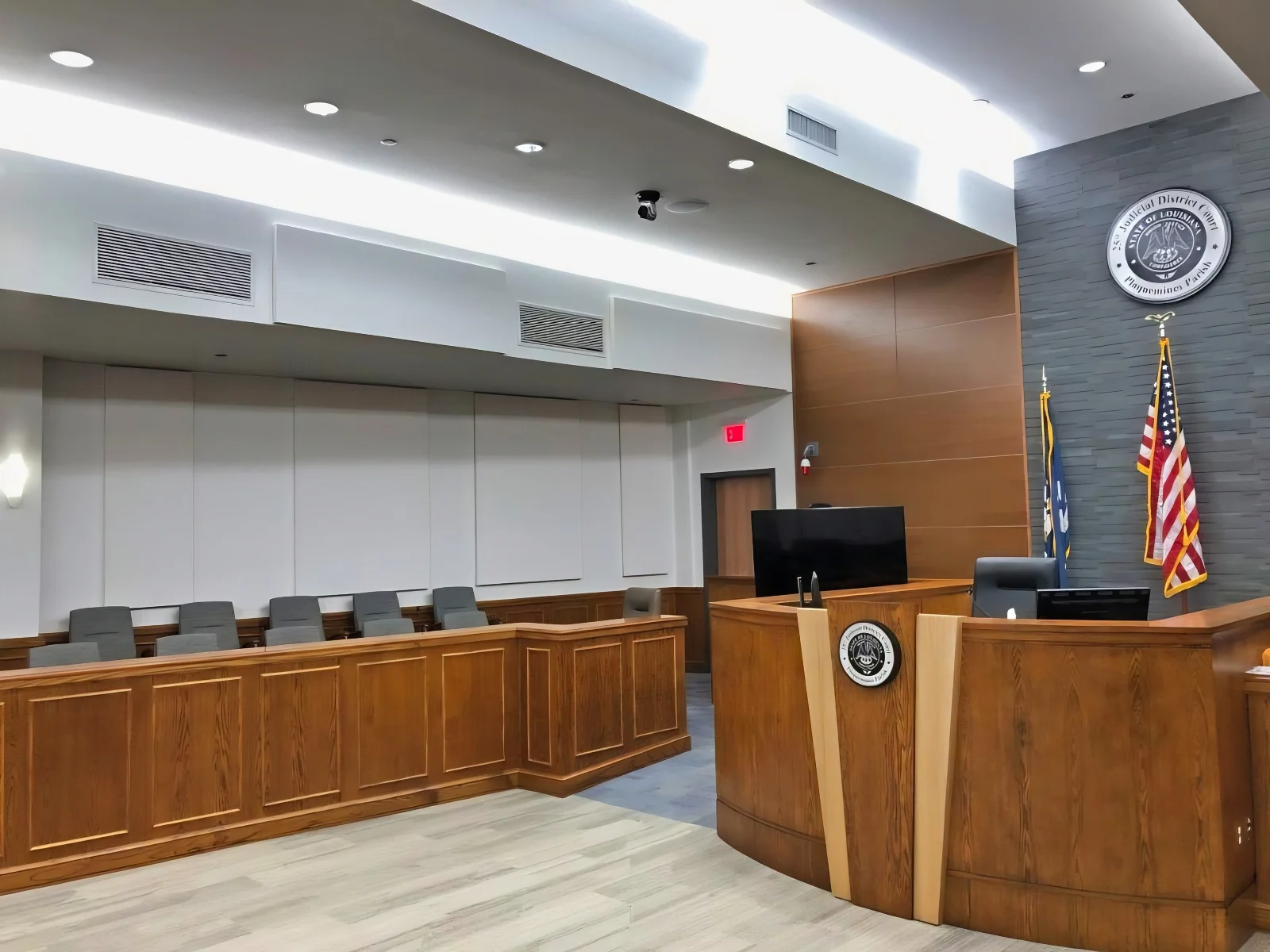
Both courtrooms featured large volumes and reflective surfaces that amplified echoes rather than absorbing sound energy. The architecture conveyed tradition and formality but produced long decay times that blurred consonants and masked voice detail. Even with microphones and an AV system, speech sounded distant, forcing participants to repeat themselves and straining the stenographer’s ability to capture testimony accurately.
Baseline measurements confirmed the issue: the reverberation time (RT60) exceeded the recommended targets for courtroom acoustics. As a practical guideline, courtrooms with amplified speech should be under 1.0 second RT60, while rooms without amplification should be under 0.7 seconds. The existing 1.4s–1.7s decay meant syllables lingered, reducing clarity and comprehension.
Acoustic Design Strategy & Planning
- Target RT60: Reduce to ≤ 1.0s for amplified speech scenarios
- Priority Zones: Behind the stenographer, witness stand & jury box
- Custom Sizing: Panels fitted between vents, fascia & soffits
The design process began with absorption calculations to determine the square footage and placement required to reach the target reverberation time without over-damping the space. The solution emphasized first‑reflection control near the most critical listening and speaking positions. By concentrating treatment behind the stenographer, witness stand, and jury box, the design intercepted early reflections that most strongly affect speech intelligibility. Additional coverage at the rear walls controlled late reflections and reduced buildup from spectator seating areas.
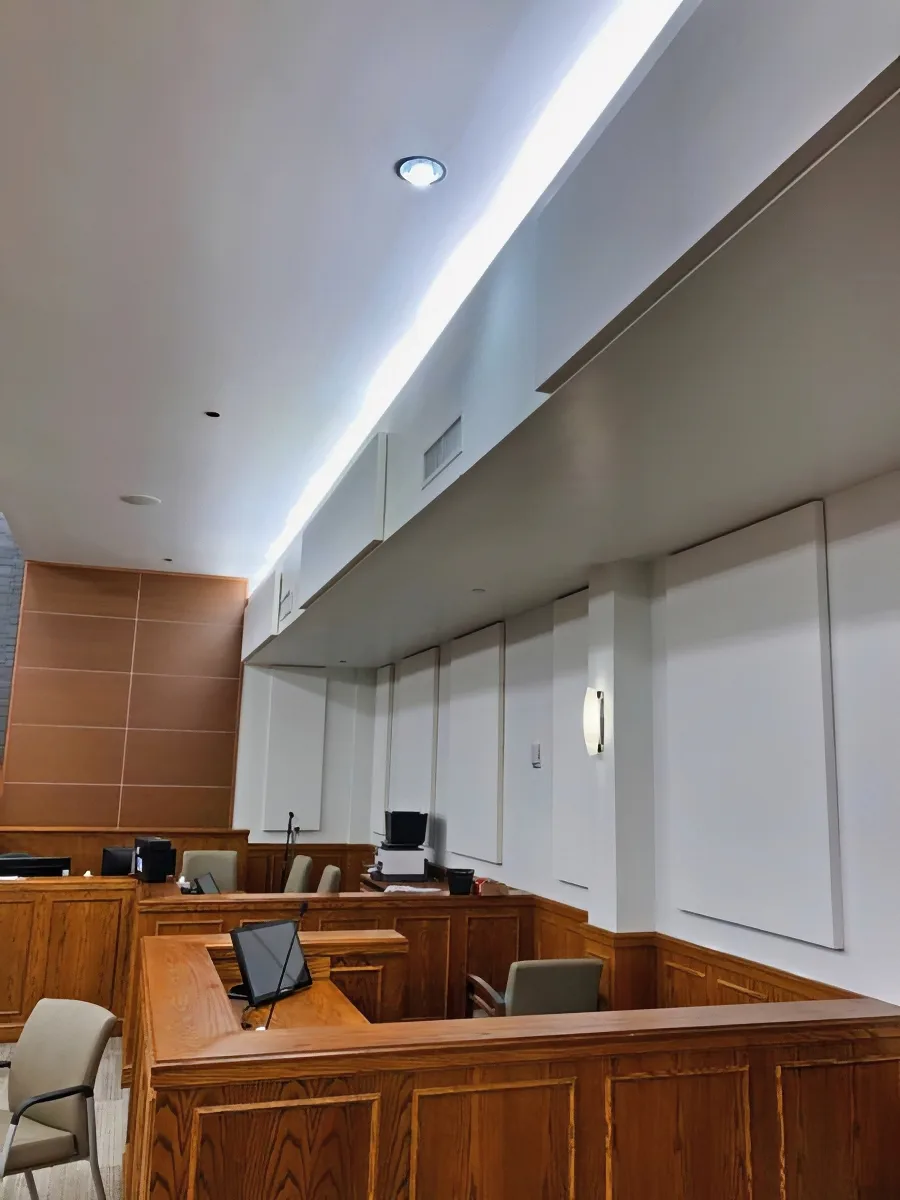
Panel sizing and layout accounted for architectural constraints, including mechanical grilles, wood fascia, and soffit transitions. This approach preserved the room’s visual character while creating a balanced distribution of absorption that performs predictably across speech frequencies.
Installation of Fabric‑Wrapped Acoustic Wall Panels
- High‑NRC Materials: Optimized for voice‑range absorption
- Fabric Integration: Acoustically transparent textiles matched to décor
- Low Disruption: Scheduling coordinated to minimize courtroom downtime
Following fabrication, the installation team coordinated work windows around the court’s calendar to avoid interfering with daily operations. Panels used high‑density absorptive cores for stable, broadband performance and were wrapped in acoustically transparent fabric selected to complement existing finishes. Mounting hardware allowed a clean, flush fit on walls and soffits, maintaining sightlines and architectural intent.
The design aligned with accepted guidelines for courtroom acoustics and good building practice, enhancing comfort for occupants and creating an environment where spoken word carries with clarity at natural vocal levels.

Measured Results & Operational Impact
- Post‑Treatment RT60: Reduced to approximately 0.7s–0.8s
- Clarity Gains: Marked improvement for judges, jurors & stenographers
- Efficiency: Fewer repetitions, smoother proceedings, better records
Verification measurements taken after installation showed a reduction in reverberation of roughly 50%, bringing both courtrooms within the recommended range for amplified speech. Judges reported that testimony could be followed without strain, and the stenographer could reliably capture soft or mumbled speech. Jurors and spectators also benefited from clearer articulation, reducing listener fatigue over long sessions.
These acoustic improvements translated into tangible operational benefits: fewer misunderstandings, quicker examinations, and more accurate transcripts. By addressing the root cause—excessive reverberation—the project restored the room’s primary function as a space for precise, intelligible communication.
Why Courtroom Acoustics Matter
- Clarity of Record: Accurate transcription and legal documentation
- Fair Proceedings: Jurors & judges hear evidence as intended
- Design Compliance: Meets recommended performance targets
Courtroom acoustics directly influence the quality and fairness of legal proceedings. Excessive reverberation masks consonants, reduces speech intelligibility, and increases cognitive load for listeners. Proper acoustic treatment—particularly well‑placed wall and ceiling absorption—controls early reflections and shortens decay time so every word is conveyed cleanly. For facilities teams, it is a high‑impact upgrade that improves day‑to‑day operations without requiring major architectural changes.
Conclusion: Delivering Precision in Courtroom Acoustics
The 25th District Courthouse project demonstrates how targeted acoustic treatment can transform a legal environment. Through careful assessment, strategic placement, and clean integration of fabric‑wrapped panels, Commercial Acoustics achieved measurable gains in speech intelligibility while preserving the room’s visual character. Proceedings are now smoother, communication is sharper, and the courtroom fulfills its purpose as a space built for clarity.
If your courthouse or municipal facility struggles with echo or long decay times, our team can design a custom solution for your space. Learn more and request a consultation at
Commercial Acoustics.

FAQs: Courtroom Acoustics
What is the ideal reverberation time for a courtroom?
For rooms with amplified speech, a target RT60 below 1.0 second is recommended. Spaces without amplification should aim for below 0.7 seconds to maintain intelligibility.
Can upgrades be installed without disrupting the court schedule?
Yes. Installation can be coordinated during off‑hours or scheduled breaks to minimize disruption and keep dockets on track.
Will acoustic panels change the look of the courtroom?
Panels can be sized and wrapped in fabrics that complement existing finishes, providing a discreet, integrated appearance with significant acoustic benefit.