

Hotel acoustics by the numbers — STC 50 versus STC 55, the wall assemblies that actually meet flag standards, the common detail failures behind guest complaints, and fast upgrades for existing properties.

09
Nov
Nov
75,000 SF of Floor Blokker membrane installed beneath hickory hardwood across Berkshire Santal’s luxury Austin apartments — beating code by 13 ASTC points with BAI field-tested results of ASTC 58 and AIIC 52 on the worst-case open-web truss floor assembly.

12
Oct
Oct
Six 4×4 ceiling clouds installed across three Morean Arts Center galleries in St. Petersburg during a bamboo-to-concrete flooring renovation — Sabin-recalculated to hold RT60 at 1.4 seconds through the floor swap and color-matched into the existing gallery design.
11
Oct
Oct
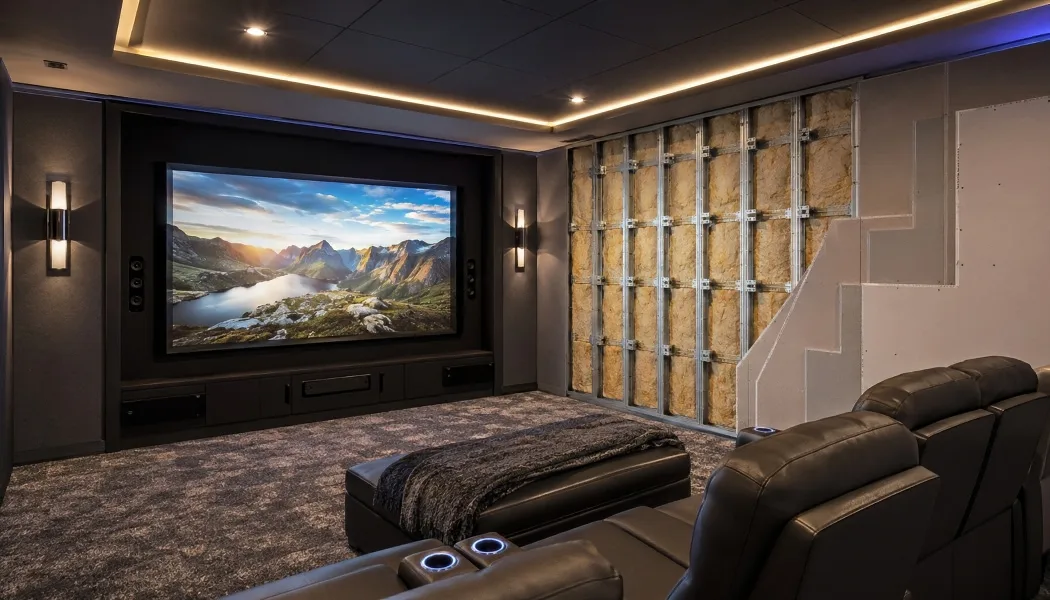
Wall Blokker Pro membrane layered behind the drywall inside a custom Westshore luxury home in Tampa — lifting standard 2×4 demising walls from STC 32 to STC 41 across three sensitive media and bedroom adjacencies during the framing-to-drywall sequence.

13
Sep
Sep
What office background noise actually does to focus and cognition — the documented side effects of white noise systems, when masking helps, when chatter hurts most, and how to design noise floors that support productivity.

15
Aug
Aug
OverWall Blokker membrane bonded to one side of an existing retail-strip partition in Valrico, FL — lifting an STC 34 wall to STC 40 between an automotive parts distributor and its karate-studio neighbor without demolition or tenant relocation downtime.

15
Aug
Aug
Absorption lowers dB in some situations and not in others — when it does, when blocking is the right call instead, and a real St. Pete restaurant example showing what coverage actually changes the meter.

07
Aug
Aug
The Sabine math behind how much absorption a room actually needs — calculating sabins from NRC and area, RT60 targets by room type, and how to size coverage without overshooting into a dead room.
02
Jun
Jun
Floor soundproofing from quick fixes to full rebuilds — IIC ratings, underlayment selection, decoupling strategies, cost and ROI curves, and the field-test verification that confirms whether the upstairs neighbor actually went quiet.

19
May
May
The three absorber types every room uses — porous, panel/membrane, and Helmholtz — how thickness drives low-frequency performance, where to place each, and the common mistakes that leave bass uncontrolled.