
Table of Contents
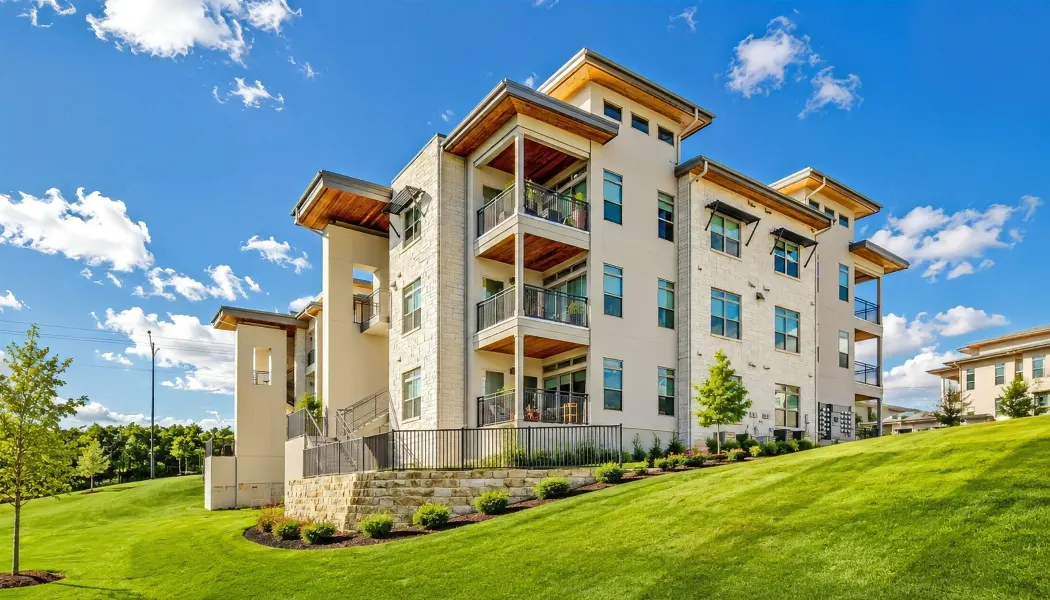
Project Overview: Berkshire Santal Apartments
- Project: Multi-family floor underlayment install across a luxury apartment community
- Client: Berkshire Santal (luxury apartment community)
- Location: 7624 Tecoma Circle, Austin, TX 78735
- Floor Assembly: Open Web Truss subfloor with hickory hardwood finish
- Underlayment: Floor Blokker membrane installed beneath the hardwood across 75,000 SF
- Field Test Results: ASTC 58 and AIIC 52, tested by BAI (independent acoustic firm)
- Cost: Less than $1 per square foot installed
Multi-Family Floor Noise in Hardwood Apartments
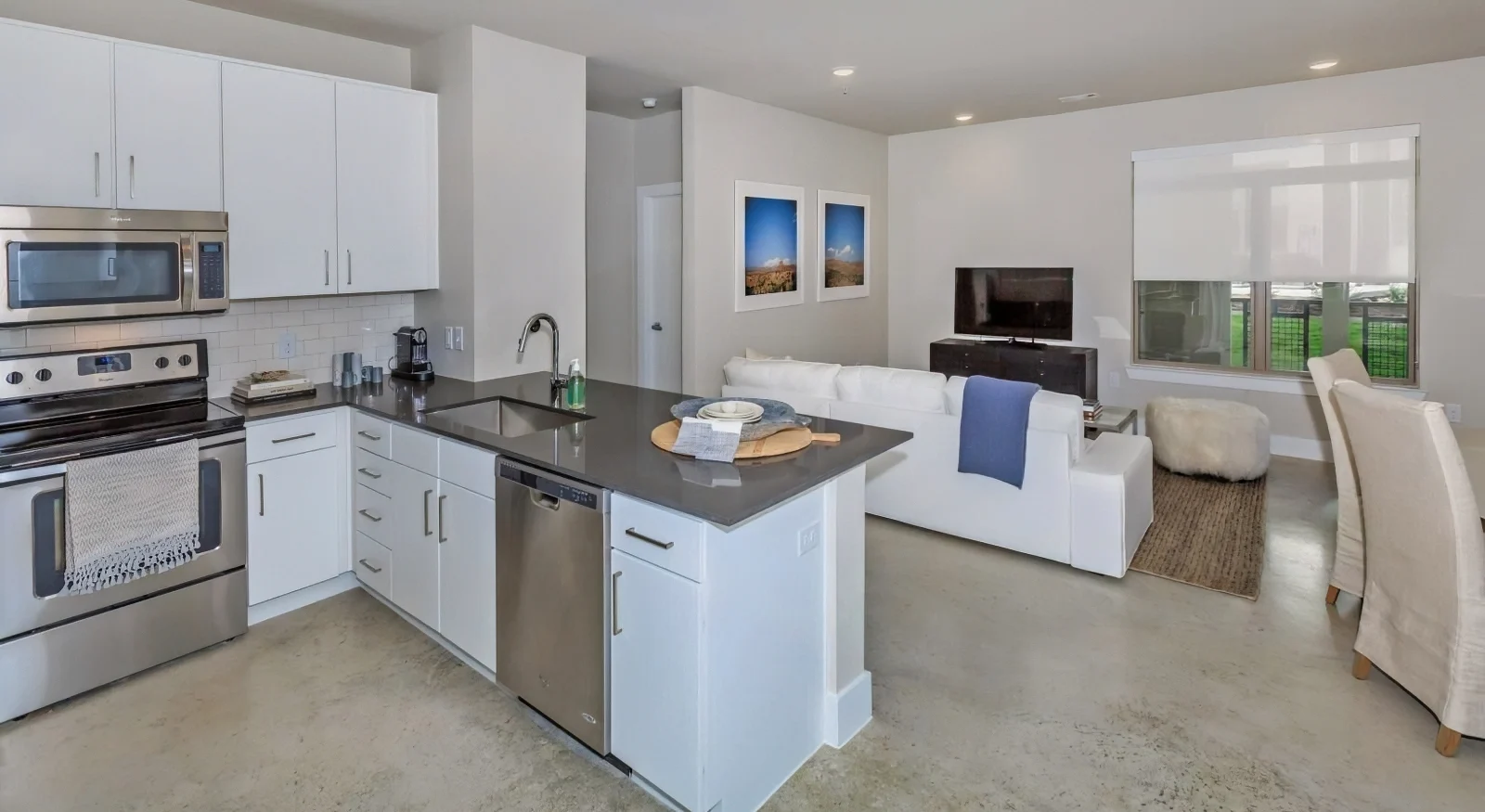
The Berkshire Santal sits in the Hill Country corridor of southwest Austin, near the AMD, SolarWinds, and Silicon Labs campuses. It is a three-story luxury apartment community with hickory hardwood floors as the standard finish across one-, two-, and three-bedroom units.
Hardwood is the worst case for floor noise transmission in multi-family. There is no carpet pile to absorb impact, no LVT cushion to deaden footfall, and no buffer between the heel strike and the joist below. Every step transmits as structure-borne energy.
When the floor assembly underneath is also an Open Web Truss, the problem compounds. That combination is exactly what the Santal was building over 75,000 square feet of luxury apartment floor space.
Why Open Web Truss Floors Are the Worst-Case Assembly
- Air Cavity: The open web between top and bottom chords lets sound travel laterally through the floor
- Mechanical Path: HVAC ducts and plumbing run through the trusses, creating coupled vibration paths
- Span Length: Web trusses span longer than I-joists, which amplifies low-frequency footfall resonance
- Code Compliance: Open Web Truss alone rarely meets STC 50 / IIC 50 without underlayment
Open Web Truss is popular with developers because it spans further and runs faster on site than I-joist or concrete. The trade-off shows up acoustically. A bare Open Web Truss floor with hardwood on top will field-test in the IIC 35-40 range, well below the code floor of 45.
That gap is what drove the Santal team to spec floor soundproofing for impact noise before any of the hardwood went down. Retrofitting after move-in is at least ten times the cost and disrupts the residents who are already paying premium rent.
Floor Blokker Under Hardwood: The Assembly
- Subfloor: OSB sheathing over Open Web Truss
- Underlayment: Floor Blokker mass-loaded vinyl membrane laid flat across the subfloor
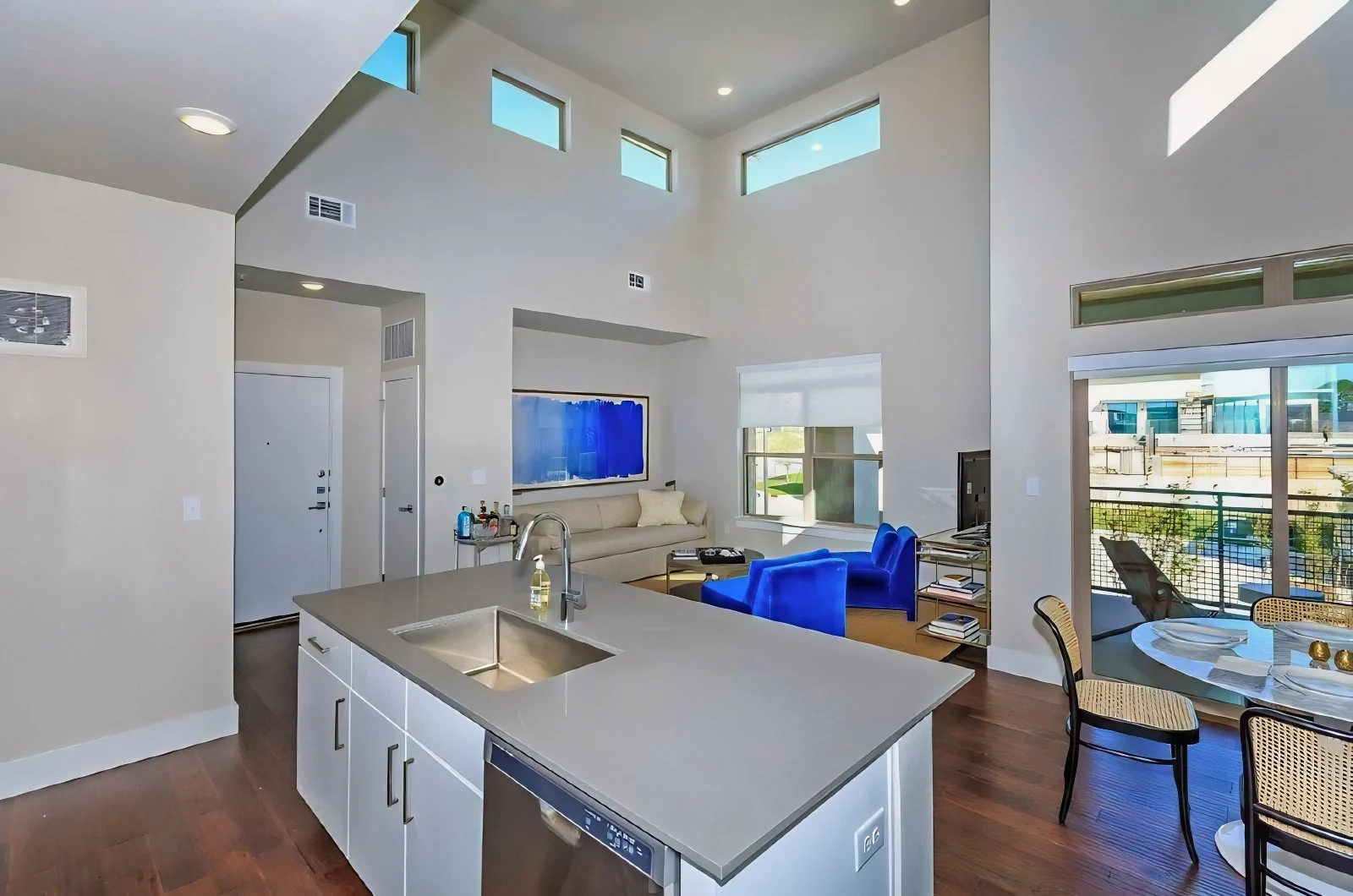
- Finish: Hickory hardwood plank installed directly over the membrane
- Ceiling Below: Standard gypsum board on resilient channel under the truss
Floor Blokker is a mass-loaded vinyl membrane sized for direct install under hardwood, LVT, tile, or carpet. The mass adds inertia to the floor diaphragm, which lowers the transmission curve across the speech and footfall frequency bands.
For sizing your own multi-family floor build, the IIC calculator estimates field IIC based on the underlayment, subfloor, and ceiling-below assembly.
BAI Field Test Results: ASTC 58 / AIIC 52
- Testing Firm: BAI, independent third-party acoustic consultancy
- Field ASTC: 58 (code minimum is 45)
- Field AIIC: 52 (code minimum is 45)
- Corresponding Lab Values: STC 63, IIC 57
BAI ran field tests in occupied units following ASTM E336 for airborne and ASTM E1007 for impact. The Apparent STC of 58 and Apparent IIC of 52 both clear the code minimum of 45 by a wide margin and exceed the more commonly used 50/50 design target.
For another multi-family field-test case in a different region, see multi-family acoustic testing in New York.
Lab vs Field: The 5-Point Drop Every Spec Should Account For
The lab values for this assembly came back at STC 63 and IIC 57. The field values from BAI came back at ASTC 58 and AIIC 52. That is a 5-point drop on both metrics, which is typical for multi-family construction once flanking paths and real installation tolerances enter the equation.
The mistake every developer makes once is specifying to the lab number and assuming the field will match. It will not. Specifying to a lab STC 50 produces a field ASTC of roughly 45, which lands exactly at the code minimum with no margin for error. Specifying to lab STC 55 or higher gives you the margin you need.
Santal got there by specifying for a lab STC 63 assembly, which delivered ASTC 58 in the field. Thirteen points over code. No call-backs, no noise complaints, no retrofit costs.
Multi-Family Floor STC/IIC Targets
The table below maps the typical lab-rating targets that translate to acceptable field results on multi-family floor assemblies.

What Multi-Family Developers Should Spec
- Identify the Subfloor: Open Web Truss, I-joist, and concrete each carry different baseline IIC numbers
- Spec Above Code: Target lab STC/IIC of at least 55/55 to land at 50/50 in the field
- Underlayment First: Install Floor Blokker before any finish goes down — retrofitting under occupied units is 10x the cost
- Plan for Field Testing: Budget for an independent ASTC / AIIC field test in a representative unit before turnover
- Document the Results: Keep the field test report on file — it is the cheapest insurance against tenant complaints and class-action exposure
The Santal job worked because the assembly was specified above code, installed before move-in, and verified by an independent third party. Skip any one of those three and the result drops back toward the code minimum.
Conclusion: Beating Code by 13 ASTC Points
Open Web Truss with hardwood on top is the hardest combination to soundproof in multi-family construction. The Berkshire Santal in Austin met code by 13 ASTC points and 7 AIIC points using a single underlayment product specified before the hardwood went down. 75,000 square feet of Floor Blokker, under $1 per square foot, no call-backs after move-in.
If your multi-family floor assembly needs to clear field code with margin, talk to an acoustic engineer about an underlayment scope before the finish goes down.
FAQs: Multi-Family Floor Soundproofing
What ASTC and AIIC do multi-family floors actually need?
IBC code minimum is field ASTC 45 and AIIC 45. Class A apartments should target 50 / 50 in the field, which means specifying a lab STC/IIC assembly of at least 55 / 55 to account for the typical 5-point field drop. Luxury buildings push higher.
Why is Open Web Truss harder to soundproof than concrete?
Open Web Truss has an air cavity between the top and bottom chords that lets sound travel laterally, plus longer spans that amplify low-frequency footfall. Concrete has mass on its side. Truss-on-truss multi-family construction requires an underlayment to clear code.
Can hardwood floors meet multi-family code without underlayment?
Rarely. Hardwood transmits impact directly into the joists below with no cushion. On an Open Web Truss subfloor the field AIIC typically lands in the 35-40 range, well below the code minimum of 45. An underlayment like Floor Blokker is required.
What does multi-family floor soundproofing cost per square foot?
Floor Blokker under hardwood runs less than $1 per square foot installed at apartment-build scale. Retrofitting the same assembly under occupied units runs 10x that number once finish removal, replacement, and resident displacement are priced in.

Walker Peek|Founder & CEO, Commercial Acoustics
Walker founded Commercial Acoustics in 2013 to bring aerospace-grade engineering discipline to soundproofing, and runs the firm as CEO from its 12,000 sq ft Tampa production facility. The company designs custom acoustic panels, sound membranes, and masking systems for multi-family, hospitality, healthcare, and commercial projects across the US — built around Walker’s invention, Wall Blokker, an EVA-based sound barrier that hits STC 50-plus at roughly $1 per square foot installed.
A Jacksonville native, Walker spent five years at Kennedy Space Center with Craig Technologies before founding Commercial Acoustics — certifying aerospace manufacturing to the AS9100 standard and leading Six Sigma Black Belt process-improvement teams on NASA programs. He is a certified Industrial Noise Control Engineer and the author of Architectural Acoustics: A Practical Handbook.
