
Table of Contents
Project Overview: USF Student Government Office
- Project: Drop ceiling soundproofing for office-to-office plenum flanking
- Client: University of South Florida (USF), student government office
- Location: Tampa, FL
- Existing Build: Partition walls stopping at the ACT, shared plenum above
- Treatment: Drop Ceiling Noise Blokker polymer tiles installed above the existing ACT grid
- Coverage: 300+ ceiling tiles across the affected office areas
- Install Window: A few hours during a school break, no ACT demolition required
The University of South Florida’s student government office sat next to a row of staff offices that needed quiet. The walls between them looked normal at human-eye level. Above the acoustic ceiling tile, those same walls just stopped, and the shared plenum carried every conversation from the student government room into the staff space next door. The staff members could not hold a confidential phone call without an audience two doors down.
Commercial Acoustics diagnosed the path as classic plenum flanking and specified a polymer-based Drop Ceiling Noise Blokker tile to install above the existing ACT grid. The work covered just over 300 tiles, took a few hours during a school break, and required no replacement of the existing ceiling. The flanking path closed. The staff offices got their privacy back.
Why Drop Ceiling Soundproofing Is a Plenum Flanking Problem
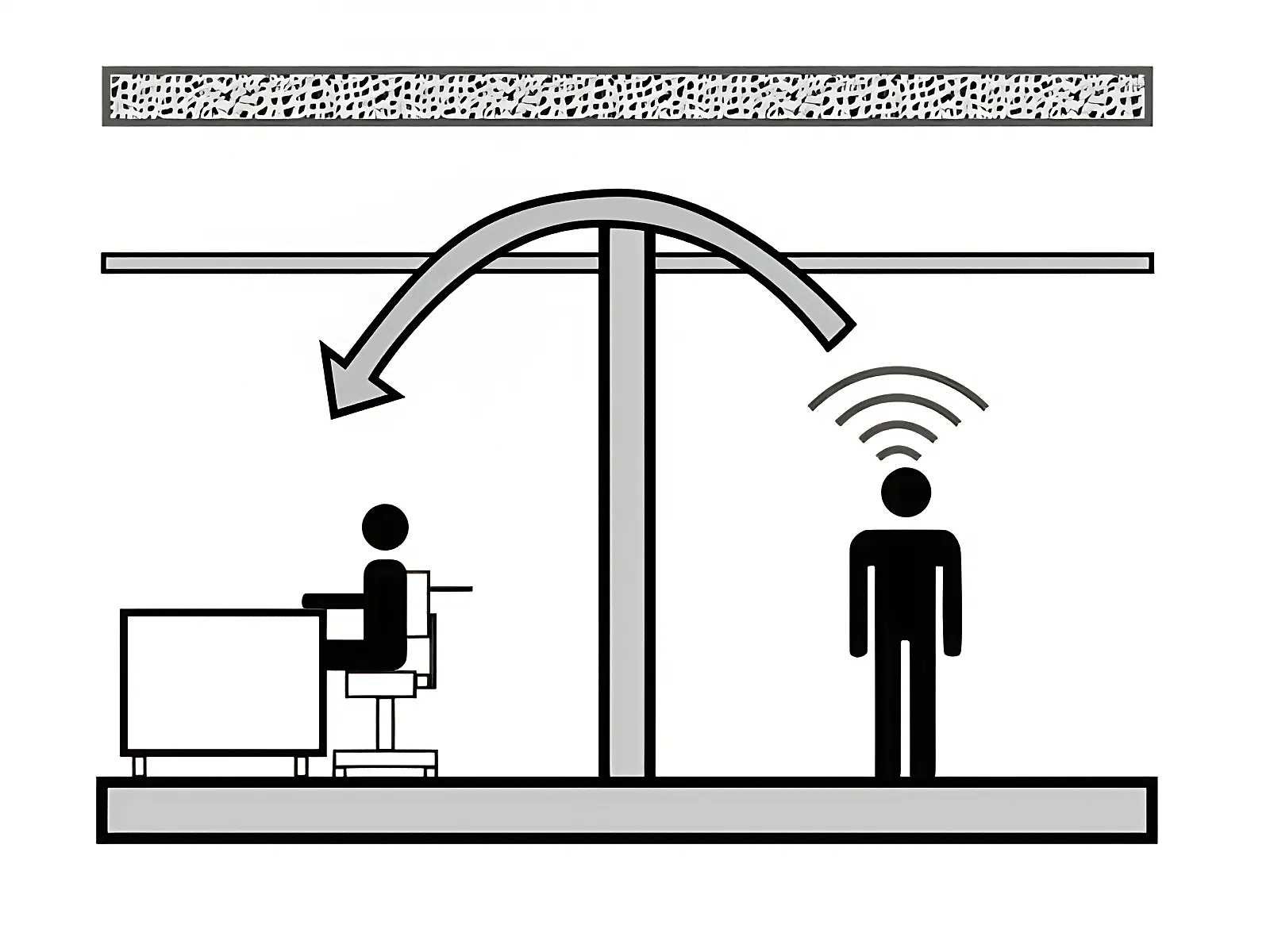
Most commercial and institutional interiors use a suspended acoustic ceiling tile (ACT) grid. The partition walls between rooms almost never extend up past the ACT to the structural deck. They stop at the tile line, and the plenum above the tile is shared across the whole floor.
That shared plenum is the sound path. Speech in one office rises through the tile, travels horizontally over the wall, and drops through the tile in the next office. The wall in the middle does nothing. The acoustic complaint is real and the wall STC is irrelevant.
For a law-enforcement parallel where this same plenum flanking problem affected interview rooms, see the ACT ceiling flanking in interview rooms case.
Why ACT Alone Does Not Block Sound
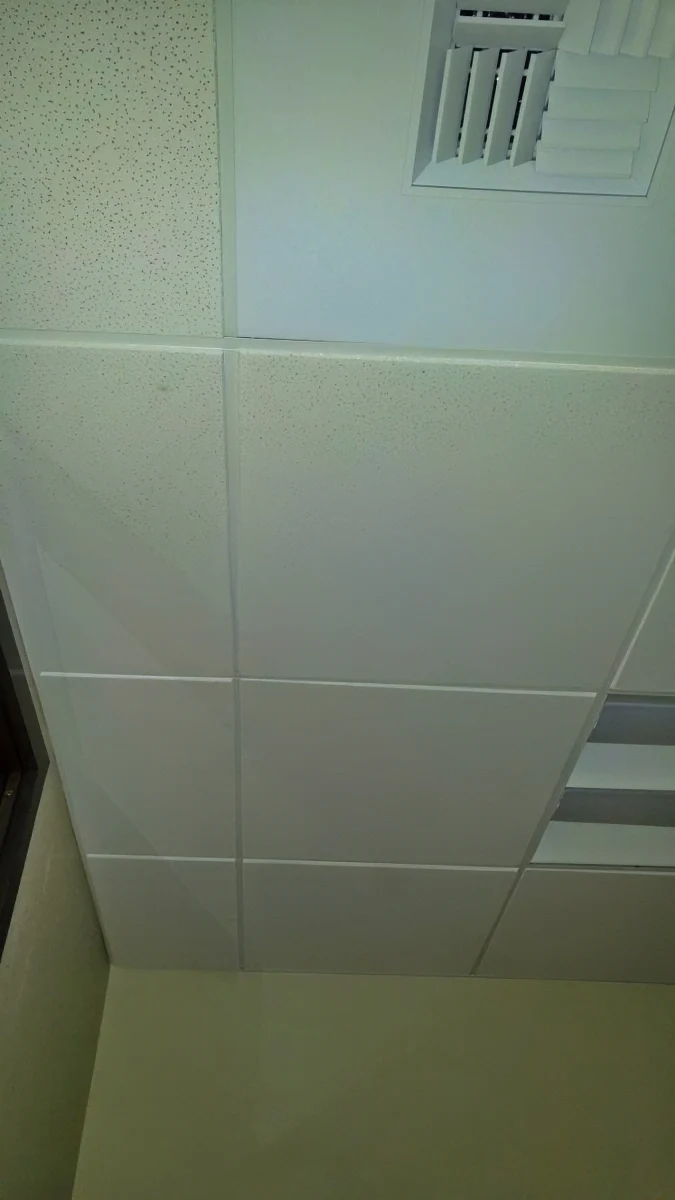
The naming creates the confusion. Acoustic ceiling tile is engineered for absorption, not blocking. The product reduces reverberation by absorbing sound that hits its face on the way down. It is not designed to stop sound from passing through it on the way up.
Manufacturers do publish a Ceiling Attenuation Class (CAC) rating that measures blocking performance through a single tile. Even high-CAC tiles only handle the vertical leg of the flanking path. The full path goes diagonal: up through one tile, horizontal across the plenum, down through the next tile. CAC does not control the horizontal leg, which is where most of the energy travels.
The fix has to interrupt the horizontal leg directly. That means a barrier sitting above the existing ACT or extending the wall to the deck. The deck-extension option requires construction. The above-ACT barrier does not.
The Drop Ceiling Noise Blokker Install
- Product: Drop Ceiling Noise Blokker polymer-based tile
- Position: Sits directly on top of the existing ACT grid, no replacement of the existing tile
- Seal: Edge contact between adjacent tiles to close the flanking path completely
- Coverage: Continuous coverage above every room boundary, not just the noisy ones
- Air Return: Verify HVAC return-air path does not bypass the barrier
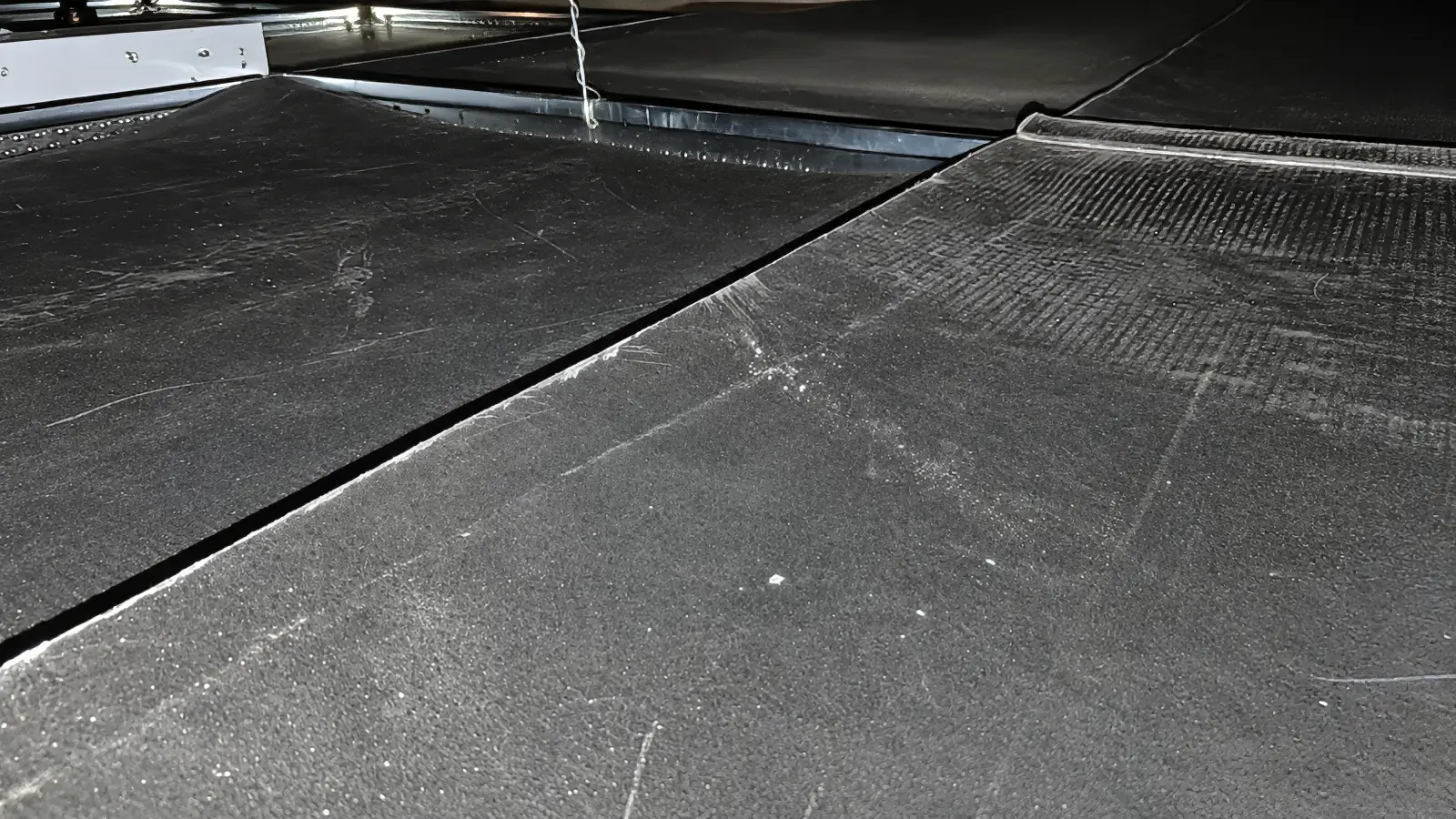
The install is fast because the product is dropped in from above through the existing ACT openings. No ceiling demo, no replacement tile order, no rebuild of the suspended grid. The crew lifts the existing ACT panel out of the grid, places the Drop Ceiling Noise Blokker on top, and the existing tile goes back. The room below sees no change.
Two install details decide whether the system works. The first is edge sealing between adjacent Noise Blokker tiles so no gaps remain. The second is checking the HVAC return air path. If air returns through the plenum, sound returns with it, and a barrier above the ACT does nothing.

When Drop Ceiling Soundproofing Works vs When to Use Sound Masking
Drop ceiling soundproofing is not always the right answer. The decision depends on how much of the ceiling is interrupted by lighting fixtures, diffusers, and other openings, plus the air return strategy. The table below maps the two paths.

The 10 Percent Lighting Rule
The single most useful rule of thumb for drop ceiling soundproofing is the 10 percent threshold. If more than 10 percent of the ceiling above a boundary is interrupted by light fixtures, HVAC diffusers, sprinkler heads, or any other opening, a barrier-style fix will leak too much to close the flanking path.
Below that 10 percent threshold the Drop Ceiling Noise Blokker covers enough continuous area to deliver real attenuation. Above it the math falls apart because the openings act as direct sound paths around the barrier. In those rooms commercial sound masking becomes the better path, raising the ambient noise floor to mask the residual transmission.
What Facility Managers Should Spec
- Audit Openings: Map lighting, diffusers, sprinklers above every speech-sensitive room boundary
- Check Return Air: Confirm whether HVAC return runs through the plenum or through ducted returns
- Continuous Coverage: Spec the barrier above every room boundary, not just the worst complaint area
- Edge Seal: Verify edge contact between adjacent Noise Blokker tiles, no gaps
- School-Break Schedule: Install during scheduled downtime, the work fits inside a typical maintenance window
The economics favor doing this right the first time. The Noise Blokker install is fast and low-disruption when scoped correctly. Trying to band-aid the noisiest room without continuous coverage produces a partial fix that does not satisfy the complaint.

Conclusion: Drop Ceiling Soundproofing Done Right
Drop ceiling soundproofing is fundamentally a plenum flanking fix. ACT absorbs echo, it does not block transmission, and the wall stops at the tile. A continuous polymer barrier sitting above the existing ACT grid closes the flanking path without rebuilding walls or replacing the ceiling. The USF student government office project closed 300 tiles of plenum flanking in a few hours during a school break.
If your facility has open plenums above the ACT and the speech-privacy complaints are stacking up, talk to an acoustic consultant about the 10 percent rule and whether a Drop Ceiling Noise Blokker scope fits your building.
FAQs: Drop Ceiling Soundproofing & ACT Flanking
Does a drop ceiling reduce noise between rooms?
Only partially. Standard acoustic ceiling tile is engineered to absorb reverberation, not to block sound transmission. When partition walls stop at the ACT instead of extending to the structural deck, sound flanks through the shared plenum above the tile and the wall is bypassed entirely. A barrier above the ACT is needed to close that path.
What is the Drop Ceiling Noise Blokker product?
It is a polymer-based tile that sits on top of the existing ACT grid above every speech-sensitive room boundary. The barrier interrupts the horizontal flanking leg through the plenum. Install is fast because no existing tile is replaced and no ceiling demo is required.
When should I use sound masking instead of drop ceiling soundproofing?
When more than 10 percent of the ceiling above a room boundary is interrupted by light fixtures, HVAC diffusers, sprinkler heads, or other openings, a barrier-style fix leaks too much to close the flanking path. In those rooms sound masking is the better path because it works regardless of the opening count.
What are common challenges with acoustic ceiling tiles?
The most common challenges are plenum flanking between rooms, low CAC ratings that do not control diagonal sound paths, HVAC return-air paths that bypass any barrier, and gaps at lighting and diffuser openings that defeat above-ACT treatments. Each requires a different fix or a combination of fixes.

Walker Peek|Founder & CEO, Commercial Acoustics
Walker founded Commercial Acoustics in 2013 to bring aerospace-grade engineering discipline to soundproofing, and runs the firm as CEO from its 12,000 sq ft Tampa production facility. The company designs custom acoustic panels, sound membranes, and masking systems for multi-family, hospitality, healthcare, and commercial projects across the US — built around Walker’s invention, Wall Blokker, an EVA-based sound barrier that hits STC 50-plus at roughly $1 per square foot installed.
A Jacksonville native, Walker spent five years at Kennedy Space Center with Craig Technologies before founding Commercial Acoustics — certifying aerospace manufacturing to the AS9100 standard and leading Six Sigma Black Belt process-improvement teams on NASA programs. He is a certified Industrial Noise Control Engineer and the author of Architectural Acoustics: A Practical Handbook.
