Table of Contents
Project Overview: Multi-Zone Office Soundproofing
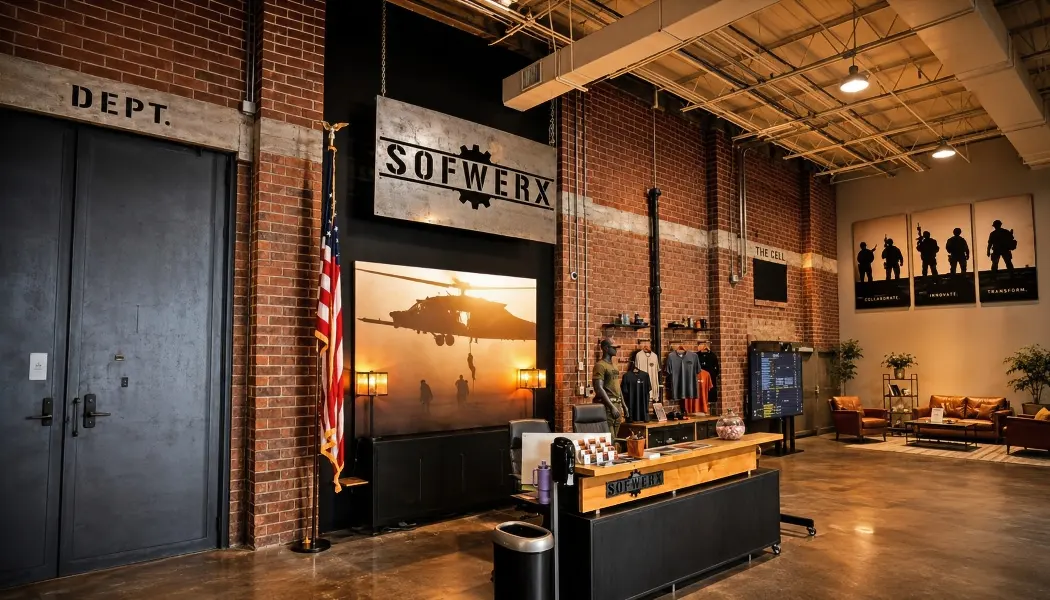
- Project: Three-Zone Acoustic Treatment for a 33,000 sq ft Warehouse-to-Office Conversion
- Address: 1925 E 2nd Ave #102, Tampa, FL 33605
- Client: SOFWERX (Department of Defense and Doolittle Institute joint venture)
- Scope: Auditorium Panels, Open-Office Sound Masking, and Machine Shop Sound Isolation
- Constraint: Two-Month Construction Timeline From Empty Warehouse to Operational Site
- Distinctive Element: Custom Hanging Acoustic Wings Designed and Installed in 30 Days
- Outcome: Three Different Acoustic Problems Solved With Three Different Approaches in One Buildout
Why Warehouse-to-Office Conversions Stack Acoustic Problems
Warehouses are built for the opposite acoustic profile than offices. Tall ceilings, exposed structure, polished concrete floors, minimal interior walls, and zero soft material on any surface. Every one of those attributes reflects sound rather than absorbing it. The volume that makes a warehouse useful for storage and equipment is the same volume that makes it acoustically hostile for desk work.
Adaptive reuse projects almost always carry over more of the warehouse profile than the design team plans for. Walls get added but rarely run all the way to deck. Drop ceilings get installed in some areas but not others. Polished concrete stays because it is part of the aesthetic. The result is a hybrid space that has office-grade requirements but warehouse-grade acoustics.
That hybrid almost never has a single acoustic solution. Different functional zones inside the same conversion need different treatment approaches. The general framing of how absorption, blocking, and masking work together as separate tools lives in our office acoustic design guide.
Zone 1: The Auditorium Panels Plus Custom Hanging Wings
- Use: Counter-UAV Pilot Training Sessions and Drone Flight Practice
- Original State: Open Sanctuary Space With Substandard Reverberation
- Complication: Existing Plush Furniture Was Being Removed, Eliminating Incidental Absorption
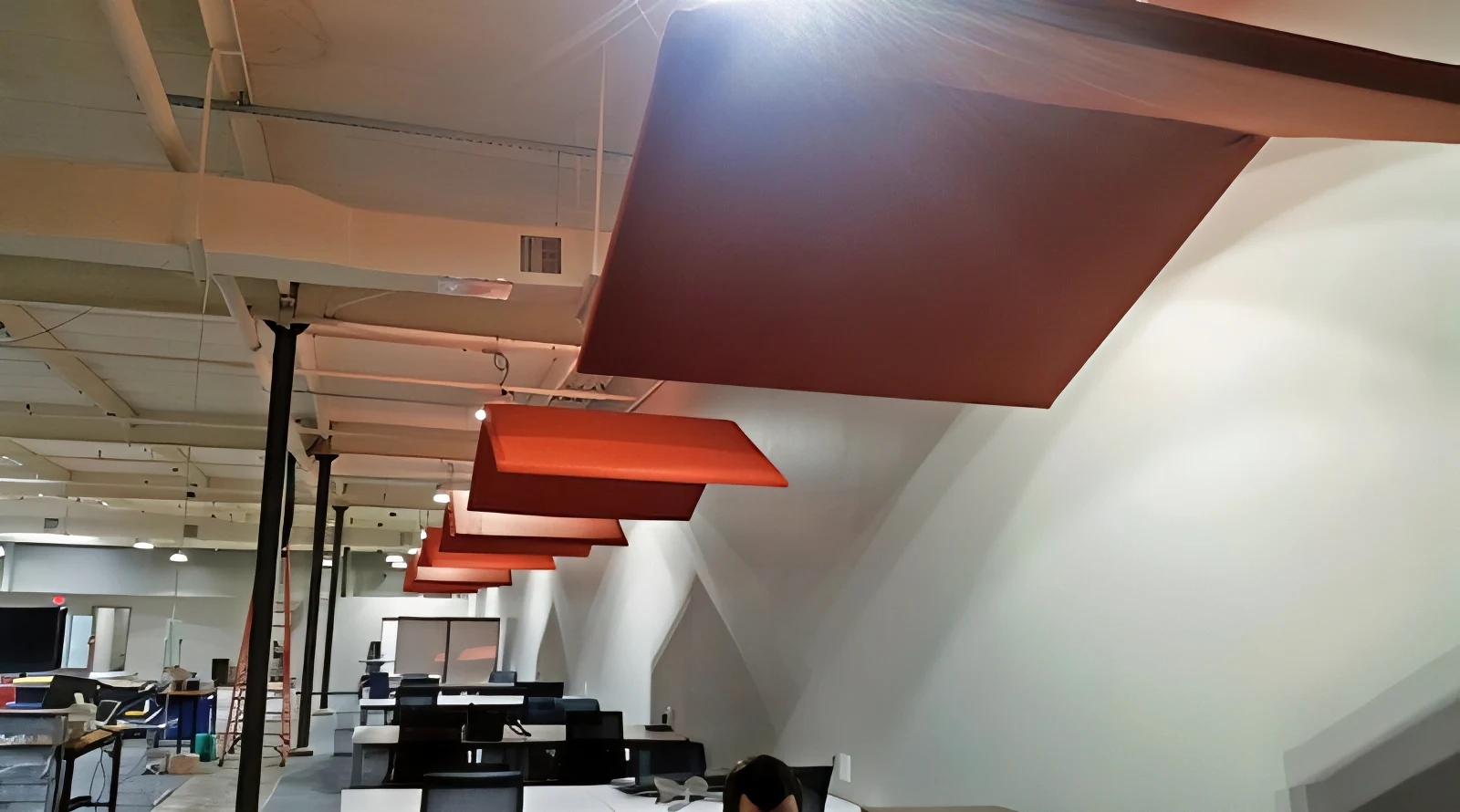
- Solution: Wall-Mounted Acoustic Absorption Panels Plus Custom Hanging Acoustic Wings Over Six-Person Desks
- Timeline: Custom Wings Designed, Built, Delivered, and Installed in 30 Days
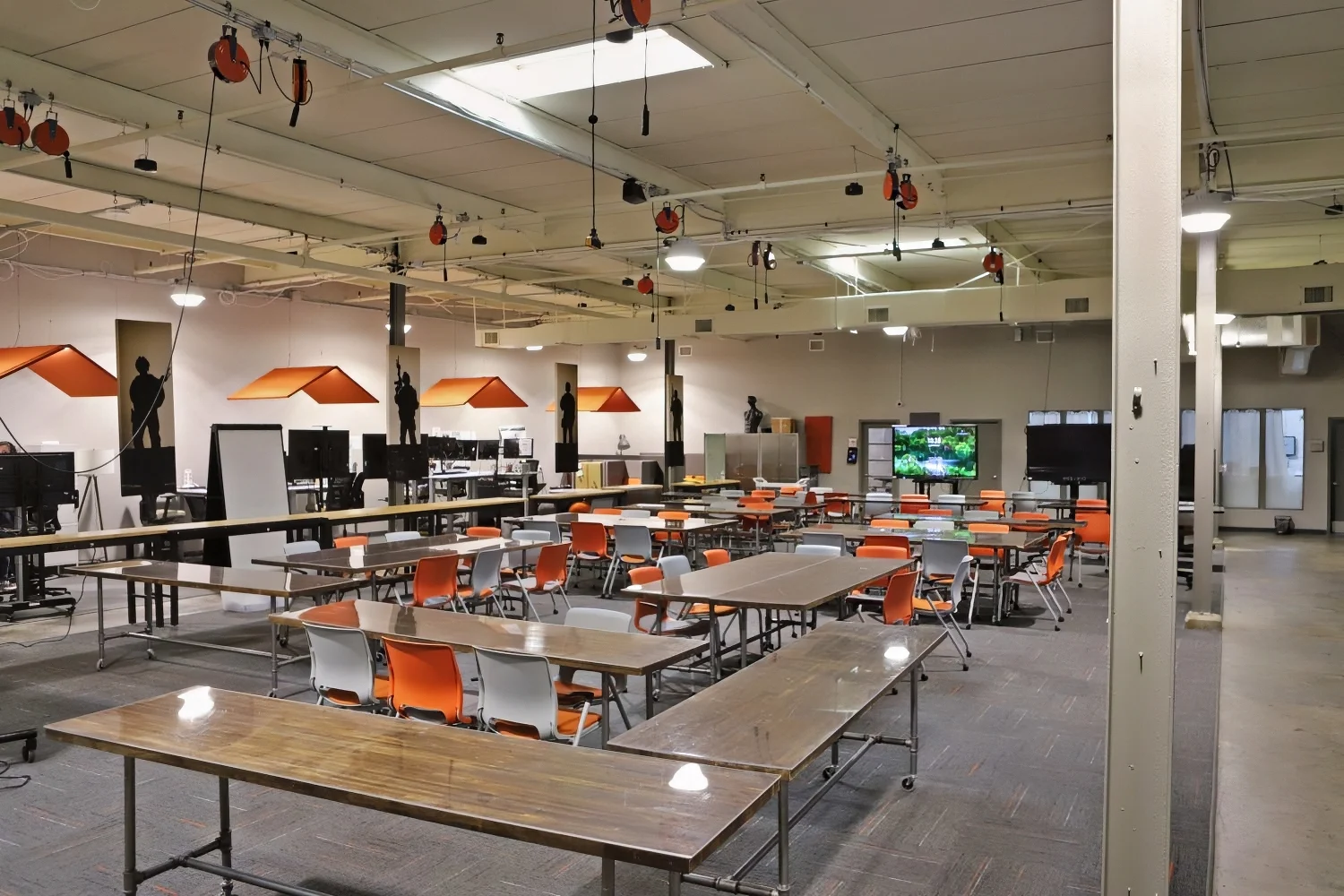
The auditorium had two problems running at once. The room itself was reverberant because of the warehouse-style finishes. The plush furniture being removed during the conversion was reducing the small amount of absorption the existing space had. Both effects pushed reverberation in the wrong direction at the same time.
Wall-mounted absorption panels handled the bulk of the reverberation budget. The custom hanging acoustic wings sometimes called “teepees” added a second elevation of absorption directly over the working desk clusters, which delivered targeted reverberation control where pilots and operators were actually sitting. The wings also added a visual signature element to the space that the design team wanted.
The product line behind the wall panels lives at the acoustic absorption panel page, with NRC ratings and finish options.
Zone 2: The Open Office Sound Masking When Walls Don’t Go to Deck
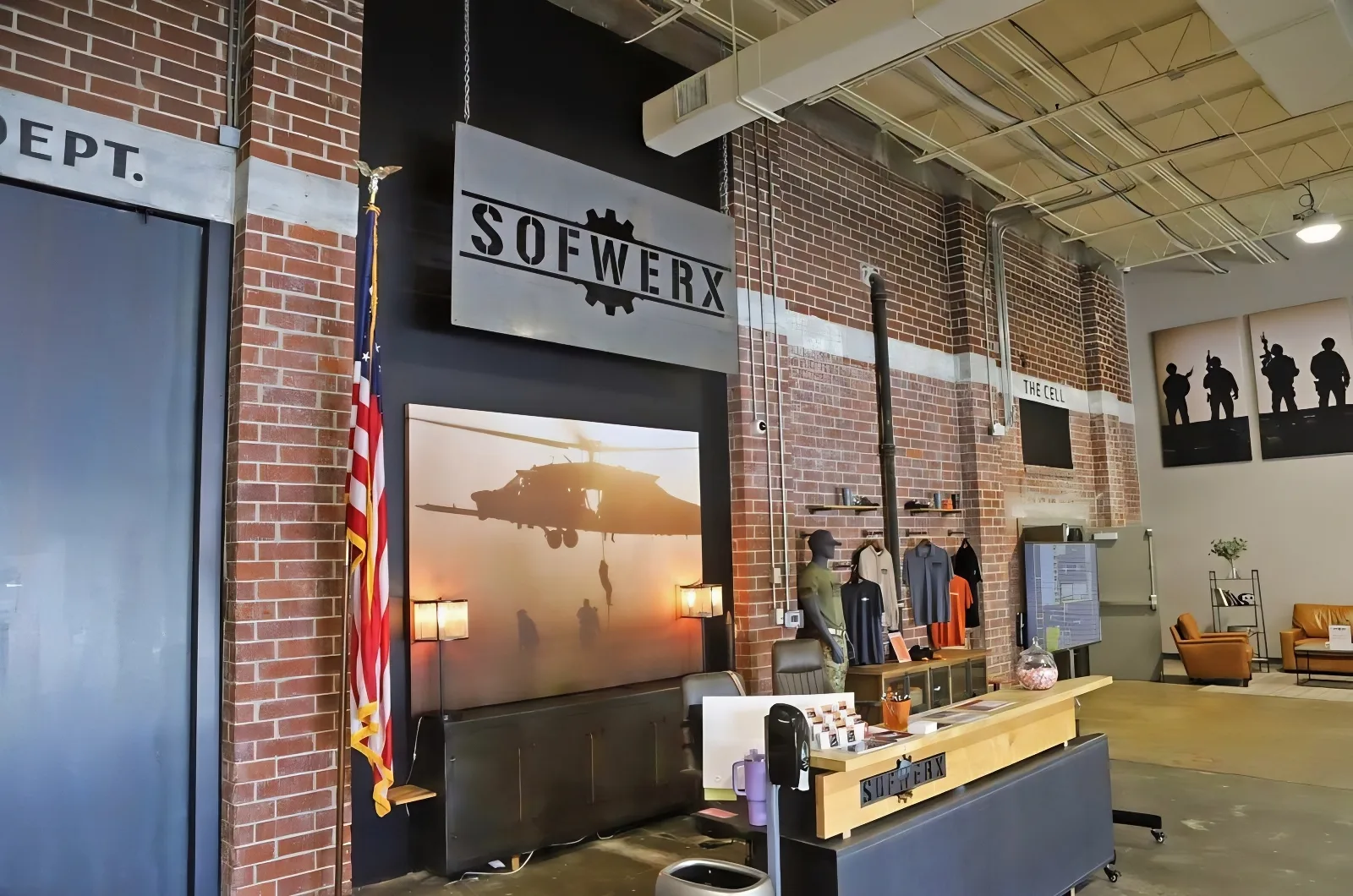
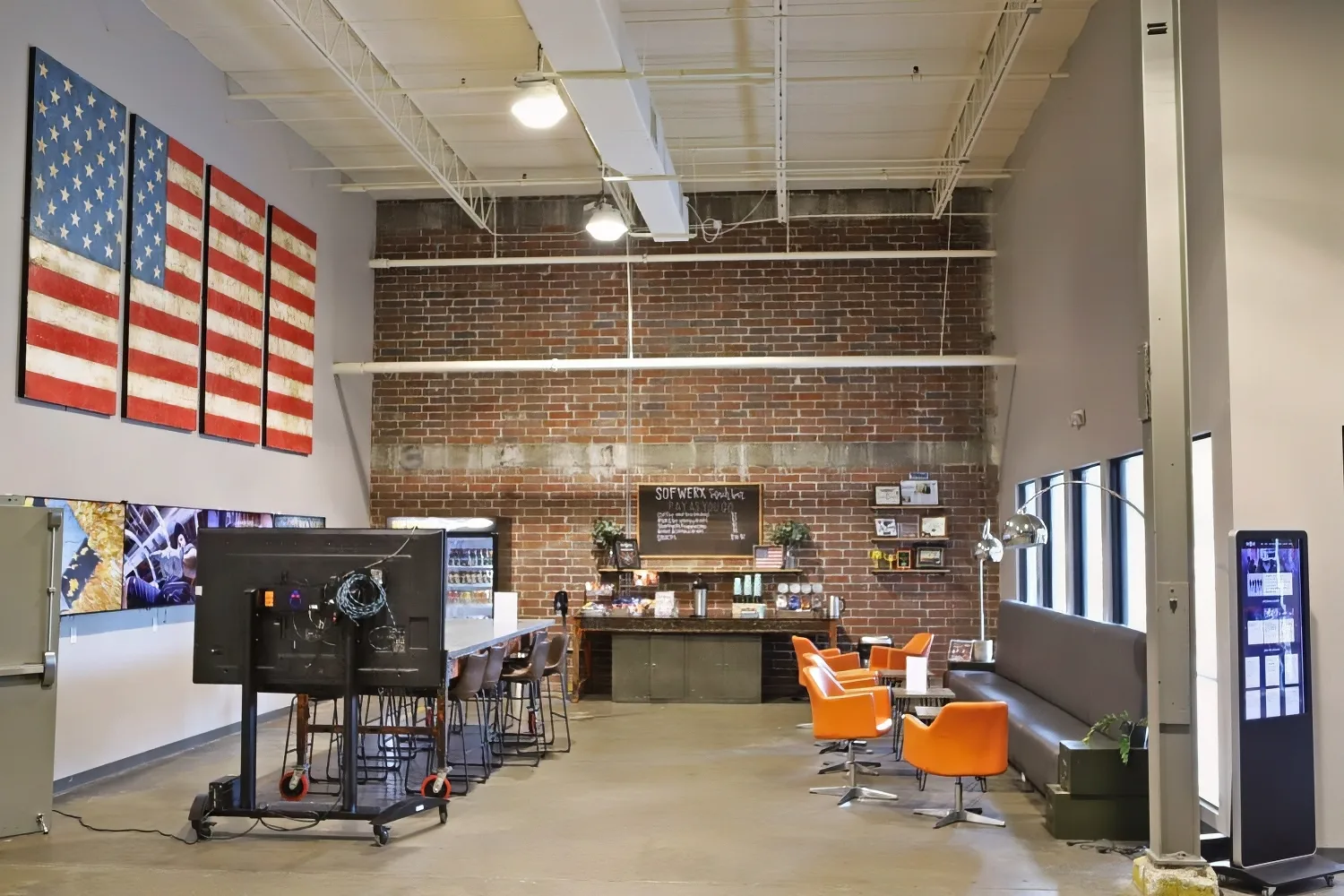
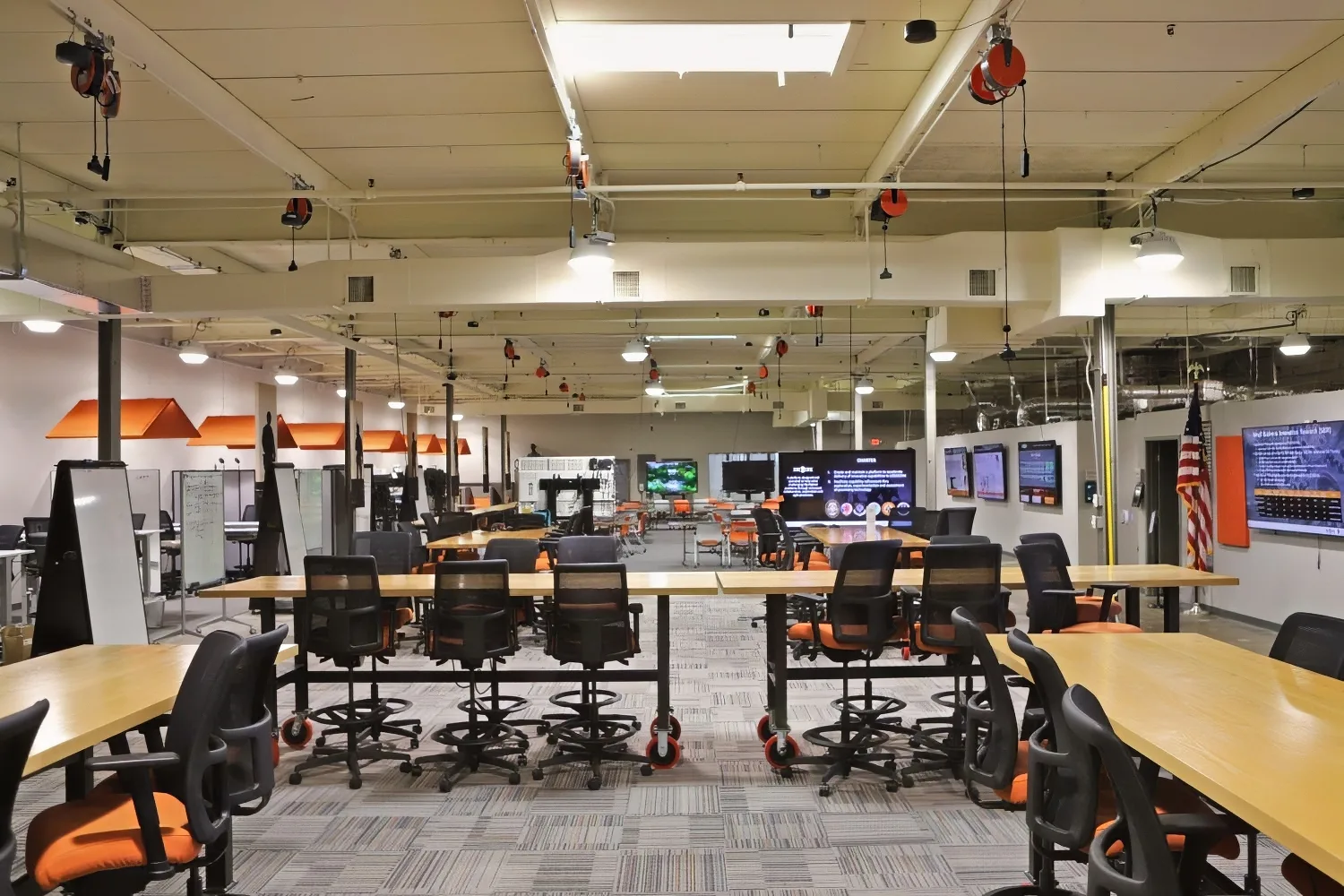
- Use: Open Bullpen Where 90% of Staff Worked Collaboratively at Large Tables
- Constraint: Office Walls Did Not Go to Deck and Most Lacked ACT Tiles
- Privacy Risk: Confidential Counter-Drone Tactics Discussions Bleeding to Adjacent Spaces
- Solution: Tuned Sound Masking System Raising the Ambient dB Floor
Speech privacy is normally a wall problem. Build the wall to STC 50, run it deck to deck, and confidential conversations stay confidential. The SOFWERX open office had neither half of that equation. Walls did not run to deck and did not have acoustical ceiling tiles to fill the airspace above them. Speech traveled freely from one zone to the next.
Sound masking is the only effective solution when walls cannot be rebuilt and ACT cannot be added. The masking system raises the ambient noise floor with a tuned spectrum that obscures speech intelligibility at distance. The receiving party hears the same dB level but cannot decode the content of conversations happening in adjacent zones. The deeper background lives in our sound masking for open offices guide.
Zone 3: Machine Shop Adjacent to Presentation Room
- Use: On-Site Machine Shop Manufacturing Replacement Drone Components
- Source Level: Grinding and Milling Operations Around 110 dB
- Receiving Space: Presentation Room Used Simultaneously for Meetings
- Solution: Wall Blokker Sound-Blocking Membrane Plus High-STC Solid-Core Door Plus High-NC Equipment Relocated to Exterior Walls
This was the most challenging zone in the buildout. A 110 dB source on one side of a wall and a meeting room on the other, used at the same time. Standard partition assemblies could not deliver the transmission loss required to make the meeting room functional during shop operations.
The fix worked on three axes at once. The Wall Blokker membrane added mass to the demising wall to attenuate the airborne path. Relocating the highest-NC machinery to the exterior walls moved the loudest sources further from the meeting room. The high-STC solid-core door closed the flanking path that would otherwise have undone the wall treatment, since door leaks dominate transmission once the wall itself is competent.
The product page with full STC contribution data lives at the Wall Blokker sound-blocking membrane page.
Multi-Zone Office Acoustic Targets by Function
Each functional zone in a multi-use office buildout has its own acoustic target and its own correct treatment tool. The table below maps the windows across the four zone types most warehouse-to-office conversions deal with.
| Zone Type | Acoustic Goal | Right Tool | Notes |
|---|---|---|---|
| Auditorium / Training Room | RT60 0.6 to 0.9 sec | Wall panels plus hanging wings or clouds | Soft furniture removed exposes reverb |
| Open Office Bullpen | RT60 0.4 to 0.6 sec, ASTC 35-40 between zones | Sound masking when walls do not go to deck | Masking is the only path without rebuilding walls |
| Machine Shop Adjacent to Meeting Space | STC 60+ on demising wall, IIC 60+ | Mass-loaded membrane plus high-STC door plus equipment relocation | Door leaks dominate once wall is competent |
| Standard Private Office | STC 45 on walls, RT60 0.5 to 0.7 sec | Standard partition assembly, light absorption | Easiest zone in any office buildout |
The SOFWERX project hit each row of the table with a different tool. No single product handled all three problems. The acoustic spec on a multi-zone buildout is a portfolio of approaches, not a single product call.
Conclusion: Multi-Zone Office Soundproofing
Warehouse-to-office conversions stack three or four distinct acoustic problems into one buildout. The right answer is rarely a single product spec. Absorption panels handle reverberation in active spaces, sound masking handles speech privacy when walls cannot run to deck, and mass-loaded membranes handle source-side noise control between high-NC equipment and adjacent meeting spaces. SOFWERX needed all three at once, on a 60-day clock. More on the team behind multi-zone office soundproofing for ownership groups scoping similar conversions.
FAQs: Multi-Zone Office Soundproofing
Can one acoustic solution work for an entire warehouse-to-office conversion?
Almost never. Different zones have different acoustic goals. Auditoriums need absorption. Open offices need sound masking when walls do not go to deck. Machine shops next to meeting rooms need mass-loaded blocking. The right spec is a portfolio of approaches, not one product.
How do you soundproof a machine shop next to a meeting room?
Three moves at once. Add a mass-loaded membrane to the shared demising wall. Relocate the highest-NC machinery to exterior walls so the loudest sources sit furthest from the meeting room. Install a high-STC solid-core door because door leaks dominate transmission once the wall itself is competent.
What do you do when open office walls don’t go to deck?
Add a tuned sound masking system. Without walls running to deck and without ACT tiles filling the airspace above them, speech travels freely between zones. Masking raises the ambient noise floor with a spectrum that obscures speech intelligibility without forcing the walls to be rebuilt.
What are acoustic wings or hanging acoustic clouds?
Suspended absorption elements that hang horizontally over a desk cluster or open seating area. Wings and clouds add a second elevation of absorption between the floor and the ceiling, targeting reverberation directly above the people sitting below them. Useful when wall coverage alone cannot hit the absorption budget.

Walker Peek|Founder & CEO, Commercial Acoustics
Walker founded Commercial Acoustics in 2013 to bring aerospace-grade engineering discipline to soundproofing, and runs the firm as CEO from its 12,000 sq ft Tampa production facility. The company designs custom acoustic panels, sound membranes, and masking systems for multi-family, hospitality, healthcare, and commercial projects across the US — built around Walker’s invention, Wall Blokker, an EVA-based sound barrier that hits STC 50-plus at roughly $1 per square foot installed.
A Jacksonville native, Walker spent five years at Kennedy Space Center with Craig Technologies before founding Commercial Acoustics — certifying aerospace manufacturing to the AS9100 standard and leading Six Sigma Black Belt process-improvement teams on NASA programs. He is a certified Industrial Noise Control Engineer and the author of Architectural Acoustics: A Practical Handbook.
