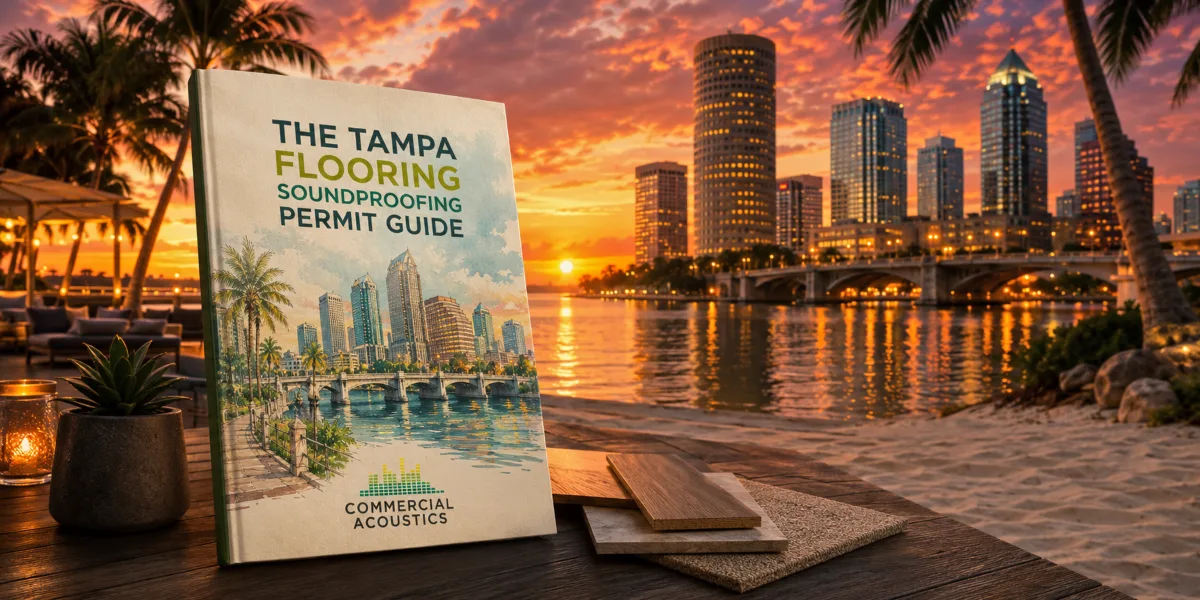
Tampa Flooring Soundproofing Permit Guide: STC/IIC 50 Compliance
(Fails Code)
Code Minimum
HOA Spec
Tampa
* Floor Blokker / Floor Blokker Lite also reach IIC 57. Ratings Above Assume: tile, concrete, resilient gypsum ceiling, fiberglass batting.
What a Floor Permit Takes in Tampa
Tampa is our HQ city, and the Bayshore-to-Channelside condo market is one we walk every week. The Construction Services Division runs flooring renovations under Florida Building Code §1207 — STC and IIC 50 between dwelling units. The one Tampa-specific quirk: even though a condo unit is a residential occupancy, the city requires the work to be filed as a commercial permit, through Accela Citizen Access. Ground-floor units skip the soundproofing. Try our IIC Calculator first.
Tampa’s Flooring Permit Process
Tampa runs all condo flooring permits through Accela Citizen Access, the city’s online portal at aca-prod.accela.com/tampa. Tile, stone, wood, and LVT in a stacked unit triggers a commercial permit application, an HOA approval letter, and underlayment literature showing STC and IIC 50. The Construction Services Division is reachable at (813) 274-3100, option 1, or CSDHelp@tampagov.net.
What the Tampa Submittal Requires
- Commercial Permit Application: signed by the owner and the licensed contractor, even for a residential condo unit.
- HOA Approval Letter: the association’s written sign-off on the scope of work.
- Underlayment Literature: manufacturer test report with STC and IIC clearly marked at 50 or higher, skipped for ground-floor units.
- Floor Plan: the unit, the work area, and the assembly section.
- Contractor Documentation: license, insurance, and Tampa registration uploaded to Accela.
- Notice of Commencement: recorded when the contract value triggers Florida’s threshold.
Everything is filed through Accela Citizen Access, including the application, plan upload, fee payment, and inspection scheduling. The Construction Services Division is in the Municipal Office Building at 306 East Jackson Street, downtown. Most flooring permits clear plan review in a single round when the HOA letter and underlayment literature are submitted together at the start.
Tampa inspects the work but runs no separate soundproofing inspection. Compliance is documented up front through the highlighted STC and IIC literature, then the permit closes on a standard final inspection.
STC, IIC, and the Slab Beneath You
- STC (Sound Transmission Class): airborne noise — a TV, music, conversation through the wall or floor.
- IIC (Impact Insulation Class): impact noise — footsteps, dropped items, a sliding chair.
Section 1207 of the Florida Building Code sets STC 50 and IIC 50 between dwelling units, measured under ASTM E90 and ASTM E492. The slab matters because a thicker concrete deck adds mass and IIC, and Tampa’s condo stock runs the full range, from 1980s and 1990s Bayshore towers with thinner decks to the new Channelside high-rises and the Ritz-Carlton Residences with thicker post-tensioned slabs. Our lab-tested assemblies ship with reports formatted for the Accela submittal.
At IIC 50, a footstep overhead reads as a soft thud rather than a sharp tap. A bare slab with tile sits in the high 20s, so the rated underlayment is what carries the assembly to code. Our IIC/STC ratings guide for condo flooring permits covers how the assembly reaches the number.
Inside a Tampa Sound-Rated Floor
The city does not require a specific assembly detail beyond hitting the §1207 numbers, but the assembly that clears Tampa plan review and survives a Bayshore or Channelside HOA looks the same in every tower. Here is what a compliant Tampa tile assembly looks like, top to bottom.
| Layer | What It Does |
|---|---|
| Tile or natural stone | The finished floor surface. |
| Tile bonding agent | Sets the tile onto the system below. |
| Sound control underlayment | The rated mat that earns your IIC. |
| Perimeter isolation barrier Recommended | Decouples the floor from the walls so impact noise stays out of the structure. |
| Approved substrate / slab | The structural base, whose thickness affects the score. |
The perimeter isolation barrier is the part owners miss. Without it, a tile floor leaks impact noise into the walls and the assembly underperforms its lab rating.
Targets by Tower, Bayshore to Channelside
| Building Type | Wall STC | Floor IIC | Where You See It in Tampa |
|---|---|---|---|
| 1980s–1990s Bayshore Tower | 52–55 | 55 | Bayshore Diplomat, Atrium on the Bayshore, and the older Hyde Park stock. Older slabs need underlayment to reach 50. |
| 2000s Channelside Mid-Rise | 55 | 55–60 | SkyPoint, Element, The Towers of Channelside, The Place at Channelside. Boards expect IIC 55 and the HOA letter. |
| New Luxury (Ritz-Carlton / Pendry / Tampa EDITION) | 55–60 | 60 | The Ritz-Carlton Residences Tampa, Pendry Residences, the Tampa EDITION Residences. Underlayment specs are written in at delivery. |
| Penthouse / Bayshore Signature | 60+ | 65+ | Top-floor Bayshore and Channelside penthouses. A floating subfloor on a thick acoustic mat reads as effectively silent below. |
Tampa is our home market, and the condo inventory has reshaped fast over the last decade. Around 45 condo high-rises run from the 1980s Bayshore stock through the 2000s Channelside boom — SkyPoint, Element, The Towers of Channelside, Grand Central at Kennedy — into the brand-new luxury wave with the Ritz-Carlton Residences Tampa, the Pendry, and the Tampa EDITION. That spread, older Bayshore to new Channel District, is exactly why the underlayment choice matters as much as the permit paperwork.
With Channelside towers stacked tightly and Bayshore boards increasingly active about noise, footstep complaints are a live issue across Tampa. The middle two rows above are where most renovations should land. Mid-market to luxury (STC and IIC 52 to 60) is the right band for almost any Tampa condo that wants board sign-off on the first pass.
Underlayments That Pass Tampa Plan Review
- AcoustiStep: premium rubber mat. Right pick when the HOA requires IIC 55 or 60.
- Floor Blokker: standard acoustic underlayment roll. Clean STC and IIC pass for typical retrofits.
- Floor Blokker Lite: lighter, lower-cost option for budget retrofits that still need to clear code.
All three are designed and shipped from our Tampa facility, and each ships with published STC and IIC test reports you can upload to Accela and pair with a perimeter isolation barrier on tile floors. The choice comes down to your board’s IIC threshold and how much margin you want above the §1207 minimum.
Clearing Tampa Plan Review the First Time
A Tampa flooring permit comes down to a clean Accela submittal: the commercial permit application, the HOA approval letter, and underlayment literature showing STC and IIC 50. Pair the underlayment with a perimeter isolation barrier on tile floors and the assembly clears the §1207 numbers in the field, not just on paper.
Every underlayment in the Commercial Acoustics catalog is engineered and shipped from our Tampa facility, with the STC and IIC reports plan reviewers expect, ready to upload and submit. Match the product to your board’s threshold and approval is a formality.
FAQs: Tampa Flooring Soundproofing Permits
Do I need a permit to replace flooring in my Tampa condo?
Yes. Tampa requires a permit for tile, stone, wood, or LVT installation in a condo unit above another dwelling, and condo work is filed as a commercial permit even though the occupancy is residential. The application is submitted through Accela Citizen Access along with the HOA letter and underlayment literature showing STC and IIC 50 per Florida Building Code §1207.
What permit portal does Tampa use?
Tampa uses Accela Citizen Access, the city’s online portal at aca-prod.accela.com/tampa. The application, plan upload, fee payment, and inspection scheduling all run through Accela 24/7.
Why does Tampa require a commercial permit for a condo?
Although a condo unit is a residential occupancy, the City of Tampa Construction Services Division processes all work in condominium structures under the commercial permit pathway. Your licensed contractor handles the distinction at submittal — the practical effect on a flooring job is administrative rather than design-related.
What STC and IIC rating do I need in Tampa?
Florida Building Code §1207 sets STC 50 and IIC 50 as the minimum between dwelling units, tested per ASTM E90 and ASTM E492. Most Tampa HOAs in the Bayshore and Channelside towers want IIC 55, and the newer luxury buildings like the Ritz-Carlton Residences Tampa typically spec IIC 60.
Do ground-floor Tampa units need soundproofing?
No. The §1207 soundproofing requirement only applies between dwelling units, so a ground-floor unit with no neighbor below is exempt. You still file the commercial permit for the flooring work, but the rated underlayment is not required.
How do I reach Tampa Construction Services?
The Construction Services Division is in the Municipal Office Building at 306 East Jackson Street, downtown. Call (813) 274-3100, option 1, or email CSDHelp@tampagov.net. The team handles permit questions, Accela support, and inspection scheduling.