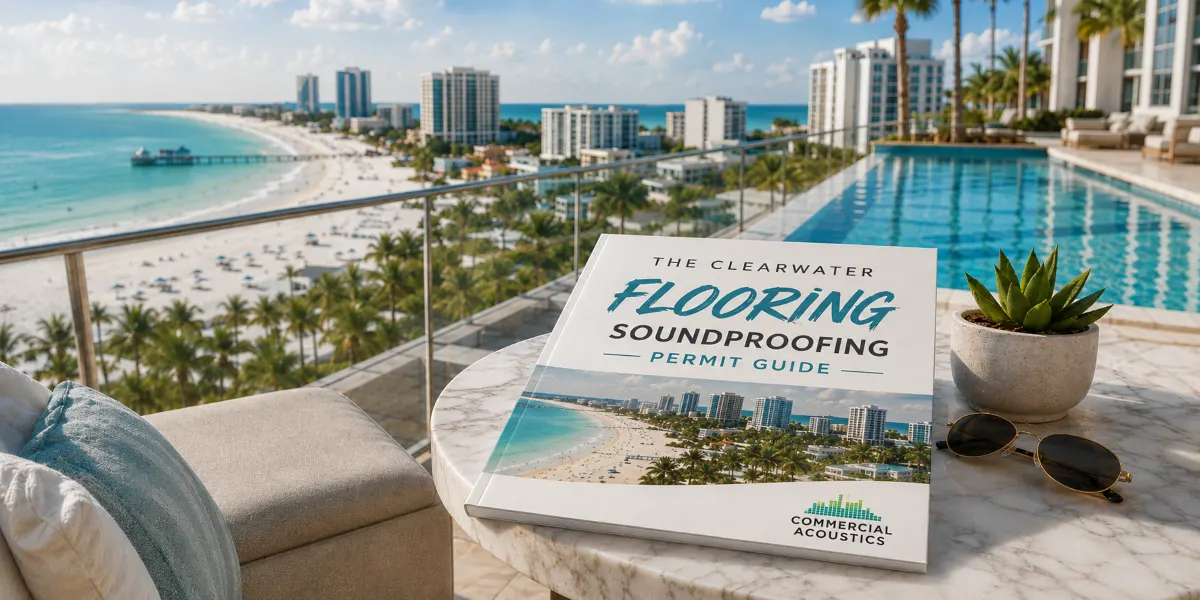
Clearwater Flooring Soundproofing Permit Guide: STC/IIC 50 Compliance
(Fails Code)
Code Minimum
HOA Spec
Clearwater
* Floor Blokker / Floor Blokker Lite also reach IIC 57. Ratings Above Assume: tile, concrete, resilient gypsum ceiling, fiberglass batting.
What a Clearwater Beach Floor Swap Really Takes
Like the rest of Pinellas, Clearwater treats a routine floor swap as exempt finish work, so a non-structural carpet-to-tile change under $500 usually needs no city permit. But Florida Building Code §1207 still demands STC 50 and IIC 50 between stacked units, and on Clearwater Beach the HOA enforces it hard. You skip the permit, not the soundproofing. Try our IIC Calculator first.
The Paperwork Clearwater Actually Wants
Clearwater publishes no flooring or soundproofing affidavit, and its permit schedule lists carpet and tile as exempt finish work. What does not go away is Florida Building Code §1207. When structural work does pull a permit, plan review expects manufacturer literature showing the assembly clears STC and IIC 50, filed through the city’s Clearwater eAccess portal.
If You Do Need a Permit, What to File
- Building Permit Application: filed online through Clearwater eAccess, the city’s Accela portal.
- Contractor License: a registered Accela account with a state or local license.
- Floor Plan: a drawing marking the area of work.
- Underlayment / Assembly Literature: manufacturer data showing STC and IIC 50 for plan review.
- HOA Association Approval: the document your beach-tower board will demand first.
- Asbestos Survey: a Pinellas County licensed survey before demolition, with notice over 160 square feet.
Most beach-condo floor swaps never reach this stage, since Clearwater exempts casual finish work under $500. When structural work does trigger a permit, it goes through Clearwater eAccess, the city’s Accela portal. The Construction Services Division is reachable at (727) 562-4567.
Clearwater runs no soundproofing inspection. A permitted job closes on a standard final inspection, and STC and IIC 50 compliance is shown on paper, not tested in the field. On the beach, your HOA is the party that actually checks the number.
STC and IIC in a Clearwater Beach Condo
- STC (Sound Transmission Class): airborne noise — a neighbor’s TV, a beach-house party, conversation.
- IIC (Impact Insulation Class): impact noise — footsteps, rolling luggage, a dropped beach chair.
Section 1207 of the Florida Building Code sets STC 50 and IIC 50 between dwelling units statewide, measured under ASTM E90 and ASTM E492. In Clearwater, where the city often skips the permit, the real enforcer is the condo association, and Sand Key boards in particular ask for proof before they approve hard flooring. Our lab-tested assemblies ship with reports a board accepts.
At IIC 50, a footstep overhead reads as a muffled thump rather than a sharp crack. A bare slab with tile sits in the high 20s, so the rated underlayment is what does the work, especially in the older beach towers. Our IIC/STC ratings guide for condo flooring permits covers how the assembly reaches the number.
Who Holds You to IIC 50 in Clearwater
Three parties decide whether your Clearwater floor flies, and only the city usually looks the other way. All of them care about the actual assembly, not just the underlayment, so spec the product for your building — here is who requires what.
| Who | What It Means for Your Floor | Verdict |
|---|---|---|
| City of Clearwater | A permit, unless the swap is casual finish work under $500 | Often Exempt |
| Florida Building Code §1207 | STC 50 and IIC 50 between units | Required |
| Your Beach-Tower HOA | Proof of the assembly, often IIC 55 on Sand Key | Required |
On Clearwater Beach the board, not the city, is the one most likely to ask for your IIC report — and to set the bar at 55.
Targets by Building, From Sand Key to Sandpearl
Clearwater carries roughly 129 condo buildings with published floor plans, most of them on the water: the Gulf-front high-rises of Clearwater Beach, the eighteen-odd towers of Sand Key, and the downtown bluff over Clearwater Harbor. Much of that beach stock went up between the 1980s and 2000s on thin slabs, exactly where carpet-to-tile conversions miss the IIC 50 mark.
Clearwater Beach runs heavy on seasonal and rental units, so footstep noise between stacked owners is a constant HOA headache, and boards there enforce IIC harder than the city ever would. The middle two rows below are where most renovations should land. Mid-market to luxury (STC and IIC 52 to 60) is the right band for almost any Clearwater condo that wants board sign-off.
| Building Type | Wall STC | Floor IIC | Where You See It in Clearwater |
|---|---|---|---|
| Sand Key Tower (1980s–2000s) | 52–55 | 55 | The Sand Key high-rise strip and older Clearwater Beach towers. Thin slabs need an underlayment to reach 50. |
| Clearwater Beach High-Rise | 55 | 55–60 | Mandalay Beach Club and the Gulf-front towers. Boards set IIC 55, partly because units turn over as rentals. |
| New Luxury / Sandpearl | 55–60 | 60 | Sandpearl Residences and newer beach product. Underlayment specs are written in at delivery. |
| Penthouse / Ultra-Luxury | 60+ | 65+ | Top-floor Gulf-front units. A floating subfloor on a thick acoustic mat reads as effectively silent below. |
Which Underlayment Clears a Beach-Tower Board
- AcoustiStep: premium rubber mat. Right pick when the HOA requires IIC 55 or 60.
- Floor Blokker: standard acoustic underlayment roll. Clean STC and IIC pass for typical retrofits.
- Floor Blokker Lite: lighter, lower-cost option for budget retrofits that still need to clear code.
All three ship with published STC and IIC test reports you can hand your beach-tower board before they approve the work. The choice comes down to your HOA’s IIC threshold and how much margin you want above the §1207 minimum.
Clearing Your Beach-Tower Board the First Time
In Clearwater the city is usually the easy part: a casual floor swap under $500 is exempt finish work. The real gate is §1207 and your beach-tower board. Spec an assembly that clears STC and IIC 50, keep the manufacturer reports ready for the association, and pull a permit only if the work turns structural.
Every underlayment in the Commercial Acoustics catalog ships with the STC and IIC reports a Clearwater board looks for, ready to submit as-is. Match the product to your association’s threshold and approval is a formality.
FAQs: Clearwater Flooring Soundproofing Permits
Do I need a permit to replace flooring in my Clearwater condo?
Usually not. Clearwater exempts carpet, tile, and casual finish work under $500 from permits. A permit is required only for structural work or jobs above that threshold. When unsure, call Construction Services at (727) 562-4567.
If the permit is exempt, do I still need soundproofing?
Yes. Florida Building Code Section 1207 still requires STC 50 and IIC 50 between stacked units, and your condo association enforces it. The permit exemption does not exempt the floor from the sound rule. A rated underlayment is what meets it.
Does Clearwater have a flooring soundproofing affidavit?
No. Like Fort Lauderdale and St. Petersburg, Clearwater publishes no flooring or soundproofing affidavit. You show STC and IIC 50 compliance through manufacturer assembly literature and, in practice, to your HOA, not a city form.
Why are Clearwater Beach HOAs so strict about flooring?
Because the towers are full of seasonal and rental units, so footstep noise between stacked owners is constant. Sand Key and beach boards often require IIC 55, above the code minimum, before they approve hard flooring.
How much soundproofing does a Clearwater condo floor need?
Section 1207 sets STC 50 and IIC 50 between units, tested per ASTM E90 and E492. A bare slab with tile sits near IIC 28, so a rated acoustic underlayment is what brings the assembly up to code.
How do I file a Clearwater permit if I need one?
When structural work triggers a permit, file online through Clearwater eAccess, the city’s Accela portal. Reach Construction Services by phone at (727) 562-4567.