
Table of Contents
Why STC Rating Matters in Movie Theater Soundproofing
Soundproofing a movie theater isn’t just about comfort—it’s about preserving the full cinematic experience. Viewers should feel the impact of a film’s soundtrack without hearing the next theater over. Achieving that starts with understanding the STC rating for movie theaters and how wall design affects real-world soundproofing results.
The Sound Transmission Class (STC) measures how well a wall blocks airborne noise, but it only tests frequencies from 125 Hz to 4000 Hz. That’s fine for offices or homes, but not for theaters, where deep bass energy below 100 Hz dominates. This means a wall rated STC 70 might still leak subwoofer rumble if it isn’t properly decoupled and mass-balanced.
You can experiment with wall configurations using the STC Calculator to estimate expected transmission loss before construction.
Challenges in Movie Theater Soundproofing
The primary challenge in movie theater soundproofing is low-frequency control. Subwoofers, explosions, and orchestral soundtracks all generate long-wavelength energy that travels through drywall, framing, and concrete. Even walls with high lab-tested STC ratings often fail on-site because low-frequency vibration isn’t included in the standard STC test range.
As many acoustical consultants say, STC might better stand for “Speech Transmission Class.” To create truly quiet auditoriums, your design must combine three factors—mass, stiffness, and decoupling—rather than relying on extra drywall layers alone.
High-Performance Wall Assemblies
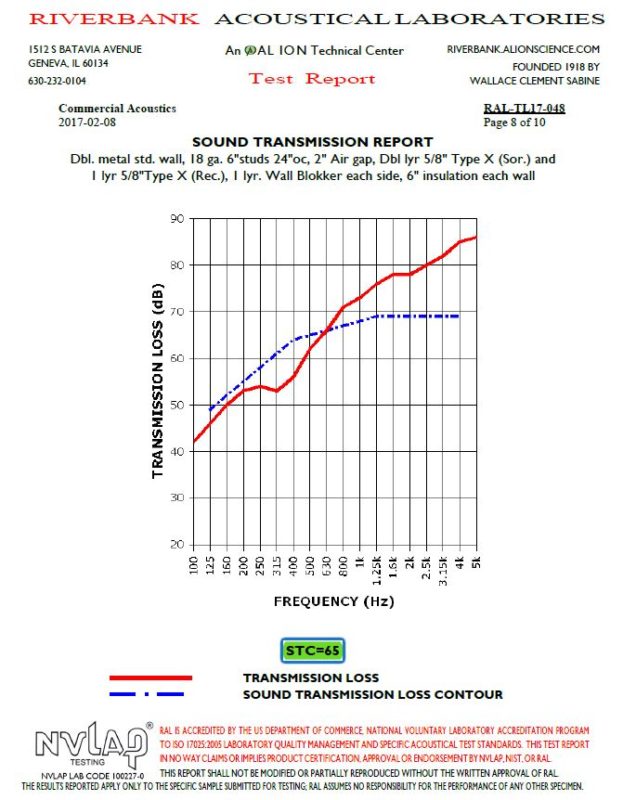
One of the most reliable approaches for achieving a high STC rating in movie theaters is a double-stud wall with an air gap and sound-damping membrane.
- Double 6″ metal studs, 24″ o.c.
- 2″ air gap between stud rows
- Two layers of ⅝″ drywall on the source side
- One layer of ⅝″ drywall on the receiving side
- One layer of Wall Blokker on each side
This design combines mass and decoupling for superior low-frequency attenuation while staying cost-effective and UL compliant. Concrete block (CMU) walls, though heavy, are too rigid to absorb bass energy and often transmit vibration through the structure.
For a real-world example, see our Cinema Soundproofing Case Study in Winter Garden, FL, where a Wall Blokker system achieved THX-level performance without excess drywall. Many theaters are designed to meet THX acoustic standards for clarity and isolation between auditoriums.
Soundproofing Design Techniques That Work
- Acoustic Membranes (like Wall Blokker): Add mass and damping to reduce vibration through walls.
- Resilient Channels & Isolation Clips: Break the rigid connection between drywall and studs to stop structure-borne noise.
- Neoprene Floor Strips: Decouple wall base plates from the slab to eliminate flanking paths.
- Air Gaps: Increase separation and dramatically raise STC values.
For a deeper look at channel performance, visit Resilient Channel: Best Uses & Worst Mistakes.
Comparing Wall Performance
| Wall Type | Construction Summary | STC Rating | Transmission Loss @ 315 Hz | Approx. Cost / ft² |
|---|---|---|---|---|
| 5-Layer Gypsum Wall | Single stud wall with 5 × ⅝″ drywall | ~58 STC | 48 dB | $5.00+ |
| Membrane Enhanced Wall | Double stud wall with 2 × drywall + 2 × MLV membrane | 65–68 STC | 58 dB | $3.20 |
| Wall Blokker System | Double stud wall with 1 × drywall + Wall Blokker each side | 70 STC + | 60 dB + | $2.80 |
A 10 dB improvement equals roughly a 50% drop in perceived loudness—meaning less bleed-through and a cleaner audio experience in every auditorium.
Real-World Performance and Design Insights
In field measurements from mid-sized auditoriums (100–150 seats), modern wall systems using Wall Blokker consistently outperform traditional drywall assemblies. Standard gypsum-only walls typically achieve STC 60 in labs, but drop to under 45 dB of isolation below 100 Hz—where most cinematic energy lives. In contrast, membrane-based assemblies routinely reach STC 68–72 while maintaining 55 dB or better isolation down to 80 Hz.
These differences translate directly to audience experience. Low-end bass rumble no longer bleeds into adjacent theaters, speech remains clear, and overall sound quality feels tighter and more immersive. Using the STC Calculator during design allows acoustical engineers and contractors to model these performance gains in advance—preventing costly field corrections after walls are built. Real-world performance depends not just on materials, but on how mass, decoupling, and damping work together as a complete acoustic system.
Achieving Acoustic Excellence in Theater Soundproofing
The STC rating for movie theaters is only one part of a larger acoustic equation. Achieving true soundproofing performance means balancing laboratory precision with on-site build quality. Walls must not only reach STC 65–70 in testing but maintain that performance under real sound pressure conditions.
By combining Wall Blokker membranes, double-stud framing, and decoupled installation methods, designers can achieve THX-level isolation and eliminate disruptive low-frequency crossover. The goal isn’t just high ratings—it’s delivering a consistently quiet, high-fidelity environment that enhances the emotional impact of every movie.
For architectural firms, general contractors, and theater operators, Commercial Acoustics provides design guidance, tested materials, and real-world experience to help projects perform exactly as modeled—every time.
FAQs: Movie Theater Soundproofing & STC Ratings
What STC rating should a movie theater have?
Most professional theaters target STC 65–70 or higher, depending on room size and sound system output.
Does higher STC always mean better soundproofing?
Not necessarily—STC ignores bass below 125 Hz. Effective theater walls also control low-frequency energy.
What’s the best wall assembly for theaters?
Double-stud walls with air gaps and soundproofing membranes like Wall Blokker provide the best cost-to-performance ratio.
Can I predict STC before construction?
Yes—using modeling tools lets designers estimate wall performance and fine-tune details before building.
Does Commercial Acoustics provide design help for movie theaters?
Absolutely. We offer acoustic modeling, wall assembly recommendations, and turnkey soundproofing installation across the U.S.